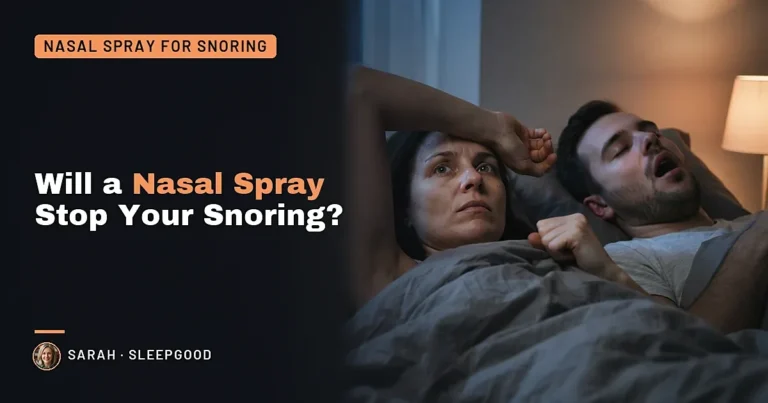

Do snoring mouthpieces work? Yes, for many people, but only when the snoring comes from the tongue or the jaw falling back while you sleep. If it comes from a blocked or narrow nose, a mouthpiece won’t help. Not sure which kind of snorer you are? The free 1-minute snore quiz helps you find out. I haven’t bought or tested any of these devices myself; this guide is based on published studies, the makers’ details and buyer reviews.
In this article
- Why some mouthpieces fail (and others work)
- Jaw mouthpiece (MAD) vs tongue device (TSD): how they differ
- Shop-bought vs dentist-made mouthpieces: cost and fit
- The wear-in period: what the first two weeks feel like
- How to clean a mouthpiece and when to replace it
- The Good Morning Snore Solution (GMSS)
- How to decide which mouthpiece fits your snore
- Common questions about snoring mouthpieces
- My verdict
The short answer
- Do they work? Yes, for many tongue and jaw snorers. Not for snoring that comes from the nose.
- The top pick: The Good Morning Snore Solution (GMSS) is our pick when the tongue is the cause, especially if you have jaw pain, because it leaves the teeth and jaw alone.
- For a jaw snore: a jaw-advancing mouthpiece; our snore quiz suggests the FDA-cleared Somnofit-S.
- The trade-off: expect a week or two of getting used to it, often with extra saliva.
Why some mouthpieces fail (and others work)

To understand if an anti-snoring mouthpiece will work for you, you have to know why you’re making noise. Snoring happens when air can’t flow freely, causing the tissues in your throat to vibrate. When the airway closes so far that breathing stops for a few seconds at a time, that is obstructive sleep apnea, which needs a doctor, not a mouthpiece from a shop.
There are three main culprits. First, the tongue can slide back and block the throat. Second, the soft palate or uvula can collapse. Third, your nasal passages can be too narrow.
This is where most people get it wrong. They buy a generic anti-snore mouth guard and find it does nothing because their problem is in their nose. A mouthpiece cannot open your nostrils. If you’ve tried a mouth guard and it failed, you might actually need nasal dilators instead.
Try the 10-second tongue check
Stick your tongue out, hold it gently between your teeth and try to snore. If the sound is much weaker, your tongue is part of the problem. See which fix matches your snore.
Jaw mouthpiece (MAD) vs tongue device (TSD): how they differ
When you look for a snoring mouthpiece, you’ll find two main types of oral appliances. They solve the same problem—a blocked airway—but they do it in completely different ways.
Mandibular Advancement Devices (MAD) work by physically pushing your lower jaw forward. This pulls the soft tissues of the throat open. Tongue Stabilizing Devices (TSD) don’t touch your jaw; instead, they hold the tongue forward so it doesn’t flop back into your airway.
| Feature | Mandibular Advancement (MAD) | Tongue Stabilizing (TSD) |
|---|---|---|
| How it works | Pushes lower jaw forward | Holds tongue forward via suction |
| Best for | Snoring from the jaw and throat | Tongue-based snoring |
| Jaw strain | Can make the jaw sore; not for TMJ problems | None (jaw stays neutral) |
| Fitting | Often boil-and-bite | Usually ready to use |
| Main trade-off | Morning jaw stiffness | Requires nasal breathing |
Shop-bought vs dentist-made mouthpieces: cost and fit
You have a choice between over-the-counter (OTC) devices and custom-made ones from a dentist. The difference is mostly about precision and price.
Custom devices are the gold standard. A dentist takes a precise mold of your teeth, ensuring the device doesn’t shift. Dentists also make them for people with diagnosed sleep apnea, as part of treatment a doctor oversees. They cost far more than a shop-bought mouthpiece.
OTC devices are a gamble on fit but a win on price. Most use “boil and bite” plastic that you mold to your teeth. While more affordable, buyer reviews frequently mention that they can feel bulky or shift during the night. If you have loose teeth, crowns, gum disease or a bite problem, ask your dentist before you use a jaw mouthpiece.
Myth vs fact
Myth: Any mouthpiece can treat sleep apnea.
Fact: No, they cannot. While some custom oral appliances are used to manage symptoms under medical supervision, OTC mouthpieces are for reducing snoring only. They are not a substitute for CPAP or medical treatment.
The wear-in period: what the first two weeks feel like

The biggest reason people throw their snoring mouthpiece in the bin after two nights is that they expect instant comfort. They don’t.
According to buyer reviews across various platforms, there is a genuine “wear-in” period. Your brain suddenly realizes there is a foreign object in your mouth, which triggers your salivary glands. Many buyers report extra saliva in the first week. If you’re using a MAD device, your jaw muscles might feel like you’ve spent the night chewing rocks.
Buyers often say it takes one to two weeks to get used to one. If it still hurts after two weeks, stop: the device is the wrong size or the wrong type for your mouth.
How to clean a mouthpiece and when to replace it
These devices sit in a warm, moist environment filled with bacteria. If you don’t clean them, they become a health hazard. Most manufacturers recommend rinsing with cold water and brushing with a soft toothbrush and mild soap after every use.
One common mistake is using boiling water to “deep clean” a device that was only meant to be boiled once for fitting. This can warp the plastic and ruin the alignment. Always check the manual.
Mouthpieces don’t last forever. The materials degrade over time due to saliva and brushing. Many shop-bought mouthpieces need replacing every 6 to 12 months, and the GMSS lasts about a year. If you notice the material becoming porous, yellowed, or losing its grip, it’s time for a new one.
The Good Morning Snore Solution (GMSS)
The Good Morning Snore Solution (GMSS) is a specific type of tongue-retaining device. Unlike the jaw-pushing devices mentioned earlier, the GMSS uses a soft, clear mouthpiece with a bulb that holds the tongue forward using gentle suction.
Because nothing grips the teeth and the jaw isn’t forced forward, it’s a strong choice for people who suffer from TMJ problems, jaw pain, or those who wear dentures. It is an FDA-cleared over-the-counter device intended for adults 18 and over. It’s ready to use straight out of the box—no boiling required.
Regarding its efficacy, a small crossover trial published in Sleep and Breathing (2008) by the device’s designer, Dort and Brant, found that snoring events dropped from 214.7 to 132.9 per hour—a reduction of roughly 38%. In that study, 54% of participants wanted to continue using the device.
The cost is $79.94 for a single mouthpiece (Regular or Small) or $139.94 for a two-pack. There is a 30-day money-back guarantee (from delivery) for orders from the official store, and free shipping on orders over $99 for the US, Canada, UK, and Australia. It typically lasts about a year.
The main trade-off is that you must be able to breathe through your nose. Since the device occupies the mouth and the lips are closed around it, nose breathing is mandatory. If you have a chronic cold or deviated septum, you’ll find this frustrating. You can read more in our Good Morning Snore Solution review.
When to see a doctor
- You wake up gasping, choking, or feeling like you’ve stopped breathing.
- You feel exhausted during the day despite getting 8 hours of sleep.
- You have high blood pressure that is difficult to control.
- You experience severe morning headaches.
How to decide which mouthpiece fits your snore

Don’t just buy the first device you see in an ad. Use these questions to narrow it down, or let the free snore quiz walk you through them:
- Do you have a blocked nose or allergies? If yes, a mouthpiece won’t help. Look at nasal strips or nasal dilators first.
- Does your jaw ache or do you have TMJ? If yes, avoid Mandibular Advancement Devices (MAD). Look for a Tongue Stabilizing Device (TSD) like the GMSS.
- Does the “Tongue Check” work? If holding your tongue forward stops the noise, a TSD is your best bet.
- Is the snoring deep and “throaty”? If the tongue check doesn’t help and you have no jaw pain, a jaw mouthpiece (MAD) is the more likely fix. Our snore quiz suggests the FDA-cleared Somnofit-S.
- Is it only when you sleep on your back? Before spending money on a mouthpiece, try anti-snore pillows or a wedge pillow to change your angle.
Before you buy: a quick checklist
- Check your nose: Can you breathe comfortably through your nostrils? (Essential for TSDs).
- Check your jaw: Do you have any history of jaw clicking or pain? (Avoid MADs).
- Check your budget: Are you okay with a $80-150 OTC trial, or do you need a permanent dental solution?
- Check your patience: Are you ready for a week or two of getting used to it?
Common questions about snoring mouthpieces
Will they stop the snoring sound completely?
For some people the snoring stops. For many it gets quieter rather than silent: in the GMSS study, snoring events fell by about 38%. However, if your snoring is caused by multiple issues—say, both a narrow throat and a blocked nose—a mouthpiece will only fix one half of the problem, and you’ll still hear some noise.
What causes snoring?
It’s a physical vibration. When the muscles in the roof of your mouth (soft palate) or your tongue relax too much, they partially block your airway. As you breathe, the air forces its way through that narrow gap, making the tissues flutter like a flag in the wind.
Why did my mouthpiece stop working after a few months?
Two main reasons: material wear and weight change. The plastic or silicone loses its structural integrity over time, allowing your jaw or tongue to slip back. Weight gain can also add tissue around the neck and make snoring worse again.
Can I use mouth tape together with a tongue-retaining mouthpiece?
Don’t combine them. A tongue-retaining mouthpiece like the GMSS sits between your lips, and you already have to breathe through your nose to wear it. Tape adds nothing and could make breathing harder if your nose blocks up in the night.
Are snoring mouthpieces safe?
For most healthy adults, yes, when used as the maker says. Jaw mouthpieces can make the jaw sore and, used for a long time, can shift the teeth or bite a little, so see a dentist if you have dental work, loose teeth or jaw problems. Any mouthpiece can cause extra saliva at first. They are made for snoring; sleep apnea needs a doctor.
My verdict

Do snoring mouthpieces work? Yes, provided you match the device to your specific anatomy. If you have a sensitive jaw or suspect your tongue is the culprit, the Good Morning Snore Solution is the most logical, low-risk starting point. If the tongue check does nothing and your jaw is fine, a jaw mouthpiece is the type to try. And if you have any of the warning signs above, see a doctor before you buy anything.
Is your tongue behind the snoring?
See how the Good Morning Snore Solution works, what the study found and who it suits.
Read our Good Morning Snore Solution review →Sources: Dort L, Brant R. A randomized, controlled, crossover study of a noncustomized tongue retaining device for sleep disordered breathing. Sleep and Breathing, 2008. Good Morning Snore Solution product details, checked 4 October 2026. Links marked as sponsored are affiliate links; see our affiliate disclosure. This article is general information, not medical or dental advice.