

Yes, you can snore with your mouth closed, and it’s common. Snoring with mouth closed tells you something useful: the noise isn’t coming from your lips but from your nose or the back of your throat, where the soft palate and tongue sit. That’s also why the viral fix, mouth tape, rarely helps. In a 2025 review of 10 mouth-taping studies, most found no clear benefit, and the authors warned of real risk if your nose is blocked.
I didn’t test these products myself. Instead, I read the studies behind them, including that 2025 review of mouth taping, plus the makers’ details and buyer reviews. So you get what the research shows, not a sales pitch.
In this article
- Why snoring with mouth closed happens
- Can the sound tell you where it starts?
- Nasal causes: beyond the deviated septum
- Mouth tape: what the research says
- At-home checks: find your snore type
- The Good Morning Snore Solution
- Comparing your options for closed-mouth snoring
- Why does it start suddenly?
- Frequently Asked Questions
- My verdict
The short answer
- Why it happens: With your mouth closed, the snore starts in your nose (narrow or blocked passages) or in your throat (the soft palate or the tongue falling back).
- What helps: For the nose, nasal dilators or treating congestion. For the tongue, the Good Morning Snore Solution is our pick for simple snoring.
- What doesn’t: Mouth tape and chin straps. Your mouth is already closed.
- See a doctor first if you gasp, choke or stop breathing in your sleep, or feel very sleepy during the day.
Why snoring with mouth closed happens

Many people think of snoring as a mouth-open problem. Breathing through an open mouth does make snoring more likely, because the jaw drops and the tongue moves back. But when you snore with your mouth closed, the vibration is happening somewhere else in your upper airway.
There are two main places it can start. The first is the nose: if your nasal passages are narrow or swollen, air has to squeeze through, and the tissue inside can flutter. The second is the throat: even with a clear nose, the soft palate or the base of the tongue can sag into the airway while you sleep and vibrate as air passes.
That’s why a chin strap or mouth tape, which only keep the mouth shut, does little for these sleepers. Their mouth is already shut; the narrowing is in the nose or the throat.
Try the 10-second tongue check
Stick your tongue out, hold it gently between your teeth and try to snore. If the sound is much weaker, your tongue is part of the problem. See which fix matches your snore.
Can the sound tell you where it starts?
A little, but less than you might think. In a small sleep-lab study, doctors recorded 16 snorers while watching their airway with a camera. Snoring from the soft palate was deep and low (around 137 Hz). Snoring from the base of the tongue was much higher-pitched (around 1,243 Hz). A whistle through the nose usually points to the nostrils.
So a high-pitched snore isn’t always your nose; it can be your tongue. Sounds overlap, many people snore from more than one place, and a partner half asleep is not a sound lab. Treat the sound as a clue, then use the two quick checks below to confirm it.
| What your partner hears | Where it often starts | How to check |
|---|---|---|
| A whistle through the nose | Narrow or blocked nostrils | The nose check below |
| A deep, fluttering rumble | Soft palate | Snoring may stay the same in the tongue check |
| A higher-pitched, harsher snore | Base of the tongue | The tongue check makes it much weaker |
Nasal causes: beyond the deviated septum

When people talk about nasal snoring, they usually mention a deviated septum, a crooked wall between the nostrils. It’s common, but it’s not the only cause. Swollen turbinates are another: these are small ridges inside the nose that warm and moisten the air, and when allergies or a long-lasting cold make them swell, they narrow the passage like half-drawn curtains.
Nasal polyps, soft noncancerous growths, can also block the passage. And in some people the sides of the nostrils pull inward when they breathe in hard, which is called nasal valve collapse.
For narrowing at the front of the nose, nasal dilators can help by holding the nostrils open. If allergies or a stuffy nose are behind it, our guide to nasal spray for snoring explains which spray fits. Neither helps if the vibration is coming from the base of the tongue.
Myth vs fact
Myth: If I keep my mouth closed, I can’t have sleep apnea.
Fact: In sleep apnea the throat narrows or closes again and again during sleep, at the level of the tongue or soft palate, whether your lips are sealed or not. Gasping, breathing pauses or heavy daytime sleepiness are the signs to watch for.
Mouth tape: what the research says
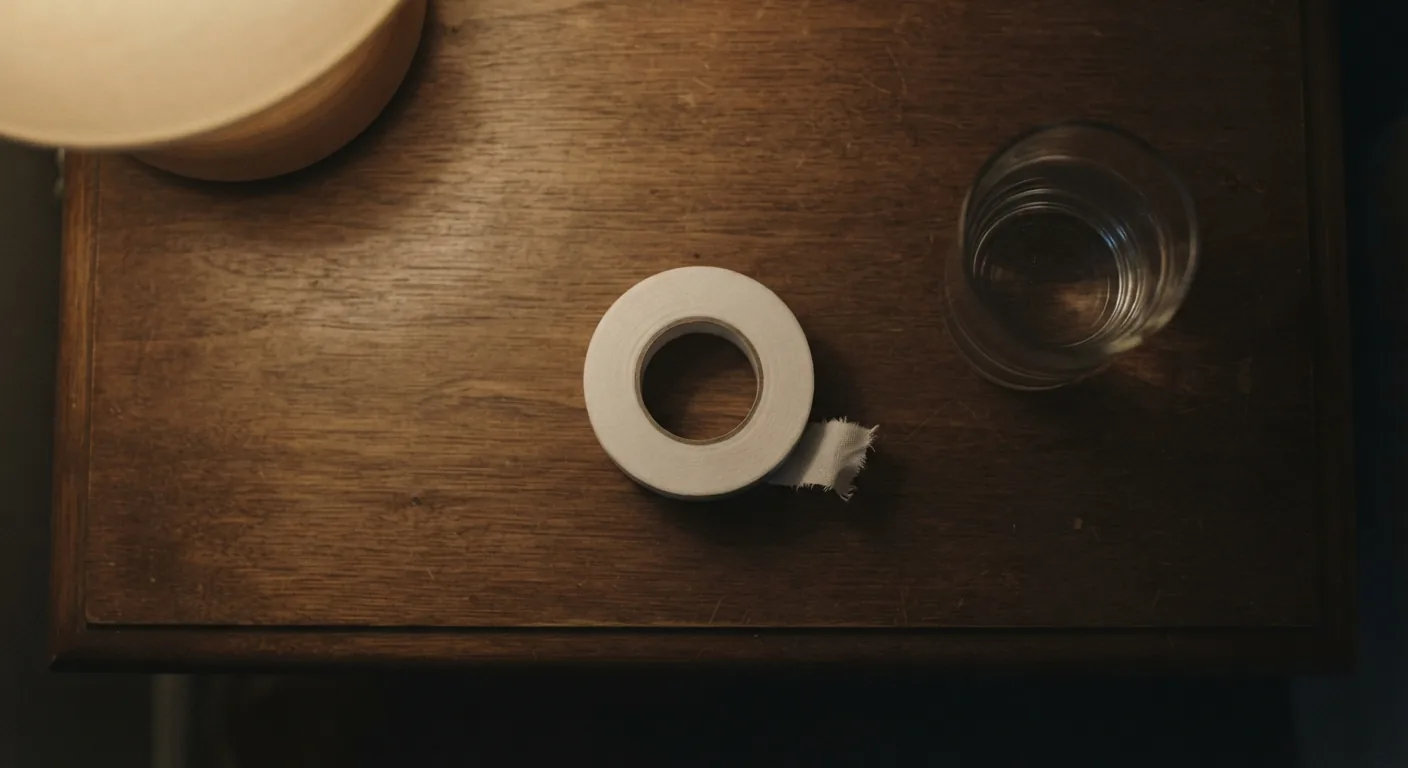
Mouth taping went viral as a way to force nose breathing at night. The 2025 review found only 10 studies, with 213 people in total. Two showed some improvement in sleep apnea measures; most showed no difference. The authors warned of a potentially serious risk of harm for people who tape without checking first, including the risk of not getting enough air if the nose is blocked.
For someone already snoring with mouth closed, tape has even less to offer: it keeps your lips shut, and they already are. It doesn’t move the tongue or open a narrow nose. If you can’t breathe easily through your nose while awake, never tape your mouth at night, and talk to a doctor before trying it for mouth breathing.
At-home checks: find your snore type

Before you spend money on a gadget, two minutes of checks can tell you whether you need a nose fix or a throat fix.
- The nose check: Close one nostril with your finger and breathe in through the other. Then switch. If one side feels much more blocked, or the side of your nose pulls inward as you breathe in, your nose is likely part of the problem.
- The tongue check: As in the box above, hold your tongue forward between your teeth and try to snore. If the sound gets much weaker, your tongue is likely part of the problem.
- The position check: Ask your partner whether the snoring is worse on your back. Lying on your back lets the tongue fall back, so if side sleeping helps, a pillow that keeps you off your back may be worth a look.
If you’re still unsure, the free snore quiz takes about a minute and matches your answers to a snore type.
Try this tonight
- Clear your nose: Use a saline spray before bed if you feel stuffy.
- Sleep on your side: It keeps the tongue from falling back.
- Skip the nightcap: Alcohol in the evening relaxes the throat muscles and makes snoring worse.
The Good Morning Snore Solution
If the tongue check points to your tongue, a tongue-retaining mouthpiece like the Good Morning Snore Solution (GMSS) goes after that cause directly. Unlike mouthpieces that push the lower jaw forward, which can be uncomfortable for people with TMJ or jaw pain, the GMSS works on the tongue alone.
It’s an FDA-cleared over-the-counter device for reducing snoring in adults 18 and over. A soft, clear mouthpiece with a bulb holds the tongue forward with gentle suction. Because nothing grips the teeth and the jaw isn’t pushed forward, it suits people with dentures or a sensitive jaw.
The facts:
- Price: $79.94 for one mouthpiece (Regular or Small), or $139.94 for a two-pack.
- Guarantee: 30-day money-back guarantee, counted from delivery, on orders from the official store.
- Use: Ready to use, with no boiling or fitting. It lasts about a year.
- Shipping: Free on orders over $99 (US, Canada, UK, Australia).
In a small crossover trial by Dort and Brant (Sleep and Breathing, 2008; Dr. Dort designed the device), snoring events fell from 214.7 to 132.9 per hour, about 38% fewer, and 54% of participants wanted to keep using it.
Source: Dort and Brant, Sleep and Breathing, 2008
There is one hard rule: you must be able to breathe through your nose. The device sits between your lips and teeth, so your nose handles all the airflow. Never use it together with mouth tape. And it’s sold for snoring only; it isn’t a treatment for sleep apnea.
Comparing your options for closed-mouth snoring
| Option | Best for | Pros | Cons |
|---|---|---|---|
| Nasal dilators | Narrow or collapsing nostrils | Simple, nothing in the mouth | No help for throat or tongue snoring |
| Nasal sprays | Allergies, swollen turbinates | Saline is safe every day; steroid sprays calm swelling | Steroids take days; decongestants cause rebound after 3 days |
| Tongue-retaining device (GMSS) | Tongue-based snoring | No jaw pressure, FDA-cleared | Needs clear nose breathing |
| Wedge pillows | Snoring mostly on your back | No device in the mouth | Bulky; many people slide down at night |
| Mouth tape | Mouth breathers, with a doctor’s OK | Cheap | Little evidence; risky with a blocked nose; no help if your mouth is already closed |
Before you buy: a quick checklist
- Check your nose: If you can’t breathe through your nose, avoid tongue-retaining devices and mouth tape until the nose is treated.
- Check your jaw: If you have jaw pain or dentures, avoid mouthpieces that push the jaw forward.
- Check your symptoms: If you wake with morning headaches or feel sleepy all day, skip the gadgets and see a doctor.
When to see a doctor
- You stop breathing or gasp for air during the night.
- You are very sleepy during the day despite a full night in bed.
- You often wake up with a morning headache.
- You have high blood pressure that is hard to control.
Why does it start suddenly?
If snoring with mouth closed is new for you, look for something that changed. Weight gain is a common trigger, because extra tissue around the neck narrows the airway. A new allergy, a cold that hasn’t fully cleared or a recent change in medication can do it too.
Age plays a part as well: the throat muscles lose some tone over the years, so the airway sags more easily. Sleeping pills, some muscle relaxants and alcohol relax those muscles further. If the snoring started suddenly together with breathing pauses or heavy daytime tiredness, see a doctor.
Frequently Asked Questions
Can you snore with your mouth closed?
Yes. Snoring comes from tissue vibrating somewhere in the airway, and that can be in the nose or the throat with your lips sealed. Closed-mouth snoring simply tells you the open mouth isn’t the cause.
What causes snoring with a closed mouth?
A narrow spot in either the nose or the throat. In the nose, that’s often swollen turbinates, a deviated septum, polyps or collapsing nostrils. In the throat, it’s the soft palate or the base of the tongue vibrating as air passes.
Does mouth tape help with snoring through the nose?
Unlikely. If you already snore with your mouth closed, tape changes nothing about where the sound starts. A 2025 review found little evidence for mouth taping, and with a blocked nose it can be dangerous.
Is tongue-based snoring possible with a closed mouth?
Yes. The base of the tongue can fall back while you sleep, especially on your back, and narrow the airway behind it, even with your lips sealed. The 10-second tongue check is the quickest way to tell.
Can alcohol make closed-mouth snoring worse?
Yes. Alcohol relaxes the muscles that hold the throat open, so the soft palate and tongue sag more easily. Skipping drinks in the few hours before bed is one of the simplest things to try.
My verdict

If you’re snoring with mouth closed, start with the two checks. If your nose is the problem, treat the nose first with dilators or the right spray. If your nose is clear and the tongue check quiets the snore, the tongue is the likely cause, and the Good Morning Snore Solution is the most logical, jaw-friendly fix to try. Skip the mouth tape, and if you have any of the warning signs above, see a doctor first.
Snoring with your mouth closed?
See how the Good Morning Snore Solution holds the tongue forward, what the study found and who it suits.
Read our Good Morning Snore Solution review →Sources: Rhee J, et al. Breaking social media fads and uncovering the safety and efficacy of mouth taping in patients with mouth breathing, sleep disordered breathing, or obstructive sleep apnea: a systematic review. PLoS One, 2025. Agrawal S, et al. Sound frequency analysis and the site of snoring in natural and induced sleep. Clinical Otolaryngology, 2002. Dort L, Brant R. A randomized, controlled, crossover study of a noncustomized tongue retaining device for sleep disordered breathing. Sleep and Breathing, 2008. Good Morning Snore Solution product details, checked 4 October 2026. We may earn a commission from products we recommend; see our affiliate disclosure. This article is general information, not medical advice.
[…] is that you must be able to breathe through your nose. Since the device occupies the mouth and the lips are closed around it, nose breathing is mandatory. If you have a chronic cold or deviated septum, you’ll find this […]