
If your partner says the snoring stops when you roll onto your side, your sleep position is part of the problem. That is good news, because position is one of the easiest things to change. An anti-snore pillow is built to do exactly that: keep you off your back without waking you up.
I looked closely at the Posiform anti-snore pillow sold by SnoreLessNow, because it is one of the few snoring pillows with a published sleep-lab study behind it. I have not slept on it myself. Everything below comes from the maker’s published details, the study, and what buyers report.
The short answer
- An anti-snore pillow helps when you snore mostly on your back. It does little for snoring that comes from a blocked nose or from your tongue.
- The Posiform keeps you on your side and tilts your head slightly forward. In a 2018 study of 28 adults, time spent on the back fell from 52% to 20% of the night after one month.
- It costs $119.99 on sale (normally $129.99) and comes with a 120-night money-back guarantee.
In this article
Why sleeping on your back makes snoring worse
When you lie on your back, gravity pulls your tongue and the soft palate at the back of your mouth down toward your throat. The airway gets narrower, air has to squeeze through a smaller gap, and the soft tissue starts to flutter. That flutter is the snore.
On your side, your tongue falls to the side instead of backward, so the airway stays wider. This is why so many people snore loudly on their back and quietly, or not at all, on their side.

You can check this at home. Ask your partner whether the snoring changes when you turn over, or record a few nights with a free snore-recording app and note your position. If the loud parts happen on your back, a positional pillow is worth trying. Not sure what causes your snoring? The 1-minute snore quiz walks you through four simple checks.
How the Posiform pillow works
A normal pillow supports your head in whatever position you fall asleep in. The Posiform is shaped to steer you into one position and keep you there. SnoreLessNow describes four design features:
- Forehead support. Your head rests in a side position, slightly forward.
- A raised ridge down the middle. Rolling onto your back becomes uncomfortable, so you tend to stay on your side without waking.
- Cut-outs for your ear and shoulder. Side sleeping does not squash your ear or push your shoulder up.
- A slight downward head tilt. This is meant to keep the airway open.
The core is memory foam, with a cotton inner cover and a bamboo velvet outer cover. The maker says the materials meet OEKO-TEX and CertiPUR standards, the cover is machine washable, and the foam has a 3-year warranty.
What the research shows
SnoreLessNow calls the pillow “clinically proven”. Three published studies are worth knowing about. Two are good news for positional pillows, and one is a useful reality check.
The Posiform sleep-lab study (2018)
The study behind the maker’s claim was published in Sleep and Breathing in 2018 by Newell, Mairesse and Neu. It followed 28 adults with positional sleep apnea, which means their breathing problems happened mostly on their back. They slept in a sleep lab before treatment, on their first night with the Posiform, and again after one month of using it at home.
| Measure | Before | After one month |
|---|---|---|
| Share of sleep spent on the back | 52% | 20% |
| Breathing pauses per hour (AHI) | 12.1 | 6 |
These results come from a sleep lab, not a survey. The study was small and lasted one month, and it measured sleep position and breathing rather than snoring volume.
A head-positioning pillow cut snoring by a third (2015)
A 2015 study in Scientific Reports tested a different head-positioning anti-snore pillow on 25 adults with mild to moderate positional sleep apnea. Snoring events fell from 218 to 115 per hour, a drop of 34%, and snoring severity improved too. The pillow worked best for people of normal weight. For overweight people, the fall in snoring events was smaller and not statistically clear.
A reality check from a home trial (2025)
A small 2025 trial in Cureus compared the Posiform with a vibrating belt in 19 people at home, for two nights each. The belt cut time spent on the back by 26.4%. The Posiform cut it by 7%, which was not statistically significant. People rated sleep quality and comfort about the same for both.
Two nights is very short for a pillow that most people need a couple of weeks to get used to, and the one-month study above found a much bigger effect. Still, it shows the pillow is not an instant fix for everyone. That is why the 120-night guarantee matters: it gives you time to find out whether it works for you.
Positional pillow vs wedge pillow vs your normal pillow
Wedge pillows are the other common choice for snoring. They work in a different way, so it helps to see them side by side.
| Positional pillow (Posiform) | Wedge pillow | Normal pillow | |
|---|---|---|---|
| What it does | Keeps you on your side, head tilted slightly forward | Raises your head and upper body | Supports your head only |
| Best for | Snoring that is worse on your back | People who cannot sleep on their side, and acid reflux | Snoring that does not depend on position |
| Downside | Takes time to get used to | You still sleep on your back, and you can slide down in the night | Does not change your position |
If you can sleep on your side, a positional pillow goes after the cause directly. If side sleeping hurts your shoulder or hip, a wedge pillow is the gentler option.
Price, guarantee and delivery
These details are from the SnoreLessNow product page, checked on 28 September 2026:
- Price: $119.99 on sale, normally $129.99. Buying two saves $30.
- Guarantee: 120-night money-back guarantee, which gives you time to get used to it.
- Warranty: 3 years on the memory foam.
- Delivery: the maker currently lists a lead time of about 3 weeks because of demand.
- Reviews: 4.8 out of 5 from 99 reviews on the maker’s site.
- Bundle: also sold together with the Airflow Clip nasal dilator and a sleep patch.
Quick checklist: is it right for you?
A good fit if:
- You snore mostly on your back.
- You can sleep on your side, but you roll onto your back during the night.
- Your partner hears the snoring mainly when you lie on your back.
Look at something else if:
- You snore in every position. Start with the cause instead.
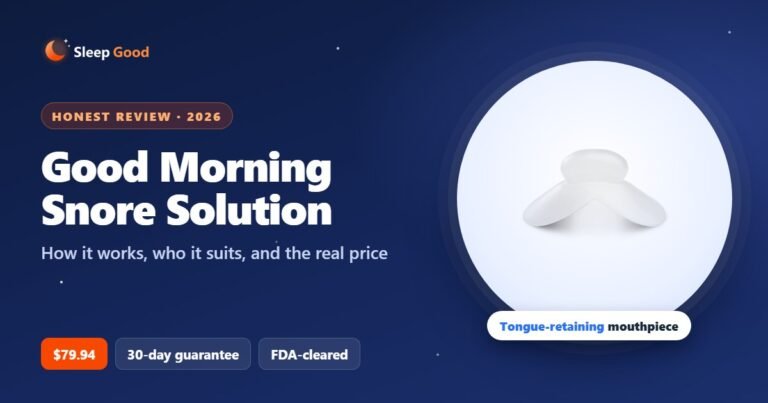
- Your snoring gets much quieter when you hold your tongue forward. A tongue device such as the Good Morning Snore Solution targets that.
- Your nose is blocked most nights. Read our guide to nasal dilators for snoring.
- Shoulder or hip pain makes side sleeping hard. Our guide to side sleeping on a firm mattress may help first.
What to expect in the first weeks
If you have slept on your back all your life, the first nights on your side will feel strange. That is normal. Most of the change happens while you are asleep, as the ridge nudges you back onto your side.
- Give it a couple of weeks before you judge it. The 120-night guarantee leaves plenty of time.
- Put a normal pillow behind your back if you keep rolling over.
- Record your snoring for a few nights before you start and again after two weeks. Then you can compare real numbers instead of guessing.
When to see a doctor
If someone has seen you stop breathing, choke or gasp in your sleep, or you feel very sleepy in the day even after a full night, get checked for sleep apnea. A pillow can reduce the time you spend on your back, but it should not replace a doctor’s advice if you might have sleep apnea.
Frequently asked questions
Do anti-snoring pillows work?
They work for positional snoring, which is snoring that happens mainly on your back. A pillow that keeps you on your side removes the position that narrows your airway. They do little for snoring caused by a blocked nose or by the tongue falling back in every position.
Can a pillow fix sleep apnea?
No pillow should be used as a sleep apnea treatment on its own. Some doctors do use positional therapy for people whose apnea happens only on their back, and the Posiform study was done with those patients. If you think you might have sleep apnea, see a doctor first.
Is a wedge pillow better for snoring?
A wedge pillow raises your upper body, which can help if you must sleep on your back. A positional pillow keeps you off your back altogether. If you can sleep on your side, the positional pillow deals with the cause more directly.
How long does it take to get used to an anti-snore pillow?
Many people need one to two weeks to feel settled, especially lifelong back sleepers. Judge it after a few weeks, not after the first night.
Can I use the Posiform with an anti-snoring mouthpiece?
Yes. They work on different causes: the pillow deals with your position and a mouthpiece deals with the tongue or jaw. Some people need both.
Can you wash the Posiform pillow?
The maker says the cover can go in the washing machine on a gentle cycle. Let it air dry, or use a low dryer setting.
My verdict
If your snoring is mostly a back-sleeping problem, the Posiform is one of the few snoring pillows with a sleep-lab study behind it, and the 120-night guarantee gives you time to find out whether it works for you. If you snore in every position, find the cause first with our 1-minute snore quiz.
sleepgood.org is reader-supported. When you buy through links on this page, we may earn a commission at no extra cost to you. We have not tested the Posiform pillow ourselves. This review is based on the maker’s published details, the study named above and buyer reviews. Prices checked on 28 September 2026. This article is general information, not medical advice.
Sources: Newell J, Mairesse O, Neu D. Can positional therapy be simple, effective and well tolerated all together? Sleep and Breathing, 2018. Chen W-C et al. Treatment of snoring with positional therapy in patients with positional obstructive sleep apnea syndrome. Scientific Reports, 2015. Aguilar Pelaez et al. Comparison of a vibrating belt versus a positional pillow for positional obstructive sleep apnea. Cureus, 2025. SnoreLessNow, Posiform Anti-Snore Pillow product page.