
Your partner says you stopped breathing last night. Not snored: stopped. Then you gasped, rolled over and carried on snoring like nothing happened. 😳 You feel fine, mostly. A bit tired. Okay, very tired.
Here’s the surprising part: in a study of nearly 5,000 working adults, researchers estimated that 82% of men and 93% of women with moderate to severe sleep apnea had never been diagnosed. Lofta sells a way to find out without a night in a sleep lab. In this Lofta review, I’ll show you what the test is like, what it costs, how accurate it really is, and who should skip it.
I didn’t take this test myself. Instead, I read the studies behind it, including a 2020 study that checked the same device against a full lab study in 500 patients, plus Lofta’s own details and policies. So you get what the research shows, not a sales pitch.
The short answer
Lofta’s home sleep test is a real, doctor-read sleep apnea test that uses the FDA-cleared WatchPAT ONE. It costs $189, often less on sale. It’s good at confirming moderate or severe sleep apnea, weaker with mild cases. It doesn’t bill insurance.

In this article
- Lofta at a glance
- How does the Lofta home sleep test work?
- How accurate is the Lofta sleep test?
- Who should use a home test, and who needs a sleep lab?
- What does Lofta cost, and does insurance pay?
- What happens after your results?
- What is the test like for patients?
- Lofta vs Sleeping.com vs a doctor-ordered test
- Pros and cons
- FAQ
- My verdict
Lofta at a glance
Lofta Home Sleep Apnea Test
★★★★☆ 4.0/5
Best for: adults with loud snoring and signs of sleep apnea who’d rather pay cash than wait for a sleep lab. Skip if: you have heart or lung disease, a past stroke, or insurance that covers a sleep study.
Lofta is a US online sleep apnea company. It sells this home test, CPAP machines and supplies, and coaching. Lofta itself doesn’t diagnose anyone: an independent, board-certified physician approves your test and reads the results. Since August 2026, Lofta has belonged to ReDream Brands, the group that also runs cpap.com and Sleeping.com.
So is Lofta legit? Yes, it’s a real company selling a real medical test. Whether it’s the right test for you is the more useful question, and that starts with how the night works.
How does the Lofta home sleep test work?

You order online, a doctor approves the test on a short video call, you sleep one night with a small device on your wrist, and a sleep physician reads the data. Here are the steps from Lofta’s product page:
- Order and fill in a short health form. It asks about your sleep, symptoms and medical history.
- Have a quick video call. An independent medical practice reviews your form and approves the test. Lofta says the call is generally under 5 minutes. If the doctor decides a home test isn’t right for you, Lofta refunds the whole order.
- Sleep one night with the WatchPAT ONE. The kit comes to your door, and an app walks you through putting it on.
- A sleep physician reads your data. The device sends it through your phone, so there’s nothing to mail back.
- Get your sleep report. It comes with a prescription and a treatment suggestion if you’re diagnosed. A Lofta sleep coach goes through it with you.
What the WatchPAT ONE measures
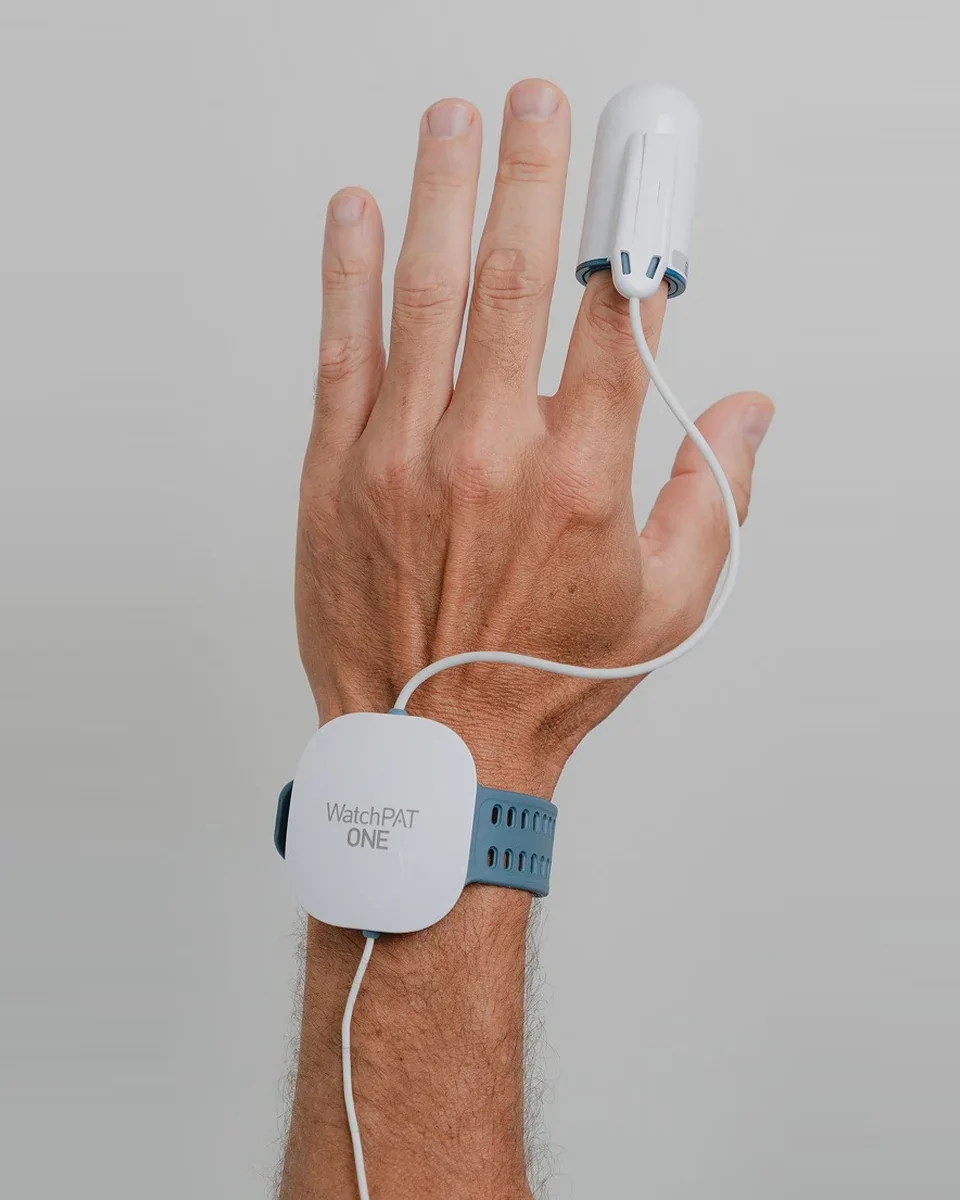
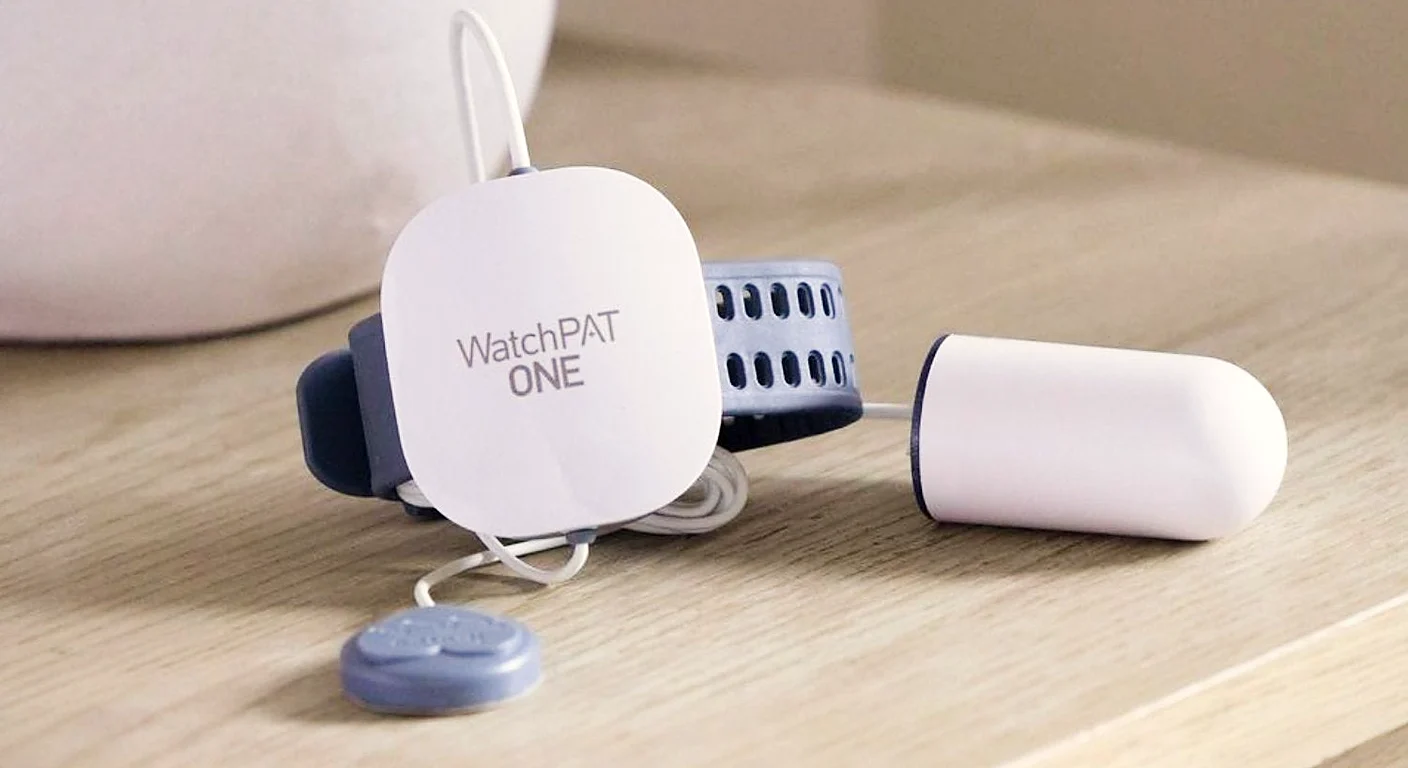
The WatchPAT ONE is made by Itamar Medical. The FDA cleared it in 2019 (510(k) K183559), and cleared an updated version in 2023. Lofta’s page says “FDA approved”, but cleared is the correct word for this kind of device. It’s a single-use test, so you don’t return it.
It has three parts: a unit on your wrist, a probe on one fingertip and a small sensor on your chest. Together they record seven signals:
- Peripheral arterial tone (PAT): tiny changes in the blood flow in your finger, which shift when your breathing stops or gets shallow.
- Blood oxygen and heart rate, from the finger probe.
- Movement, which helps estimate when you’re really asleep.
- Snoring, body position and chest movement, from the chest sensor.
No nose tube, no wires on your head, no technician watching you. That’s the big draw compared with a sleep lab. 😌
How to get a good test night
A home test only knows the night you give it. Lofta asks you to keep your normal routine, plus a few rules on the day of the test:
- No alcohol and no sedatives.
- No coffee or other caffeine after lunch.
- No afternoon nap.
- Tell the doctor about any medicines you take.
Worried you’ll be too nervous to sleep? Lofta says the device usually gets enough data even from a restless night. If you sleep less than about 2.5 hours, you may need to repeat the test, and Lofta says a retest it asks for is free.
How accurate is the Lofta sleep test?

It’s good at confirming moderate or severe sleep apnea and much less sure about mild cases. That’s the part no other Lofta review explains, so let’s go through it.
Lofta’s page says the WatchPAT has an “89% correlation” with a lab sleep study. That number matches a 2013 review of 14 studies with 909 patients, which found a correlation of 0.89 between the WatchPAT’s score and the lab’s score. It sounds great. But correlation only means the two numbers rise and fall together. It doesn’t tell you how often a person ends up in the right group: no apnea, mild, moderate or severe.
So a team at the Atlanta VA sleep center tested exactly that. In a 2020 study of 500 patients who wore a WatchPAT during a full lab study on the same night, the home device agreed with the lab in 83% of severe cases. For mild cases, it agreed in only 42%.
It went both ways. Of the people the WatchPAT called mild, 30% turned out to have no sleep apnea in the lab, and 20% had moderate or severe apnea. On average it scored people a little higher than the lab did. The researchers’ advice: anyone the device rates as normal or mild should have a lab study.
A 2022 analysis of 17 studies and 1,318 people, by the same research group, looked at the line doctors use for moderate sleep apnea (15 breathing events an hour). The WatchPAT caught 92% of people above that line, but it also put 28% of the people below it on the wrong side. A 2020 study co-written by the maker’s staff was kinder: 85% of cases caught and a 0.87 correlation, in 84 patients.
When to see a sleep doctor anyway
- Your result is normal, but you still snore loudly, gasp or feel exhausted: the American Academy of Sleep Medicine says a negative or unclear home test should be followed by a lab study.
- Your result says mild: ask whether a lab study is worth it before you buy expensive treatment.
- Your result says moderate or severe: this is where the test is most reliable. Treat it seriously.
That’s the honest picture: a useful test with one known blind spot. Which raises the next question: should you be using a home test at all?
Who should use a home test, and who needs a sleep lab?
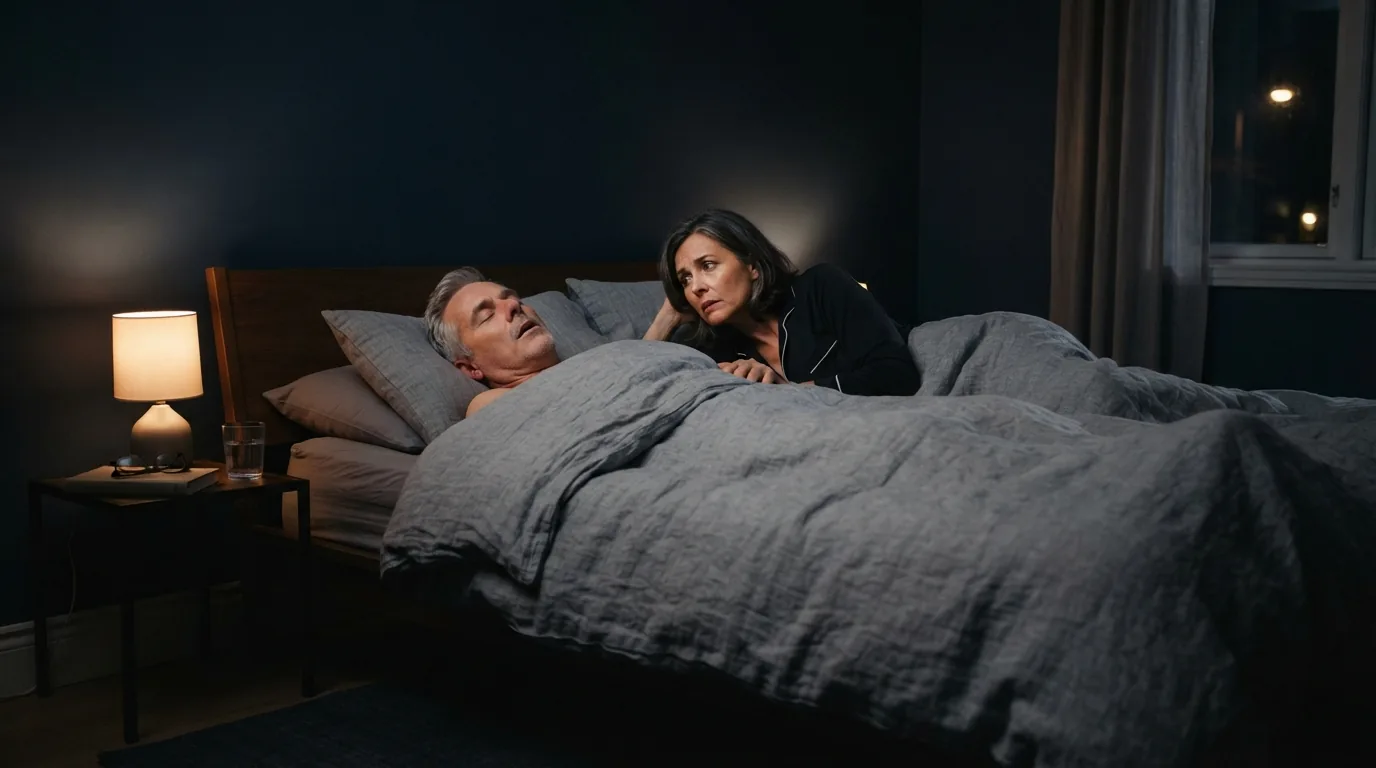
A home test suits healthy adults whose symptoms point to moderate or severe sleep apnea. That’s the 2017 guideline of the American Academy of Sleep Medicine, and Lofta’s own page gives nearly the same list.
| A home test fits if… | A sleep lab is better if… |
|---|---|
| You’re an adult (Lofta’s test is for 18+) | You have serious heart or lung disease |
| You snore loudly, and someone has seen you stop breathing or gasp | You’ve had a stroke |
| You’re sleepy in the daytime, or wake with headaches | You take opioid pain medicine every day |
| You have no other major sleep problem | You have severe insomnia, muscle weakness or low breathing while awake |
Not sure your snoring is the worrying kind? Our free snore quiz checks the sleep apnea warning signs first, before it looks at snore types. Or watch our animated See Your Snore tool, which asks the same safety questions in three taps. If you share a bed, the person next to you is often the best witness. Our guide to sleeping with someone who snores lists what to watch for.
Don’t wait for a test if: you nod off while driving, someone sees you stop breathing often, or you wake up choking. See a doctor soon. A home test can be part of the plan, but it shouldn’t delay one.
What does Lofta cost, and does insurance pay?
The Lofta test is $189 before discounts, and Lofta doesn’t bill insurance. That price covers the video call, the device, the doctor’s report and a prescription if you need one.
Lofta Home Sleep Apnea Test
$189
- On sale for $132.30 (30% off) when I checked
- Includes the approval call, the device, a physician-read report and a prescription if diagnosed
- Full refund if the doctor decides a home test isn’t right for you
- Cash only: no insurance billing, no Medicare or Medicaid
Price checked on the official site on 3 Nov 2026. Lofta changes its sale prices often in November.
Is it cheaper than a lab? Usually, if you pay yourself. Lofta says an in-lab study runs $1,000 to $7,000. You can send Lofta’s receipt to your insurer, but Lofta says payment is up to them, so ask about prior approval first.
Have Medicare? Then Lofta is probably the wrong route. Medicare Part B covers home and lab sleep tests when you have signs of sleep apnea and your doctor orders the test. You pay 20% of the approved amount after the deductible. Lofta has no Medicare or Medicaid supplier number, so neither will pay for anything bought there.
What happens after your results?

Your report shows how many times an hour your breathing stopped or got shallow: the apnea-hypopnea index (AHI). Doctors use 5, 15 and 30 events an hour as the lines between none, mild, moderate and severe sleep apnea. Lofta’s report also shows your oxygen drops, true sleep time, snoring and sleeping position.
If you’re diagnosed, you get a prescription. In the US, you can’t buy a CPAP machine without one. You can fill it at Lofta or at any other supplier, including one that takes your insurance. No, you won’t look like Darth Vader tonight. That part comes later, and modern masks are much smaller than the jokes suggest. 😄
Does starting at home make treatment harder? A big trial says no. In the HomePAP study of 373 people, those diagnosed and started on CPAP at home did as well as those who went through a sleep lab. After three months, they used their CPAP for 4.7 hours a night, against 3.7 hours in the lab group.
CPAP isn’t the only treatment. For mild or moderate sleep apnea, a doctor may suggest a mouthpiece fitted by a dentist. Our guide on whether snoring mouthpieces work explains why that’s a decision for a doctor, not a drugstore shelf. If the report shows your breathing stops mostly on your back, ask about position therapy too; our sleep position guide covers how back sleeping narrows the airway.
What is the test like for patients?

Mostly easy, according to the research. In a 2024 study of 167 patients who did the WatchPAT ONE at home with telemedicine follow-up, results came back in a median of 5 working days, and 99% were satisfied with the remote process.
Half of them found both the app and the device extremely easy, and 60% said they would recommend the test. Most were men (78%), with an average age of 55, so that’s the group the study speaks for best.
They lived an average of 147 km (about 90 miles) from the hospital, which is exactly the kind of trip a home test saves. For people far from a sleep center, that’s a big part of the appeal.
On Lofta’s own product page, buyers rate the test 4.5 out of 5. Keep in mind that the shop collects those ratings itself.
Tips for a smooth test
- Pay by credit card and keep your order email.
- Track the delivery, so you can plan your test night.
- Ask for your full report, with the AHI number, not just the summary.
- For any return, get an RMA (return) number first. Lofta wants the item back within 14 days of that number.
Lofta vs Sleeping.com vs a doctor-ordered test
Lofta isn’t your only way to get tested. Here’s how it compares with its cheaper sister brand and with the old-fashioned route through your own doctor.
| Lofta | Sleeping.com | Your doctor | |
|---|---|---|---|
| Price | $189 ($132.30 on sale) | $99 | Your plan’s share |
| Device | WatchPAT ONE | Wesper patches | Home or lab |
| Nights | 1 | 2-3 | Varies |
| Before the test | Form + video call | None | A visit |
| Insurance | ❌ Cash | ❌ Cash | ✅ Usually |
| Nothing to return | ✅ Yes | ➖ Mail back in 60 days | Varies |
If price matters most, Sleeping.com’s home sleep test is $99 and records two or three nights, which can smooth out one bad night. It skips the health form and the video call. The catch: you must mail the device back within 60 days, or you’re charged a fee of up to $250.
Lofta costs more, but you sleep one night, keep nothing to return, and talk to a clinician before you test. If you have good insurance or Medicare, a test ordered by your own doctor is usually the cheapest choice of all.
Pros and cons
👍 What we like
- An FDA-cleared device, read by a board-certified physician
- One night at home, nothing to mail back
- A prescription included if you’re diagnosed
- Full refund if the doctor says a home test isn’t right for you
- Reliable for moderate and severe sleep apnea
👎 What could be better
- Mild cases are often mislabeled
- No insurance billing, no Medicare
- Costs more than Sleeping.com’s $99 test
- Not for people with heart or lung disease or a past stroke
FAQ
Is Lofta legit?
Yes. Lofta is a real US company that sells an FDA-cleared home sleep test read by independent, board-certified physicians. If you’re diagnosed, the report comes with a prescription.
How long do Lofta sleep test results take?
Usually several days after your test night. A 2024 study of the same device with telemedicine follow-up found a median of 5 working days.
Does Lofta take insurance?
No. Lofta is cash pay, and it has no Medicare or Medicaid supplier number. You can ask your insurer about paying you back, but check before you buy.
Is the WatchPAT ONE reusable?
No. The WatchPAT ONE is a single-use test, so you don’t mail it back. Its data goes to the doctor through the app on your phone.
Can a home sleep test be wrong?
Yes, especially with mild sleep apnea. In a study of 500 patients, the WatchPAT agreed with a lab study in 83% of severe cases but only 42% of mild ones, so a normal or mild result with real symptoms deserves a lab study.
My verdict
4.0/5
Our verdict: a good first step if you pay cash
Lofta is a fast, real way to test for sleep apnea at home, and the WatchPAT ONE is at its best when the signs point to moderate or severe apnea. Choose it if you’d pay cash to skip the lab. Choose your doctor if you have Medicare or good insurance, and get a lab study if a mild or normal result doesn’t match how you feel. Score based on the research, the specs and Lofta’s policies, not on testing.
Ready to find out?
One night at home, a doctor-read report, and a prescription if you need one.
Check today's Lofta price →Some links in this article are affiliate links: if you buy through them, we may earn a commission at no extra cost to you.
Sources
- Lofta Home Sleep Apnea Test product page, home sleep test overview and refund policy, checked 3 November 2026 (official site)
- Sleeping.com home sleep test page, checked 3 November 2026 (official site)
- Ioachimescu OC, Allam JS, Samarghandi A, et al. Performance of peripheral arterial tonometry-based testing for the diagnosis of obstructive sleep apnea in a large sleep clinic cohort. J Clin Sleep Med, 2020.
- Iftikhar IH, Finch CE, Shah AS, Augunstein CA, Ioachimescu OC. A meta-analysis of diagnostic test performance of peripheral arterial tonometry studies. J Clin Sleep Med, 2022.
- Yalamanchali S, Farajian V, Hamilton C, Pott TR, Samuelson CG, Friedman M. Diagnosis of obstructive sleep apnea by peripheral arterial tonometry: meta-analysis. JAMA Otolaryngol Head Neck Surg, 2013.
- Pillar G, Berall M, Berry R, et al. Detecting central sleep apnea in adult patients using WatchPAT: a multicenter validation study. Sleep Breath, 2020.
- Kapur VK, Auckley DH, Chowdhuri S, et al. Clinical practice guideline for diagnostic testing for adult obstructive sleep apnea. J Clin Sleep Med, 2017.
- Rosen CL, Auckley D, Benca R, et al. A multisite randomized trial of portable sleep studies and positive airway pressure autotitration versus laboratory-based polysomnography: the HomePAP study. Sleep, 2012.
- Moffa A, Giorgi L, Nardelli D, et al. A new telemedicine-based sleep service using WatchPAT ONE for patients with suspected OSA: what does the patient experience? Sleep Breath, 2024.
- Young T, Evans L, Finn L, Palta M. Estimation of the clinically diagnosed proportion of sleep apnea syndrome in middle-aged men and women. Sleep, 1997.
- US Food and Drug Administration, 510(k) clearances K183559 (2019) and K223675 (2023), WatchPAT ONE, Itamar Medical (FDA database)
- Medicare.gov, Sleep studies coverage, checked 3 November 2026
This article is general information, not medical advice. See our medical disclaimer.