
You’ve seen the ads. A sleek black band sits across someone’s nose, they take one deep breath, and suddenly they look like they’ve just discovered air. 😮 Intake Breathing went viral on TikTok with that magnetic nasal strip, and now it sells a mouth tape too.
Here’s the surprising part: no published study has tested Intake itself. And the biggest recent review of nasal dilators, 17 studies with 496 people, found no average change in snoring. So in this Intake Breathing review, I’ll show you who it can still help, who should skip it, what it really costs per night, and how to use the strip and the tape in the right order.
I didn’t test these myself. Instead, I read the studies behind them, including a 2025 review of the mouth taping studies published since 1999, plus the makers’ details and buyer reviews. So you get what the research shows, not a sales pitch.
The short answer
Intake’s magnetic strip opens the front of your nose, and its mouth tape keeps your lips closed. Together they suit one snorer: the mouth breather whose nose feels blocked at night. They won’t fix snoring that starts in the tongue or throat, and they don’t treat sleep apnea. The kit costs $49.99, the tape $24.99.

In this article
- Intake Breathing at a glance
- How does Intake Breathing work?
- Does Intake Breathing work for snoring?
- Who is Intake for, and who should skip it?
- Is Intake mouth tape safe?
- What does Intake cost, and is it worth it?
- Intake vs Breathe Right vs the Airflow Clip
- What buyers like and don’t like
- Pros and cons
- FAQ
- My verdict
Intake Breathing at a glance
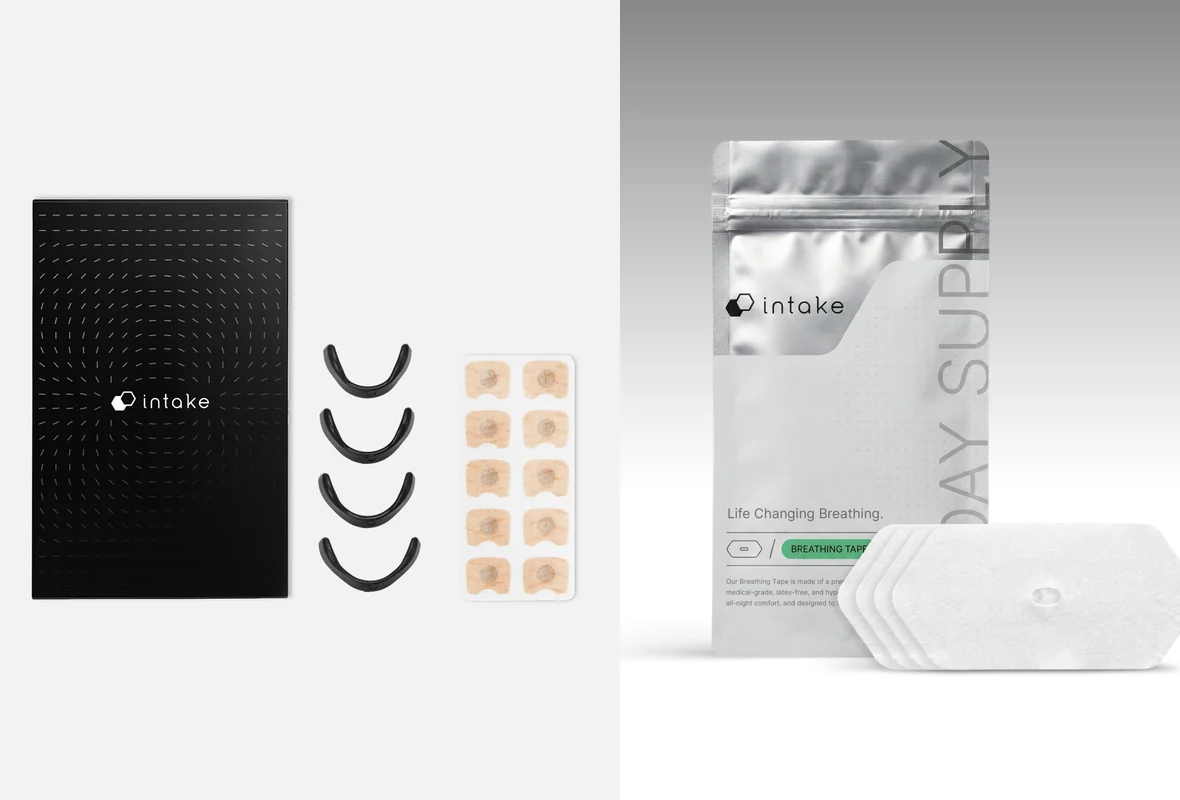
Intake Starter Kit and Intake Mouth Tape
★★★☆☆ 3.5/5
Best for: mouth breathers whose nose feels narrow or stuffy at night. Skip if: you might have sleep apnea, your snoring starts in your tongue or throat, or you can’t breathe easily through your nose even with the band on.
Intake Breathing Technology is a US company that designs its products in Santa Barbara, California. It started with the magnetic nasal strip, which the maker says was first built for motocross riders, and it now also sells mouth tape. We link to cpap.com, a sleep shop that sells the kit and the tape at the same prices as Intake’s own shop.
So what are you actually sticking on your face? Let’s look at how each part works.
How does Intake Breathing work?
The nasal strip comes in three pieces. Two small adhesive tabs stick to the sides of your nose. A stiff curved band, with a magnet at each end, clicks onto them and pulls the sides of your nostrils outward. A magnetic applicator helps you place the tabs in the same spot each night.
That’s the big difference from a drugstore strip like Breathe Right. A normal strip is one springy piece of plastic and glue across the bridge of the nose. Intake’s band is rigid, and only the two small tabs touch your skin.
- The starter kit (15 uses, $49.99 at cpap.com): 4 reusable magnetic bands in four sizes, 15 pairs of adhesive tabs and the applicator.
- The bands are reusable. The tabs are single-use; Intake describes them as medical-grade, hypoallergenic and latex-free.
- The mouth tape (30 strips, $24.99) is a small patch with a breathing hole in the middle, which Intake calls a Comfort Vent. It comes in white or black.
The idea behind the pair is simple: the band opens the nose, the tape keeps the mouth shut, and you breathe through your nose all night. Lovely in theory. But does a wider nose actually mean quieter nights?
Does Intake Breathing work for snoring?

It can, but only for some snorers. No published study has tested Intake’s magnetic band, so the best guide is the research on nasal dilators in general, and that research is more modest than the ads.
- A 2026 review of 17 studies (496 people) found no significant difference in snoring, sleep apnea events, sleep or oxygen between nasal dilators and no dilator. The authors say dilators can’t be recommended on their own for sleep-disordered breathing, but may help as an add-on for people with mild symptoms or a blocked nose (Alotaibi et al., 2026).
- A lab study of 18 heavy snorers compared a real nasal strip with a fake one. The real strip made the nose measurably wider, but snoring lasted just as long and was just as loud. Only the 6 people with a badly blocked nose breathed better: the share of their sleep with low oxygen fell from 49.9% to 4.9% (Djupesland et al., 2001).
- A study of 70 people with a stuffy nose every night found that a stronger nasal strip lowered nasal resistance by 39% while they slept. They felt they slept better and were less sleepy in the day, though the lab measures barely changed. The study was funded by GSK Consumer Healthcare, then the maker of Breathe Right (Wheatley et al., 2019).

Put together, the pattern is clear. A nasal dilator helps when the nose is the problem. If your nose is clear and your snore comes from further back, a wider nostril changes very little. One ear, nose and throat doctor told HuffPost he’d like to see more peer-reviewed studies on magnetic strips before anyone makes big claims. Same, doctor. Same. 🙃
So the real question isn’t “does Intake work?” It’s “is my nose the reason I snore?”
Who is Intake for, and who should skip it?
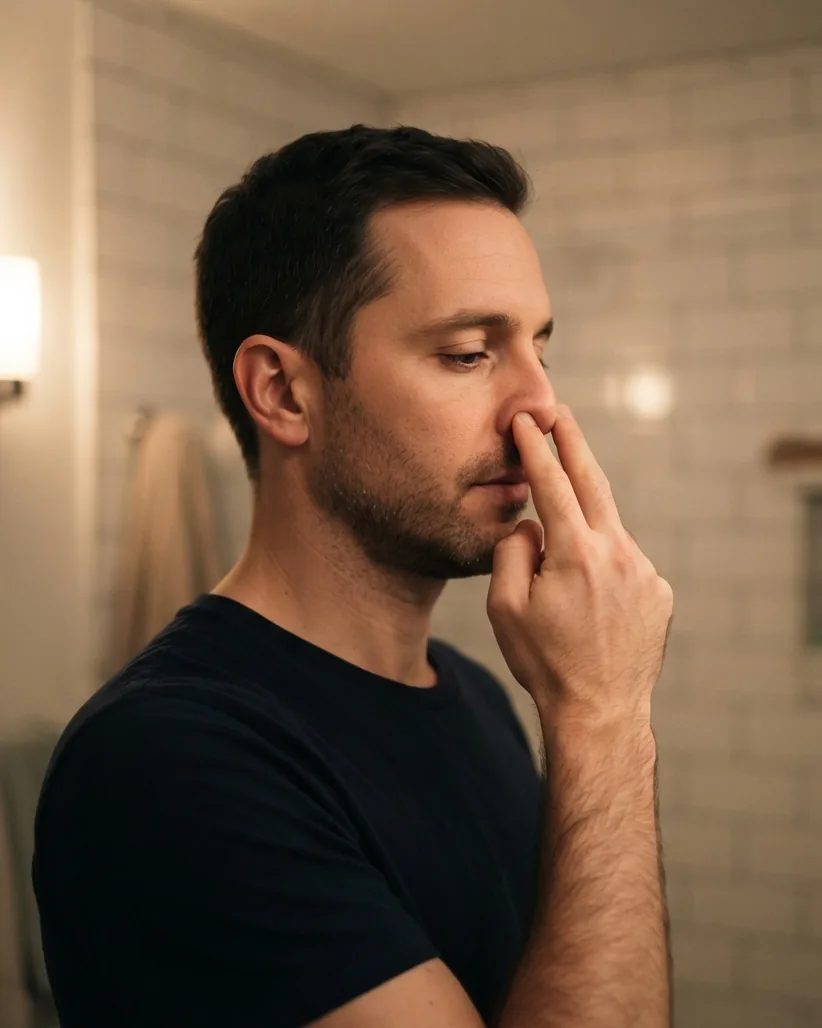
Intake makes most sense if your snoring starts with your nose: it feels narrow or stuffy at night, your mouth falls open, and you wake up with a dry mouth. You can check the nose part in ten seconds, tonight.
- Close one nostril. Press it gently with a finger and breathe in through the other with your mouth shut.
- Watch the open side. If the nostril wall sucks inward, or it feels like breathing through a straw, the front of your nose narrows when you breathe in. That’s what a nasal dilator targets.
- Swap sides, then ask what else is going on. Stuffy on both sides and worse with colds or allergies? A swollen nose may need a different fix first, like the right nasal spray for snoring.
Not sure where your snore starts? Our 1-minute snore quiz sorts it out, and our guide to snoring with your mouth closed covers the snorers a strip won’t help. If your tongue or jaw is the cause, read whether a snoring mouthpiece works instead.
When to see a doctor first
Gasping or choking in your sleep, pauses in your breathing that someone has noticed, heavy daytime sleepiness or high blood pressure can be signs of sleep apnea. Neither the strip nor the tape treats it; cpap.com’s own product pages say so. Get tested first. Our Lofta review explains how a home sleep test works. And if you already use CPAP, keep using it: talk to your doctor before you add tape or a strip.
Is Intake mouth tape safe?

The proof that mouth tape helps is thin, and the main risk is taping over a nose that can’t keep up. In 2025, a team led by ear, nose and throat surgeons in Canada reviewed the mouth taping studies published since 1999. Only 10 studies, with 213 people in total, made the cut (Rhee et al., 2025).
Two of those studies showed better sleep apnea markers with tape. The rest found no difference. The authors also warned of a serious risk for people who tape without checking first, including not getting enough air when the nose is blocked. Many of the studies simply left out anyone with a blocked nose.
That’s why the order matters so much: nose first, then mouth. A 2026 review found that a blocked nose raised sleep apnea events by about 14 an hour (Alshehri et al., 2026). Taping your mouth shut over a nose like that is the wrong way round.
Mouth tape safety checklist
- Only when you can breathe easily through your nose while awake.
- Use tape made for skin, never office or duct tape. Intake’s has a breathing hole in the middle.
- Skip it with a cold, a blocked nose, or any sign of sleep apnea, and don’t use it on children unless their doctor says so.
So the tape is the second step, never the first. Now, what does this two-step routine cost you?
What does Intake cost, and is it worth it?
Intake Starter Kit (15 uses)
$49.99
- 4 reusable magnetic bands in four sizes, 15 pairs of tabs, applicator
- Intake Mouth Tape, 30 strips: $24.99; both together: $74.98
- cpap.com takes back unopened items within 60 nights of shipping (refund minus return shipping)
Prices checked on cpap.com and Intake’s own shop on 3 Nov 2026.
The kit is the easy part. The ongoing cost is the tabs, because each pair is used once. Intake lists 30 pairs at $39.99 (it also offers a monthly refill plan). That’s about $1.33 a night for the strip, plus about $0.83 for a strip of tape: roughly $2.17 a night for both.
Is that worth it? If the band lets you breathe through your nose and your partner stops elbowing you, a couple of dollars a night is cheaper than a spare-room mattress. 😅 If your nose was never the problem, it’s an expensive way to find out. One more thing to know: opened packs usually can’t go back to cpap.com, so start with the 15-use kit rather than a big refill order.
Intake vs Breathe Right vs the Airflow Clip
Intake isn’t the only way to open a nose. Here’s how it compares with a drugstore strip and an in-nose dilator, the Airflow Clip we reviewed in our guide to nasal dilators for snoring.
| Intake strip | Breathe Right-type strip | Airflow Clip | |
|---|---|---|---|
| Sits | Outside, magnetic band | Outside, one adhesive strip | Inside the nostrils |
| Reusable | ➖ Band yes, tabs no | ❌ Single-use | ✅ Up to 90 days |
| Glue on skin | ➖ Two small tabs | ❌ Across the bridge | ✅ None |
| To start | $49.99 (15 nights) | Varies | $14.99 (trial pack $17.99) |
| Best for | Nothing in the nose, little glue | Trying a strip cheaply | No glue, lowest cost |
Honestly? If you’re not sure a dilator will help you, the Airflow Clip is the cheaper test. If you’ve tried strips that peel off at 3 a.m., or you hate the feeling of something inside your nose, Intake is the one to try. And a humidifier can help a nose that dries out in winter, whichever you pick.
What buyers like and don’t like

I read all 8 reviews on cpap.com’s two Intake pages, collected by the shop: 5 for the mouth tape and 3 for the starter kit. Small numbers, so take them as a flavour, not a verdict.
- The tape: buyers say it stays on all night and comes off easily. Two use it with a CPAP mask to stop air leaking out of an open mouth, and one of them says it’s thin enough not to disturb the mask’s seal.
- The strip: one buyer with a deviated septum says it opens the blocked side and doesn’t peel off like other strips. Another found the tabs so sticky they were hard to remove, and stopped after one night out of worry for their skin.
Fit is the other thing to watch. The kit comes with four band sizes, and Intake also sells other sizes separately if none of them fits.
Pros and cons
👍 What we like
- Nothing inside the nose, and only two small tabs of glue
- Reusable bands in four sizes
- Strip and tape fit the “nose first, then mouth” order
- The tape has a breathing hole and comes in two colours
👎 What could be better
- No study has tested Intake itself
- About $2.17 a night for both once you need refills
- Doesn’t help snoring that starts in the tongue or throat
FAQ
Does Intake Breathing help with sleep apnea?
No, it isn’t a sleep apnea treatment, and cpap.com’s product pages say so. Reviews of the research found that nasal dilators don’t improve sleep apnea on their own, so get tested and keep using any CPAP your doctor prescribed.
Can you reuse Intake strips?
The magnetic band, yes; the adhesive tabs, no. Each pair of tabs is single-use, so the starter kit’s 15 pairs last 15 nights.
Is Intake better than Breathe Right?
It’s different, and no study has compared them. Intake uses a rigid magnetic band and two small tabs instead of one springy strip across the nose, and it costs more per night.
Can I use Intake mouth tape without the nasal strip?
Yes, if you can breathe easily through your nose without it. If your nose feels blocked, open it first, with the strip or another fix, before you tape your mouth.
Does Intake work for a deviated septum?
It may help if the narrowing is at the front of the nose, where the band pulls. A deviated septum further back is a question for an ear, nose and throat doctor.
My verdict
3.5/5
Our verdict: a smart pair for nose-first snorers, not for every snorer
Intake’s band is a clever way to open a nose that narrows at night, and its mouth tape is the sensible second step once the nose is clear. Choose it if the nostril check points to your nose and cheaper strips have let you down. Skip it if your snoring starts in your tongue or throat, or if you might have sleep apnea. Score based on the research, the specs and the shop’s policies, not on testing.
Is your nose the reason you snore?
Start with the 15-night kit, then add the tape once your nose is clear.
See the Intake starter kit →Some links in this article are affiliate links: if you buy through them, we may earn a commission at no extra cost to you.
Sources
- Intake Starter Kit and Intake Mouth Tape product pages, and the return and exchange policy, cpap.com, checked 3 November 2026 (official shop)
- Intake Breathing’s own shop: starter kit, refill pack and mouth tape pages, checked 3 November 2026
- Alotaibi S, Bin Saddiq BW, Alfarhoud RS, et al. Clinical effectiveness of nasal dilators in sleep-disordered breathing: a systematic review and meta-analysis. Cureus, 2026.
- Rhee J, Iansavitchene A, Mannala S, Graham ME, Rotenberg B. Breaking social media fads and uncovering the safety and efficacy of mouth taping in patients with mouth breathing, sleep disordered breathing, or obstructive sleep apnea: a systematic review. PLoS One, 2025.
- Alshehri NA, Alsaif NF, Abdulrazaq AN, Jabor RM, Al-Sayed AA. Impact of nasal obstruction and mouth taping on sleep apnea indicators: systematic review and meta-analysis. OTO Open, 2026.
- Djupesland PG, Skatvedt O, Borgersen AK. Dichotomous physiological effects of nocturnal external nasal dilation in heavy snorers: the answer to a rhinologic controversy? Am J Rhinol, 2001.
- Wheatley JR, Amis TC, et al. Objective and subjective effects of a prototype nasal dilator strip on sleep in subjects with chronic nocturnal nasal congestion. Adv Ther, 2019.
- Camacho M, Malu OO, Kram YA, et al. Nasal dilators (Breathe Right strips and NoZovent) for snoring and OSA: a systematic review and meta-analysis. Pulm Med, 2016.
- HuffPost, Intake Breathing magnetic nose strips, July 2026: quotes from otolaryngologist Dr Geoffrey Trenkle (article)
- Airflow Clip product page, SnoreLessNow, checked 3 November 2026 (official shop)
This article is general information, not medical advice. See our medical disclaimer.