
Here’s a number most tongue retaining device guides skip: in a five-year follow-up of people fitted with one, only 52% of those who answered were still using it. 😬
So does a tongue retaining device actually stop snoring, or does it end up in the drawer with the other gadgets? 😅 Spoiler: it depends on whose tongue it is, and on which study you’re reading.
Here’s the catch most guides skip: every study of these devices was done in people with sleep apnea or other breathing problems at night, not in plain snorers, and only one compared the device with a dummy. This guide sorts out what that means for you, how to check whether your tongue is even the problem, and who should skip it.
I didn’t test these myself. Instead, I read the studies behind them, including Lazard and colleagues’ 2009 five-year follow-up, plus the makers’ details. So you get what the research shows, not a sales pitch.
Short answer
A tongue retaining device is a soft bulb that holds your tongue forward with gentle suction. It can quiet snoring when your tongue falls back: one small trial found about 38% fewer snores an hour. It needs a clear nose and doesn’t treat sleep apnea. For tongue snorers, the Good Morning Snore Solution is the one I’d try first.
In this article
- What is a tongue retaining device? 👅
- Does a tongue retaining device stop snoring? What the studies found
- Why do so many people stop using one? 😅
- Will it work for your snoring? The 10-second tongue check ✅
- Who should skip a tongue retaining device? 🚫
- Tongue device or jaw mouthpiece: how to choose
- Is a tongue retaining device FDA approved? 🏛️
- Our pick for tongue snorers: Good Morning Snore Solution
- Frequently asked questions
- My verdict: worth a fair try, with three conditions
- Sources
What is a tongue retaining device? 👅
A tongue retaining device (TRD) is a small mouth appliance that holds your tongue forward while you sleep. Some people call it a tongue stabilizing device (TSD). Same idea, two names.
Here’s why that helps. When you fall asleep, your tongue relaxes and can slide back toward your throat. That narrows the airway, the soft tissue behind it flutters, and that flutter is the snore. A TRD keeps the tip of your tongue in a soft bulb. You squeeze the bulb, slide your tongue in, let go, and gentle suction holds it in place.
Two kinds get mixed up, and that’s where a lot of the confusion starts:
Does a tongue retaining device stop snoring? What the studies found
Short version: it can, for some people. Here’s the longer version, with the catch: all four studies below were in people with sleep apnea or other breathing problems at night, and only the first compared the device with a dummy. That one was run by the device’s designer.
| Study | Who and what | What it found |
|---|---|---|
| Dort and Brant, 2008 | Ready-made suction device vs a no-suction copy, in people with sleep-disordered breathing (randomised crossover trial) | Snores an hour fell from 214.7 to 132.9 with suction, not with the copy. 54% would keep using the suction one. |
| Lazard et al., 2009 | Custom-made device, in 84 adults with sleep apnea (records, no comparison group) | Partner-rated snoring score fell 68%. 52% of those who answered were still using it after 5 years. |
| Deane et al., 2009 | Ready-made tongue device (AVEO-TSD) vs a custom jaw splint, in 27 adults with sleep apnea (randomised crossover trial) | Both lowered breathing events: 68% responded to the splint and 45% to the tongue device. 91% preferred the splint. |
| Banhiran et al., 2020 | Tongue device vs CPAP, in 27 adults with sleep apnea (randomised crossover trial) | CPAP cut breathing events more (38.7 down to 2.5 an hour) than the tongue device (down to 12.7). |

How to read that table without getting fooled:
- Only row one compared the device with a dummy. It’s small, and the lead author is the device’s designer. I’d call it promising, not proven.
- All four are about sleep apnea or breathing problems at night, not plain snoring. They show that tongue devices work on the tongue and cut breathing events. None tested snorers without apnea, so nobody can tell you exactly what to expect.
- Rows three and four are a reality check. Head to head, a custom jaw splint and CPAP both beat the tongue device, and in row three that tongue device was a ready-made one.
38%
fewer snores an hour with the suction device, in the only trial against a dummy version (214.7 down to 132.9)
Why do so many people stop using one? 😅
Because wearing a bulb on your tongue all night is, well, a bit weird. The numbers show it.
Source: Lazard 2009; Alshhrani 2021
These are different devices and different groups, and all of them are people with sleep apnea. So take them as a rough picture, not a promise. Still, the pattern is the same: many people give up.
Why? In the five-year study, the people who stopped (35 of them answered) said it was uncomfortable or felt like a foreign object (49%), painful (31%), too much saliva (8%) or too dry (3%). And 60% of the quitters stopped in the first six months.
The good news: 30% of users in that study reported no side effects at all. Among the ones who stayed, 79% wore it more than four nights a week.
The side effects to expect
- More saliva (hello, damp pillow 💧)
- A dry mouth
- A sore, numb or tingly tongue tip
- An odd feeling when you swallow
- The device slipping out in the night, if the fit isn’t right
What about your teeth? With custom devices that sit over the teeth, 16% of people in the five-year study had unfavourable dental or gum changes, and a small study of five people found bite changes after about six years. Ready-made bulbs don’t grip your teeth, and I didn’t find a study that measured bite changes for them.
Want a night-by-night plan for the first two weeks? We lay one out in our Good Morning Snore Solution review.
Will it work for your snoring? The 10-second tongue check ✅

Stick your tongue out, hold it gently between your teeth and try to snore. If the sound gets much weaker, your tongue is probably part of the problem. See which fix matches your snore.
That’s a rough check, not a diagnosis. Here’s the full routine:
- Do the tongue check. Tongue out, held gently between your teeth, then try to snore. A much weaker sound points to the tongue.
- Check your nose. Breathe in through one nostril at a time. If either side is blocked or collapses, sort that out first (a nasal dilator is one option).
- Look at your sleep position. If you only snore on your back, a position fix might be enough.
The nose step matters more than it sounds. In the five-year study, people with nasal obstruction were much more likely to give up (an odds ratio of 6.9).
Prefer to start without a device? Our tongue exercises guide covers six moves. Not sure which snore is yours? The free 1-minute snore quiz sorts you into a type.
Who should skip a tongue retaining device? 🚫

See a doctor first if you notice
- Gasping or choking in your sleep
- Your partner sees you stop breathing
- Heavy sleepiness during the day
- High blood pressure
A tongue device isn’t a test or a treatment for sleep apnea. The Good Morning Snore Solution says so itself: it “is not marketed as a treatment for sleep apnea.” People with central sleep apnea shouldn’t use one either (Verywell Health).
Children: the Good Morning Snore Solution is cleared for adults 18 and over. Children’s snoring often has other causes, such as allergies or enlarged tonsils, so ask their doctor.
Tongue device or jaw mouthpiece: how to choose
The other big family of mouthpieces holds your lower jaw forward instead, which pulls the tongue forward too. Our guide to whether snoring mouthpieces work goes through both. Here’s the quick version:
| Tongue device | Jaw mouthpiece | |
|---|---|---|
| What it moves | Your tongue | Your lower jaw (and the tongue with it) |
| Grips your teeth? | ✅ No | Yes |
| Dentures or few teeth | ✅ Often fine | ❌ Needs healthy teeth |
| Jaw pain or TMJ | ✅ Your jaw stays put | ➖ Needs a comfortable jaw |
| What the studies say | Fewer people stick with it | 91% preferred it in the 2009 head-to-head trial |
| Our pick | Good Morning Snore Solution | VitalSleep (jaw) |
My take: if your teeth and jaw are healthy, a jaw mouthpiece such as VitalSleep or the Somnofit-S is a fair first try, and more people preferred it in that trial. If you have dentures, few teeth or a sore jaw (see TMJ and snoring), the tongue device is the one to look at.
Is a tongue retaining device FDA approved? 🏛️
Short answer: the FDA clears these, it doesn’t approve them. Clearance means the FDA agreed a device is similar to one already sold. It didn’t test the device itself. We went through all 242 FDA records for snoring mouthpieces in our FDA guide.
Two tongue devices show up there for over-the-counter snoring use:
- Good Morning Snore Solution: K193239, cleared in 2020 for over-the-counter use. An earlier clearance, K081965 (2008), was for prescription use.
- AVEOtsd tongue stabilizing device: K231663, cleared in 2023 for over-the-counter use.
Both are cleared for snoring, not as a sleep apnea treatment. A custom device from a dentist is a different path: claims about sleep apnea come with a prescription. So if a page calls a tongue retaining device “FDA approved”, read it as “cleared” and check the number yourself.
Our pick for tongue snorers: Good Morning Snore Solution
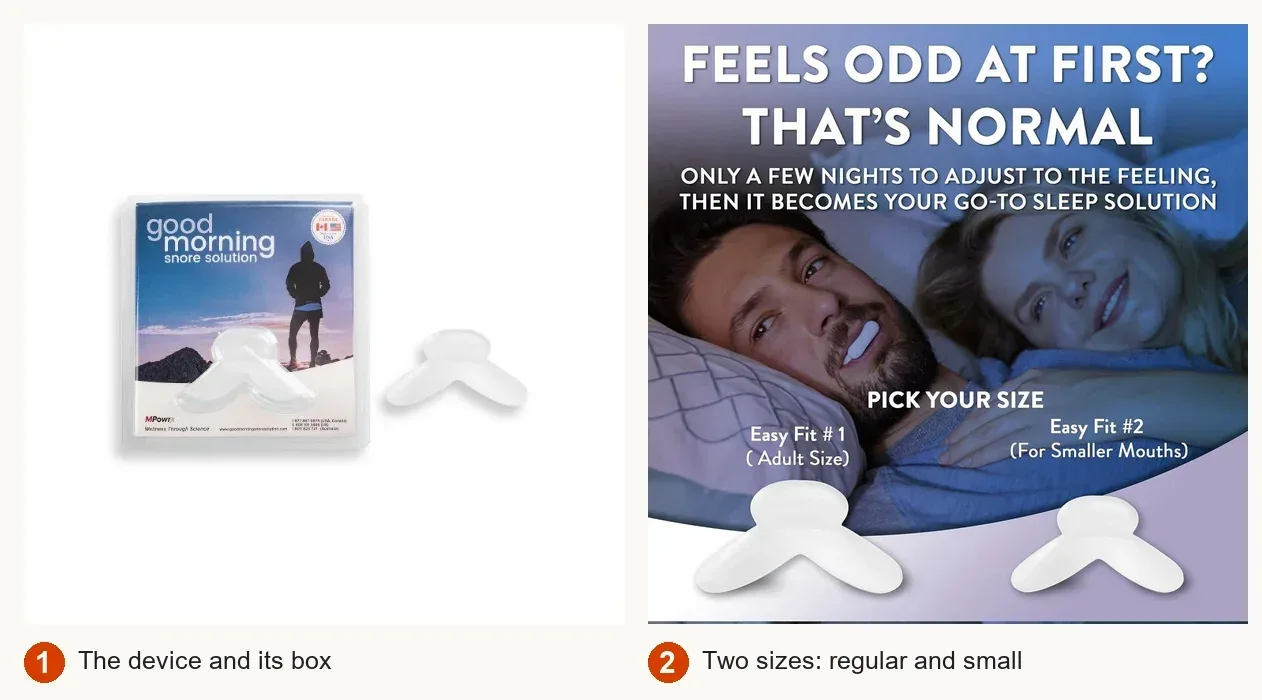
If your tongue check was positive and your nose is clear, the ready-made device I’d look at first is the Good Morning Snore Solution (GMSS). I went through everything on its official page on 24 October 2026, and the full details are in our Good Morning Snore Solution review.
Why this one? It’s FDA-cleared over the counter for snoring in adults (K193239). It needs no fitting, comes in Regular and Small, and it’s the design tested against a dummy in the Dort and Brant trial above.
👍 A good fit if
- Your tongue check made the sound weaker
- Your nose breathes freely
- You have dentures, few teeth or a sore jaw
- You want to try something under $100 with a money-back window
👎 Skip it if
- Your nose is often blocked
- You can’t stick your tongue out past your teeth
- You have signs of sleep apnea
- You want proof from large, independent trials (there aren’t any yet)
Good Morning Snore Solution
$79.94
- Regular or Small size, $79.94 each
- Two-pack (Regular and Small): $139.94
- 30-day money-back guarantee
- Free shipping over $99 (US, Canada, UK, Australia)
Price checked on the official site on 24 Oct 2026.
Frequently asked questions
Do tongue retaining devices work for snoring?
They can, if your tongue is part of the cause. In the only trial that compared one with a dummy device, snores fell from 214.7 to 132.9 an hour and 54% wanted to keep using it. The trial was small and the device’s designer was involved.
Is a tongue retaining device the same as a tongue stabilizing device?
Yes, for practical purposes. Both hold your tongue forward with suction, and TRD and TSD are just two names for the same idea.
Can a tongue retaining device treat sleep apnea?
A custom one prescribed by a dentist or doctor may be used for sleep apnea, but CPAP lowered breathing events much more in a head-to-head trial (to 2.5 an hour against 12.7). A ready-made one bought online is not a sleep apnea treatment, so see a doctor if you have warning signs.
How much does a tongue retaining device cost?
Ready-made ones are under $100: the Good Morning Snore Solution is $79.94 (official site, checked 24 Oct 2026). Custom ones from a dentist run from $500 to $3,000, according to SleepApnea.org.
What are the side effects of a tongue retaining device?
The usual ones are extra saliva, a dry mouth and a sore or numb tongue tip. In the five-year study, 30% of users reported no side effects at all.
Can children use a tongue retaining device?
No. The Good Morning Snore Solution is cleared for adults 18 and over, and children’s snoring often has other causes, like allergies or enlarged tonsils. Talk to their doctor.
My verdict: worth a fair try, with three conditions
A tongue retaining device isn’t magic, and it isn’t a gimmick either. It’s a simple idea with thin but real evidence for the ready-made kind, a high drop-out rate and a short list of people who should skip it.
Try one only if all three of these are true:
- Your tongue is part of it. The 10-second check made the sound much weaker.
- Your nose is clear. If not, fix that first.
- No warning signs of sleep apnea. Gasping, choking or heavy daytime sleepiness means a doctor first.
All three? Then a ready-made device under $100 with a 30-day guarantee is a low-risk experiment. Give it a proper go, because most of the people who quit did it in the first six months.
Is yours a tongue snore?
See who the Good Morning Snore Solution suits, what it costs and how the guarantee works.
Read our Good Morning Snore Solution review →Sources
- Dort L, Brant R. A randomized, controlled, crossover study of a noncustomized tongue retaining device for sleep disordered breathing. Sleep Breath 2008
- Lazard DS et al. The tongue-retaining device: efficacy and side effects in obstructive sleep apnea syndrome. J Clin Sleep Med 2009
- Deane SA et al. Comparison of mandibular advancement splint and tongue stabilizing device in obstructive sleep apnea: a randomized controlled trial. Sleep 2009
- Banhiran W et al. Randomized crossover study of tongue-retaining device and positive airway pressure for obstructive sleep apnea. Sleep Breath 2020
- Alshhrani WM et al. Compliance and side effects of tongue stabilizing device in patients with obstructive sleep apnea. Cranio 2021
- Chen H et al. Dental changes evaluated with a 3D computer-assisted model analysis after long-term tongue retaining device wear in OSA patients. Sleep Breath 2008
- FDA 510(k) record K193239 (MPowRx Snoring Solution, over the counter, 2020) and K231663 (AVEOtsd, 2023)
- SleepApnea.org: Tongue-Retaining Device (TRD), updated 10 Apr 2026 (price ranges)
- Verywell Health: Using a Tongue Stabilizing Device for Sleep Apnea, updated 27 May 2026
- Good Morning Snore Solution: price, guarantee and FDA wording from the official product page, checked 24 Oct 2026 (summarised in our review)
This article is general information, not medical advice. See our medical disclaimer.