
There is a lot of sleep advice online, and much of it is either too vague (“relax before bed”) or too complicated. This guide sticks to habits that have been tested in research, and explains each one in plain terms. You do not need all of them. Start with the first three, which matter most, and add others if you need them.
In this article
- 1. Give yourself enough time in bed
- 2. Keep a regular wake-up time
- 3. Use light to set your body clock
- 4. Time your caffeine
- 5. Be careful with alcohol
- 6. Make the bedroom cool, dark and quiet
- 7. Have a warm bath or shower 1 to 2 hours before bed
- 8. Exercise regularly, and not too hard right before bed
- 9. Wind down
- 10. Do not fight it in bed
- 11. Watch late meals
- 12. Be careful with naps
- Frequently Asked Questions
- Conclusion
- Sources
The short answer
- Give yourself enough time in bed: adults need 7 hours of sleep or more.
- Keep the same wake-up time every day, including weekends.
- Get daylight in the morning and keep evenings dim.
- Stop caffeine about 6 hours before bed, and go easy on alcohol.
- Keep the bedroom cool, dark and quiet.
1. Give yourself enough time in bed
Adults need 7 hours of sleep or more on a regular basis, according to the US sleep medicine societies. Most people take a little time to fall asleep and wake briefly in the night, so you usually need about 7.5 to 8 hours in bed to get 7 hours of sleep. Read more about why 7 hours matters.
2. Keep a regular wake-up time
Your body clock works best with a steady rhythm. Getting up at the same time every day, even after a bad night, is one of the most effective ways to improve sleep. A 2024 study of about 60,000 adults found that people with the most regular sleep times had a lower risk of early death than those with the least regular sleep.
Try to keep your weekend wake-up time within about an hour of your weekday time.
3. Use light to set your body clock
Morning: get outdoor light within an hour of waking, for at least 15 to 30 minutes if you can. Daylight is much brighter than indoor light, even on a cloudy day.
Evening: dim the lights for the last hour or two before bed, and use warm-coloured bulbs. In a 2015 study, reading on a light-emitting tablet before bed delayed melatonin, made it take longer to fall asleep, and left people less alert the next morning, compared with reading a printed book. See our guide to light bulbs and sleep.
4. Time your caffeine
Caffeine blocks a sleep-promoting chemical in the brain called adenosine. Its effects last many hours. In a 2013 study, a large dose of caffeine (400 mg, roughly four cups of coffee) still disturbed sleep when taken 6 hours before bed. A good rule is no coffee, tea, energy drinks or cola after early afternoon.
5. Be careful with alcohol
Alcohol can help you fall asleep faster, but it makes the second half of the night lighter and more broken, and it reduces dream (REM) sleep early in the night. It can also make snoring and sleep apnea worse. If you drink, stop a few hours before bed.
6. Make the bedroom cool, dark and quiet
- Cool: your body temperature needs to drop for sleep. A room that is too warm leads to more waking. Many experts suggest around 60 to 67°F (15 to 19°C), with bedding that suits you. If you sleep hot, see our guide to cooling sheet fabrics.
- Dark: blackout curtains or an eye mask.
- Quiet: earplugs, or a steady background sound. See white noise vs brown noise, or haptic sleep devices if you prefer gentle vibration to sound. If a partner’s snoring is the noise, read how to sleep with someone who snores.
7. Have a warm bath or shower 1 to 2 hours before bed
It sounds backwards, but warming your skin helps your body lose heat afterwards, which helps you fall asleep. A 2019 review found that a warm bath or shower about 1 to 2 hours before bed helped people fall asleep faster and improved sleep quality.

8. Exercise regularly, and not too hard right before bed
Regular exercise improves sleep quality. A 2019 review found that evening exercise does not generally harm sleep, but hard exercise that ends less than an hour before bed may make it harder to fall asleep.
9. Wind down
Give yourself 30 to 60 minutes before bed to slow down. Choose something calm, such as reading a printed book, stretching, listening to music or a slow breathing exercise. Our guide to belly breathing for sleep shows a simple method.
10. Do not fight it in bed
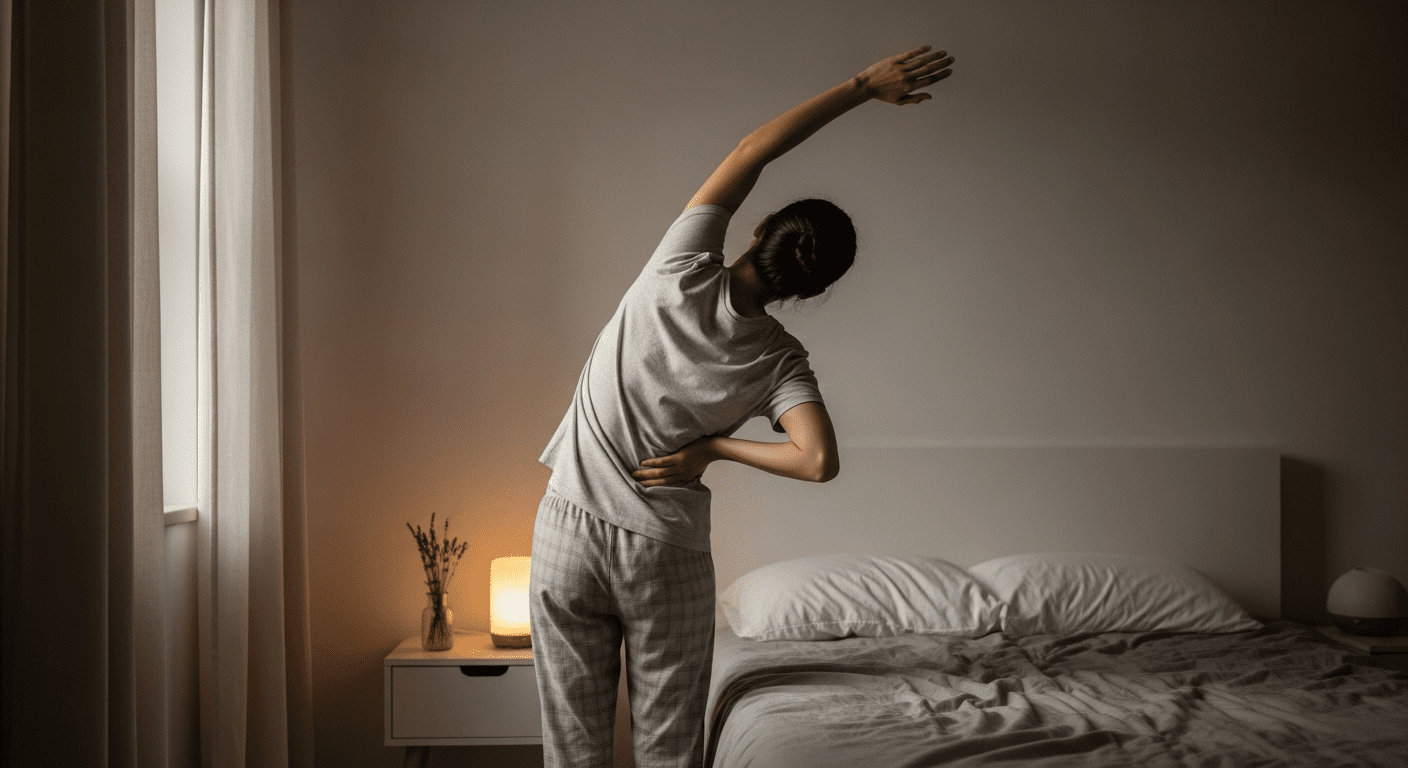
If you cannot sleep after about 20 minutes, get up and do something quiet in dim light, and go back to bed when you feel sleepy. Lying in bed awake and frustrated teaches your brain that bed is a place for worrying. This is one of the core parts of cognitive behavioural therapy for insomnia (CBT-I).
11. Watch late meals
A heavy meal right before bed can cause discomfort and heartburn. Try to finish large meals 2 to 3 hours before bed. A light snack is fine if you are hungry.
12. Be careful with naps
A short early-afternoon nap of 10 to 20 minutes is fine for most people. Long or late naps can make it harder to sleep at night. If you have insomnia, it is usually better to skip naps. See how long a nap should be.
Myth vs fact
Myth: You can catch up on lost sleep by sleeping in on weekends. Fact: Sleeping in helps a little, but it also shifts your body clock later, which makes Sunday night and Monday morning harder. A steady schedule works better.
Your 5-step checklist
- Set a fixed wake-up time and a bedtime 7.5 to 8 hours earlier.
- Go outside within an hour of waking.
- No caffeine after early afternoon.
- Dim the lights an hour before bed.
- Keep the bedroom cool, dark and quiet.
When to see a doctor
See a doctor if you have trouble sleeping three or more nights a week for three months, if you snore loudly or stop breathing during sleep, if your legs feel restless at night, or if you feel very sleepy during the day despite enough sleep. These can be signs of insomnia, sleep apnea or other conditions that can be treated.
Frequently Asked Questions
If I had a bad night, should I sleep in?
Try not to. Get up at your normal time and go to bed a little earlier the next night if you are sleepy. Sleeping in makes the next night harder.
What is the biggest mistake people make?
Not giving themselves enough time in bed, and then keeping a very different schedule on weekends.
Should I exercise close to bedtime?
Light or moderate exercise in the evening is fine for most people. Avoid very hard workouts in the last hour before bed.
Do sleep trackers help?
They can show trends, such as how much you sleep on average, but their sleep stage data is often inaccurate. If checking your score makes you anxious, stop using it. Read more in our guide to sleepmaxxing.
Are supplements worth trying?
Some, like magnesium or tart cherry juice, have small studies with modest effects. They work best on top of good habits, not instead of them. See natural melatonin alternatives.
Conclusion
Better sleep usually comes from a few simple habits done consistently, not from expensive products. Start with enough time in bed, a fixed wake-up time and smart use of light. Give each change two to three weeks before you judge it. If you still struggle, talk to a doctor about CBT-I or a sleep test.
Sources
- Watson NF, et al. Recommended amount of sleep for a healthy adult. Sleep, 2015.
- Windred DP, et al. Sleep regularity is a stronger predictor of mortality risk than sleep duration. Sleep, 2024.
- Chang AM, et al. Evening use of light-emitting eReaders negatively affects sleep, circadian timing, and next-morning alertness. PNAS, 2015.
- Drake C, et al. Caffeine effects on sleep taken 0, 3, or 6 hours before going to bed. J Clin Sleep Med, 2013.
- Ebrahim IO, et al. Alcohol and sleep I: effects on normal sleep. Alcohol Clin Exp Res, 2013.
- Okamoto-Mizuno K, Mizuno K. Effects of thermal environment on sleep and circadian rhythm. J Physiol Anthropol, 2012.
- Haghayegh S, et al. Before-bedtime passive body heating by warm shower or bath to improve sleep. Sleep Med Rev, 2019.
- Kredlow MA, et al. The effects of physical activity on sleep: a meta-analytic review. J Behav Med, 2015.
- Stutz J, et al. Effects of evening exercise on sleep in healthy participants. Sports Med, 2019.
- Edinger JD, et al. Behavioral and psychological treatments for chronic insomnia disorder in adults: an AASM clinical practice guideline. J Clin Sleep Med, 2021.