
What if the eight-hour sleep block you’ve been struggling to maintain is actually making your anxiety worse?
Look, I know what you’re thinking. Another article about sleep patterns, right? But hear me out, because this one’s different. We’re going to talk about something your great-great-great-grandparents knew instinctively but somehow got lost in our modern obsession with sleeping through the night.
I spent years lying awake at 2 AM, staring at the ceiling, convinced something was wrong with me. My anxiety would spike every single night around that time. Then I discovered something wild: waking up in the middle of the night might actually be normal. Yeah, you read that right.
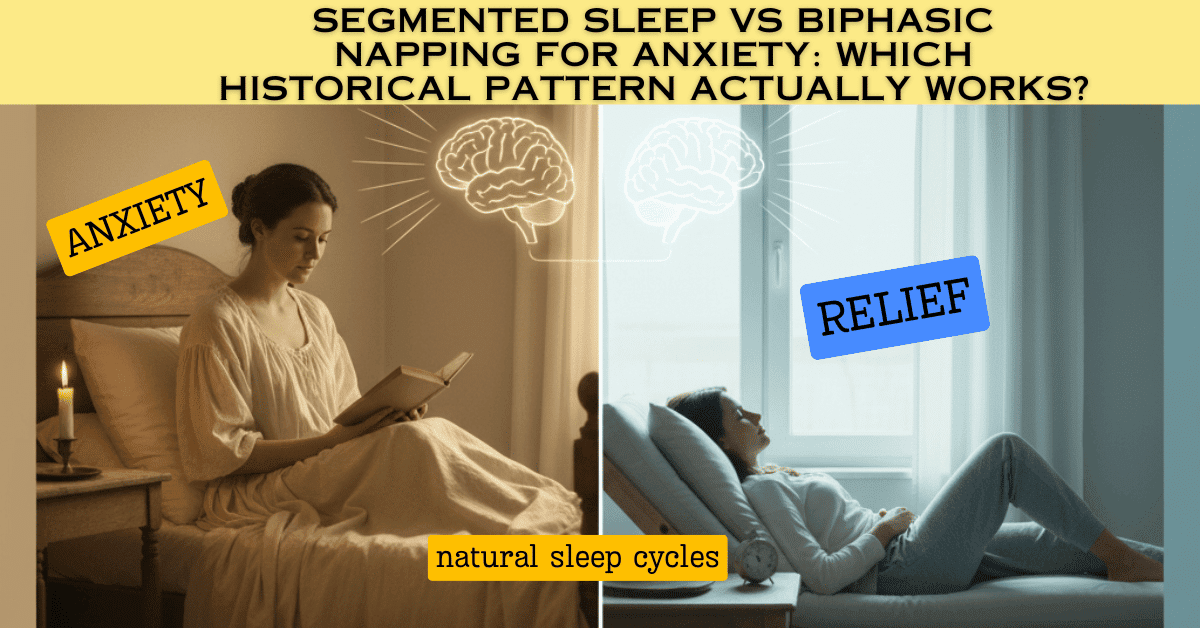
Table of Contents
The Problem: Your Anxiety and Sleep Are Playing a Nasty Game of Tag
Let’s get real about what’s happening here. You’re anxious, so you can’t sleep. You can’t sleep, so you get more anxious about not sleeping. Then you’re anxious about being anxious about not sleeping. It’s like a twisted game where nobody wins and everyone’s exhausted.
Here’s what the numbers tell us:
- 70% of people with anxiety disorders report significant sleep problems
- Adults with anxiety are 3.5 times more likely to have insomnia than those without
- The American Psychological Association found that 43% of adults say stress has caused them to lie awake at night in the past month
But here’s the kicker: we’ve been approaching this all wrong. We’re trying to force our brains into a sleep pattern that might not be natural at all.
Think about it. When was the last time you slept a solid eight hours without waking up? For most of us, that’s rare. We wake up to use the bathroom, check our phones (guilty as charged), or just lie there thinking about that embarrassing thing we said in 2009.
The Real Cost of Sleep Anxiety
Before we dive into solutions, let’s talk about what this sleep-anxiety cycle is actually doing to you:
- Your cortisol levels stay elevated throughout the day
- Decision-making becomes harder
- You’re more irritable with people you care about
- Physical symptoms like headaches and muscle tension get worse
- Your immune system takes a hit
I’m not trying to scare you here. I just want you to understand why finding a better sleep pattern matters so much.
The Agitation: We’ve Been Lied To About “Normal” Sleep
Here’s where things get interesting. That whole “eight hours of uninterrupted sleep” thing? It’s basically a modern invention.
Our ancestors didn’t sleep like we’re told to sleep today. Not even close. And get this: historical records show that people used to sleep in two distinct chunks, with a period of wakefulness in between. They called it “first sleep” and “second sleep.”
What History Actually Shows Us
Historian Roger Ekirch spent 16 years researching sleep patterns throughout history. What he found blew my mind. References to segmented sleep appear in everything from:
- Medieval prayer books
- Legal depositions from the 1600s
- Literature from ancient civilizations
- Tribal societies that never industrialized
People would go to bed around 9 PM, sleep for 3-4 hours, wake up for 1-2 hours, then sleep another 3-4 hours. And here’s the wild part: they didn’t stress about it. They used that middle-of-the-night wake time for prayer, reflection, intimacy, or quiet activities.
Sound familiar? That 2 AM wake-up I mentioned earlier? Maybe it’s not insomnia at all.
The Industrial Revolution Ruined Everything
Then came artificial light and factory schedules. Suddenly, sleeping in segments became “inefficient.” We needed to maximize daylight hours and consolidate sleep into one block. Within a few generations, we completely forgot that biphasic and segmented sleep patterns were normal.
The timeline looks something like this:
| Era | Sleep Pattern | Cultural Attitude |
|---|---|---|
| Pre-1800s | Segmented/Biphasic | Completely normal and expected |
| 1800-1920 | Transitional | Starting to consolidate sleep |
| 1920-Present | Monophasic | Considered the only “healthy” option |
The Solution: Getting Back to What Actually Works
Okay, so now we know the problem and we understand we’ve been fed some questionable information about sleep. Let’s talk about practical solutions.
There are two main historical patterns we can look at: segmented sleep and biphasic napping. They’re different, and which one works better for your anxiety depends on your specific situation.
Segmented Sleep: The Night Owl’s Friend
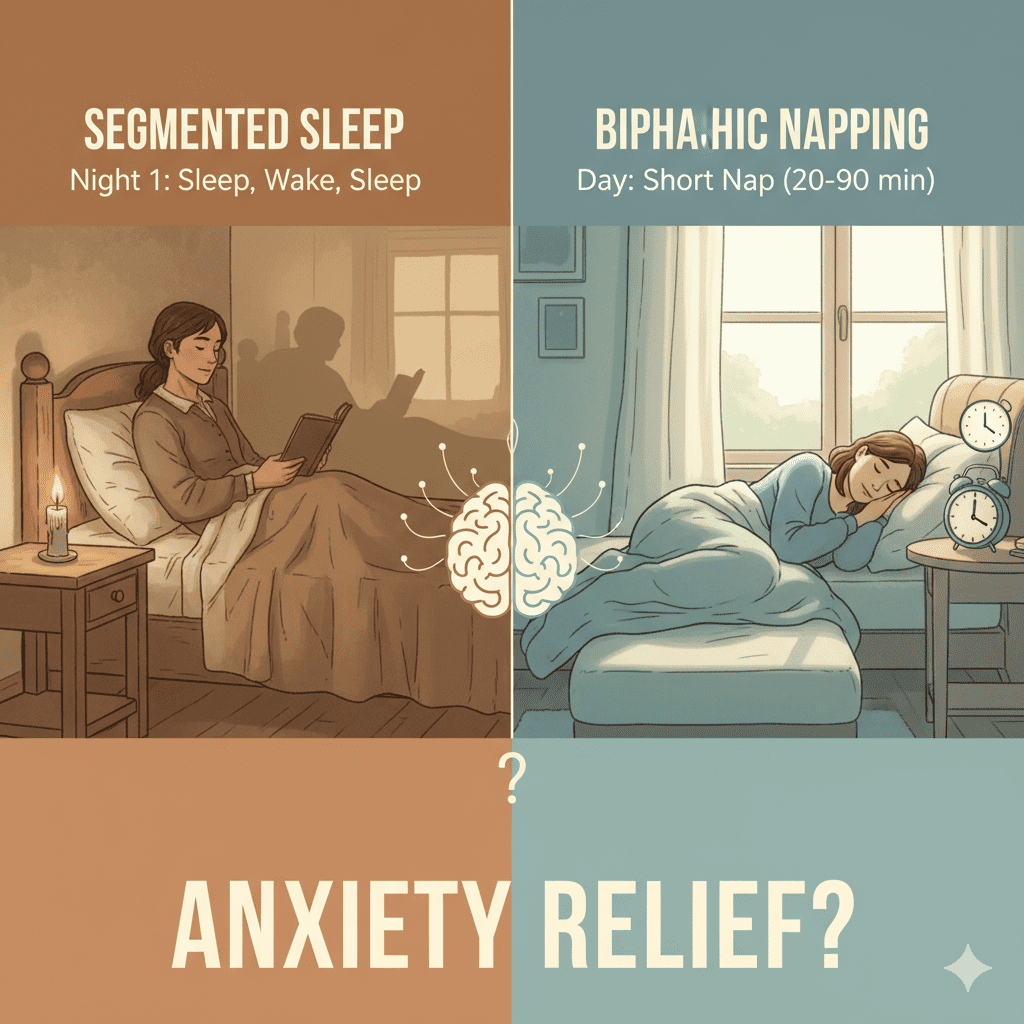
Segmented sleep is what I described earlier. You sleep in two chunks during the night with a wake period in between.
Here’s what a typical segmented sleep schedule looks like:
- 9 PM – 12:30 AM: First sleep (3.5 hours)
- 12:30 AM – 2 AM: Quiet wakefulness (1.5 hours)
- 2 AM – 6 AM: Second sleep (4 hours)
- Total sleep: 7.5 hours
During that middle period, you’re not scrolling through social media or watching Netflix. That’s the mistake people make when they try this. Instead, you’re:
- Reading by dim light
- Meditating or doing breathing exercises
- Journaling about anxious thoughts
- Having quiet conversations
- Doing gentle stretches
- Engaging in intimacy with a partner
Why Segmented Sleep Helps Anxiety
Here’s where it gets good for those of us dealing with anxiety. That middle wake period? It’s actually perfect for processing the thoughts that usually keep us up.
Dr. Thomas Wehr conducted a landmark study in the 1990s where he had participants live in darkness for 14 hours each night. Without artificial light, they naturally fell into a segmented sleep pattern. And here’s what happened:
Participants reported:
- A feeling of calm and peace during the wake period
- Increased melatonin levels throughout the night
- Better emotional regulation the next day
- Less anxiety about not sleeping
One participant described it as feeling like they were in a “meditative state” during the middle-of-the-night waking period. Their brains were producing melatonin the entire time, creating a twilight consciousness that’s actually really helpful for anxiety.
Biphasic Napping: The Siesta Approach
Now let’s talk about the other option: biphasic napping. This is what you see in Mediterranean and Latin American cultures. One long sleep at night, plus a shorter nap during the day.
A typical biphasic schedule:
- 11 PM – 6:30 AM: Main sleep (7.5 hours)
- 2 PM – 3 PM: Afternoon nap (1 hour)
- Total sleep: 8.5 hours
The difference here is you’re getting that core sleep in one block, then adding a strategic nap during your afternoon energy dip.
The Anxiety Benefits of Napping
Research from NASA (yeah, they study naps because astronauts need them) found that a 26-minute nap improved pilot performance by 34% and alertness by 54%. But for anxiety, the benefits go deeper:
Strategic napping helps reset your nervous system. When anxiety builds throughout the day, that afternoon nap gives you a chance to interrupt the stress response before it snowballs.
Studies show that:
- A 20-30 minute nap reduces cortisol by up to 50%
- Afternoon naps improve emotional regulation
- People who nap regularly report lower anxiety levels overall
- Napping can prevent the late-afternoon anxiety spike many people experience
Breaking Down the Differences
Let me make this super clear with a comparison because I know you’re probably thinking, “Okay, but which one should I try?”
| Factor | Segmented Sleep | Biphasic Napping |
|---|---|---|
| Total Sleep Time | 7-8 hours split into two chunks at night | 7-8 hours at night + 20-90 minute nap |
| Best For | Night anxiety, 2-3 AM wake-ups, processing emotions | Daytime fatigue, afternoon anxiety spikes |
| Flexibility | Requires consistent nighttime schedule | More adaptable to work schedules |
| Learning Curve | 2-4 weeks to adjust | Can start immediately |
| Social Impact | Minimal (happens at night) | Requires finding time/place to nap |
| Historical Precedent | Pre-industrial societies worldwide | Mediterranean and equatorial cultures |
Who Should Try Segmented Sleep?
You might be a good candidate for segmented sleep if:
- You regularly wake up between midnight and 3 AM
- Your anxiety is worst at night
- You have racing thoughts that need processing time
- You have a flexible schedule or work from home
- You’re already waking up anyway (might as well work with it)
- Traditional sleep advice hasn’t worked for you
Who Should Try Biphasic Napping?
Consider biphasic napping if:
- You crash hard in the afternoon (typically 1-4 PM)
- Your anxiety builds throughout the day
- You have access to a quiet space during lunch hours
- You function well with one main sleep period
- You want an easier transition from conventional sleep
- You live in a culture where napping is more accepted
How to Actually Implement These Patterns
Alright, theory is great, but let’s get practical. I’m going to walk you through exactly how to try each of these.
Starting with Segmented Sleep
Week 1: Observation
- Don’t change anything yet
- Just note when you naturally wake up at night
- Keep a journal by your bed
- Track your anxiety levels in the morning
Week 2: Embrace the Wake
- When you wake up at night, don’t panic
- Get up after 20-30 minutes if you can’t fall back asleep
- Do calm activities in very dim light (candlelight is ideal)
- Set a timer for 1-1.5 hours, then return to bed
- This is crucial: Don’t use your phone or bright lights
Week 3-4: Establish the Pattern
- Gradually shift your first sleep earlier (around 9-10 PM)
- Plan for your wake period with specific activities
- Keep the bedroom cool (around 65°F or 18°C)
- Use the wake time for anxiety processing techniques
Things you can do during your wake period:
- Write down anxious thoughts without judgment
- Practice 4-7-8 breathing (inhale 4 counts, hold 7, exhale 8)
- Read something calm and non-stimulating
- Do gentle yoga or stretching
- Pray or meditate if that’s your thing
- Have a light snack (avoid sugar and caffeine)
Starting with Biphasic Napping
Week 1: Find Your Window
- Notice when you feel most tired during the day
- For most people, this is 1-4 PM
- Even if you can’t nap, note the timing
Week 2: Short Naps
- Start with 20-minute naps only
- Set an alarm (seriously, don’t skip this)
- Find a quiet, dark spot
- Don’t worry if you don’t actually fall asleep
Week 3-4: Optimize Your Nap
- Experiment with nap length (20-90 minutes)
- Avoid naps after 4 PM (they’ll mess with nighttime sleep)
- Create a mini bedtime routine for naps
- Track how you feel 30 minutes after waking
Pro tips for successful napping:
- Drink coffee right before your nap (it kicks in as you wake up)
- Use an eye mask and earplugs
- Tell people you’re napping so they don’t interrupt
- Keep naps consistent (same time each day)
The Science Behind Why This Works for Anxiety
Okay, let’s get nerdy for a minute because understanding why these patterns help anxiety makes it easier to stick with them.
What Happens in Your Brain
When you’re anxious, your amygdala (the fear center) is basically throwing a tantrum. Normal monophasic sleep sometimes isn’t enough to calm it down because:
- You spend the whole night in “I must stay asleep” mode
- Anxiety about sleep becomes part of the problem
- Your brain doesn’t get processing time
With segmented sleep or biphasic napping, you’re giving your brain multiple opportunities to reset.
During the segmented sleep wake period:
- Melatonin stays elevated (unlike if you turned on bright lights)
- Your prefrontal cortex can process anxious thoughts
- You’re not fighting to stay asleep
- The pressure is off
During biphasic napping:
- Your nervous system gets a mid-day reset
- Cortisol drops significantly
- You prevent the anxiety build-up that happens from morning to evening
- Your brain processes information from the first half of the day
The REM Connection
Here’s something fascinating: both patterns give you more REM sleep opportunities. REM sleep is when your brain processes emotions and consolidates memories.
With segmented sleep, you get REM periods in both sleep chunks. With biphasic napping, longer naps (60-90 minutes) include a full sleep cycle with REM.
More REM sleep means:
- Better emotional regulation
- Reduced anxiety intensity
- Improved problem-solving
- Less rumination
Real Talk: The Challenges You’ll Face
I’m not going to sugarcoat this. Trying these patterns in our modern world isn’t easy. Here are the obstacles you’ll run into:
For Segmented Sleep:
- Partners who don’t get it: Your significant other might think you’re weird for getting up at 2 AM
- Social expectations: People will question why you go to bed at 9 PM
- Light pollution: Cities make it hard to maintain darkness
- Work schedules: Early morning meetings don’t care about your sleep pattern
For Biphasic Napping:
- Workplace culture: Many jobs don’t accommodate napping
- Feeling groggy: The first few naps might leave you feeling worse
- Finding space: You need somewhere private and quiet
- Social pressure: People might think you’re lazy
Making It Work in Real Life
But here’s the thing: people do make these work. Let me share some real strategies.
For Segmented Sleep in Modern Life:
If you have a partner:
- Have an honest conversation about why you’re trying this
- Share the research (show them this article)
- Create a routine where you read or meditate quietly
- Use a separate room if needed during the wake period
If you work traditional hours:
- Shift your schedule to 10 PM – 1 AM, then 2:30 AM – 6:30 AM
- Wake up naturally during the first period if possible
- Use weekends to establish the pattern
Light management:
- Use blackout curtains religiously
- Install dim red lights for the wake period
- Avoid all screens during night waking
- Consider an eye mask for the second sleep
For Biphasic Napping in Modern Life:
If you work in an office:
- Use your lunch break (eat quick, nap for 20 minutes)
- Find an empty conference room
- Sit in your car if necessary
- Talk to HR about wellness accommodations
If you work from home:
- Block your calendar for “deep work” during nap time
- Set boundaries with family members
- Create a dedicated nap space
If you can’t nap:
- Try “quiet rest” with eyes closed for 20 minutes
- Practice yoga nidra (guided relaxation)
- Even resting without sleep reduces anxiety
Key Takeaways
Let me break down the most important points so you can remember them:
- Historical context matters: Humans didn’t always sleep in eight-hour blocks, and that’s okay
- Segmented sleep works best if you already wake up at night and struggle with nighttime anxiety
- Biphasic napping works best if you need an afternoon reset and build anxiety throughout the day
- Both patterns can reduce anxiety by giving your nervous system multiple chances to reset
- It takes 2-4 weeks to adjust to any new sleep pattern, so be patient
- The key is consistency: Pick one pattern and stick with it before trying something else
- Modern life requires creativity: You’ll need to adapt these patterns to your circumstances
- Don’t stress about perfection: Missing a day or adjusting the timing is totally fine
“The best sleep pattern is the one you can actually maintain that reduces your anxiety and improves your quality of life.” – Dr. Sara Mednick, sleep researcher
What to Do Next
If you’re sitting here thinking, “Okay, I’m convinced, but where do I start?” here’s your action plan:
This week:
- Track your current sleep and anxiety patterns
- Note when you naturally feel tired
- Decide which pattern aligns better with your lifestyle
- Gather supplies (eye mask, journal, dim lighting)
Next week:
- Start implementing your chosen pattern
- Be gentle with yourself during the adjustment
- Keep notes on how you feel
- Don’t judge the results too quickly
In one month:
- Evaluate how your anxiety has changed
- Adjust timing if needed
- Decide if you want to continue or try the other pattern
Common Questions People Ask
How long does it take to see anxiety improvements?
Most people notice some change within 2-3 weeks, but significant anxiety reduction typically takes 4-6 weeks. Your nervous system needs time to adjust and trust the new pattern.
Can I switch between segmented and biphasic sleep?
Not really. Your body needs consistency to establish any pattern. Pick one and stick with it for at least a month before deciding if it’s working.
What if I can’t fall back asleep during segmented sleep?
This is normal in the first 2-3 weeks. Stay in bed, keep lights dim, and don’t stress about it. Your body will eventually learn the pattern. If you’re still awake after 30 minutes, get up and do a quiet activity.
Will napping make me unable to sleep at night?
Not if you keep naps before 4 PM and under 90 minutes. Actually, strategic napping can improve nighttime sleep by reducing anxiety and stress hormones.
What if my work schedule makes both patterns impossible?
Start with what you can do. Even adopting the principles (like not stressing about night waking or taking 10-minute rest breaks) can help. Some flexibility is better than none.
Do I need to sleep more overall with these patterns?
Not necessarily. You’re just distributing your sleep differently. Most people maintain 7-9 hours total, just split up. Some people find they need slightly less because the sleep quality improves.
Can I use sleep medication while adjusting?
Talk to your doctor about this. Some people find it helpful during the transition, while others find it interferes with establishing natural sleep pressure. Your situation is unique.
What about sleep tracking devices?
They can be helpful for understanding your patterns, but don’t obsess over the data. How you feel is more important than what your watch says. Some people find tracking increases anxiety.
Is this safe for everyone?
Most people can try these patterns safely, but if you have certain medical conditions (like epilepsy, severe sleep apnea, or bipolar disorder), talk to your doctor first. Sleep pattern changes can affect these conditions.
What if my partner or kids make this impossible?
It’s definitely harder with family obligations, but not impossible. Many parents use biphasic napping during kids’ rest time. For segmented sleep, some couples do it together or adjust their schedules to make it work.
The Bottom Line
Look, I’m not going to tell you that changing your sleep pattern will magically cure your anxiety. That would be dishonest. But here’s what I will tell you:
For many people, fighting against natural sleep patterns makes anxiety worse. When you stop trying to force yourself into a sleep box that doesn’t fit, you remove one huge source of stress.
Segmented sleep and biphasic napping aren’t magic bullets. They’re tools. They work because they align with how human sleep actually evolved rather than how we think it should work in our industrialized society.
The best part? You get to experiment. You get to figure out what your body actually needs instead of what sleep influencers and mattress companies tell you it needs.
Maybe you try segmented sleep and discover that wake period becomes your favorite part of the day. Maybe you try biphasic napping and realize that afternoon reset is exactly what your anxiety needed. Maybe you try both and decide neither works, but in the process, you learn something valuable about your own sleep patterns.
The point isn’t to be perfect. The point is to stop fighting yourself.
Your ancestors survived and thrived on these patterns. Your body might be trying to tell you something when you wake up at 2 AM or crash at 3 PM. Maybe instead of seeing it as a problem to fix, you can see it as information to use.
Whatever you decide to try, be patient with yourself. Change takes time. Your anxiety didn’t develop overnight, and it won’t disappear overnight either. But giving yourself permission to sleep differently might just be the first step toward feeling better.
Now, if you’ll excuse me, it’s about time for my afternoon nap.
Quick Reference Table: Choose Your Pattern
| If This Sounds Like You… | Try This Pattern | Start Here |
|---|---|---|
| Wake up at 2-3 AM regularly | Segmented Sleep | Embrace the wake, don’t fight it |
| Afternoon energy crash | Biphasic Napping | 20-minute power nap at 2 PM |
| Racing thoughts at night | Segmented Sleep | Use wake period for journaling |
| Building anxiety throughout the day | Biphasic Napping | Nap before anxiety peaks |
| Can’t fall asleep initially | Segmented Sleep | Go to bed earlier, expect the wake |
| Sleep through the night but wake up exhausted | Biphasic Napping | Add strategic afternoon rest |
Remember: These patterns aren’t one-size-fits-all. Start with the one that makes the most sense for your specific situation, and adjust as needed.