

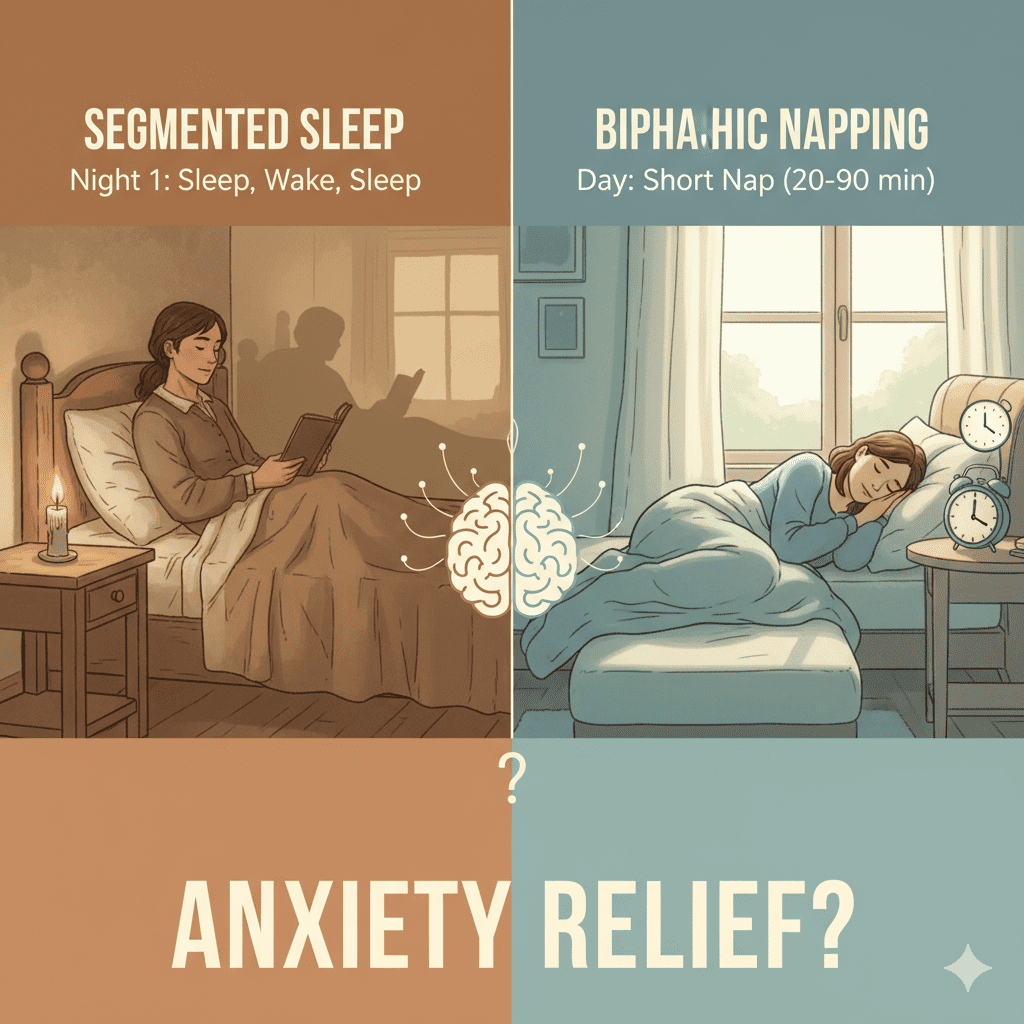
Segmented sleep means sleeping in two blocks at night with an hour or two awake in between. Biphasic napping means one main night’s sleep plus a daytime nap. Both have a real history, and both come up often when people talk about anxiety and night waking. This guide explains what the research shows, and why, if anxiety is keeping you awake, the evidence-based help looks a little different from what many online articles suggest.
In this article
The short answer
- Waking briefly in the night is normal, and knowing that can take some of the worry out of it.
- Historical records describe “first sleep” and “second sleep”, but it is not proven that this is how all humans naturally slept.
- There is no good evidence that deliberately splitting your sleep reduces anxiety.
- A short nap of 10 to 20 minutes can boost alertness, but naps can make insomnia worse.
- For anxiety-driven sleep problems, cognitive behavioral therapy for insomnia (CBT-I) is the best-supported treatment.
Anxiety and sleep feed each other
Anxiety and poor sleep are closely linked, and in both directions. Worry makes it harder to fall asleep and easier to wake at night. Poor sleep then makes people more sensitive to stress the next day. Many people also develop a specific worry about sleep itself, which keeps the cycle going.
What history shows about “first sleep” and “second sleep”
The historian A. Roger Ekirch found many references in European writing from before the 1800s to a “first sleep” and a “second sleep”. People went to bed soon after dark, woke for a while in the middle of the night to pray, talk, tend the fire or think, and then slept again. He describes this in his book At Day’s Close: Night in Times Past (2005).

In a small 1992 study, Thomas Wehr at the US National Institute of Mental Health kept healthy volunteers in darkness for 14 hours each night for several weeks. Their sleep tended to split into two blocks, with one to three hours of quiet waking in between.
But the picture is not simple. A 2015 study of three present-day hunter-gatherer groups without electricity (Yetish and colleagues, Current Biology) found that they mostly slept in one block at night and rarely napped. So segmented sleep may have been common in some places and times, but it is not proven to be the single “natural” human pattern.
Myth vs fact
Myth: Humans are meant to sleep in two segments, so you should schedule a wake period every night. Fact: Night waking was common in the past, but the evidence on what is “natural” is mixed, and planned night waking is not a proven treatment for anything.
Segmented sleep vs biphasic napping
| Segmented sleep | Biphasic napping | |
|---|---|---|
| What it is | Two sleep blocks at night, awake in between | One night sleep plus a daytime nap |
| Where it comes from | Historical records in Europe; Wehr’s 1992 study | Siesta traditions in many warm countries |
| Evidence of benefit | Little direct research | Good evidence that short naps improve alertness |
| Main risk | Less total sleep; hard to fit with work | Long or late naps can make night sleep worse |
| For insomnia | Not recommended as a treatment | Usually discouraged |
What naps can and cannot do
Short naps work. In a NASA study of long-haul airline pilots (Rosekind and colleagues, 1994), pilots given a planned 40-minute rest slept about 26 minutes on average, and were more alert later in the flight than pilots who did not rest. Studies of afternoon naps suggest that 10 to 20 minutes gives a boost with little grogginess, while longer naps often leave you groggy at first.
The downside is that naps use up some of the “sleep pressure” that helps you fall asleep at night. That is why CBT-I usually asks people with insomnia to avoid naps. If you nap, keep it short and before mid-afternoon.
If you wake at night feeling anxious
The most useful thing history teaches is that waking in the night is not, on its own, a sign that something is wrong. Short awakenings are a normal part of sleep. What helps is not planning a wake period, but changing how you respond when you do wake:
- Do not check the time.
- If you have been awake for about 20 minutes, get up. Go to another room with dim light and do something calm, such as reading a paper book.
- Write worries down on paper if your mind is racing.
- Go back to bed when you feel sleepy.
- Get up at the same time every morning, however the night went.
These steps come from CBT-I, which the American Academy of Sleep Medicine recommends as the first treatment for chronic insomnia. It is available from therapists and through structured online programs. For more on night waking, see why you keep waking up at 4 AM.
Try this tonight
Set one fixed wake-up time for the next two weeks. If you wake in the night and cannot fall back asleep, leave the bedroom after about 20 minutes instead of lying there worrying.
Who might try a planned nap
- People who sleep well at night but have a strong afternoon dip.
- Shift workers before a night shift.
- People who have to drive or work long hours and feel drowsy.
If you already have trouble sleeping at night, try the steps above before adding a nap.
When to see a doctor
See a doctor if anxiety or poor sleep lasts more than a few weeks, affects your work or relationships, or comes with low mood. Also see one if you snore loudly or someone notices pauses in your breathing. Anxiety and insomnia are both very treatable.
Common Questions People Ask
Is it normal to wake up in the middle of the night?
Yes. Short awakenings between sleep cycles are normal. It is a problem only if you often cannot get back to sleep, or you feel tired during the day.
Should I try segmented sleep for anxiety?
There is no good evidence that it helps anxiety, and it can cut your total sleep. CBT-I and treatment for the anxiety itself are better-supported options.
How long should a nap be?
For a quick boost, 10 to 20 minutes. Longer naps can leave you groggy and may make it harder to sleep at night.
Will napping stop me sleeping at night?
Short, early-afternoon naps usually do not cause problems for good sleepers. If you have insomnia, avoid naps until your night sleep improves.
The Bottom Line
The history of segmented sleep is a useful reminder that waking at night is normal. But there is no good evidence that planning your sleep in two blocks treats anxiety. A short nap can help alertness for good sleepers. If anxiety is keeping you awake, the best-supported help is CBT-I and, where needed, treatment for the anxiety itself.
Sources
- Ekirch AR. At Day’s Close: Night in Times Past. W. W. Norton, 2005.
- Wehr TA. In short photoperiods, human sleep is biphasic. J Sleep Res, 1992.
- Yetish G, et al. Natural sleep and its seasonal variations in three pre-industrial societies. Curr Biol, 2015.
- Rosekind MR, et al. Crew factors in flight operations IX: effects of planned cockpit rest. NASA, 1994.
- Brooks A, Lack L. A brief afternoon nap following nocturnal sleep restriction: which nap duration is most recuperative? Sleep, 2006.
- Edinger JD, et al. Behavioral and psychological treatments for chronic insomnia disorder in adults: an AASM clinical practice guideline. J Clin Sleep Med, 2021.
This article is general information, not medical advice. See our medical disclaimer.