
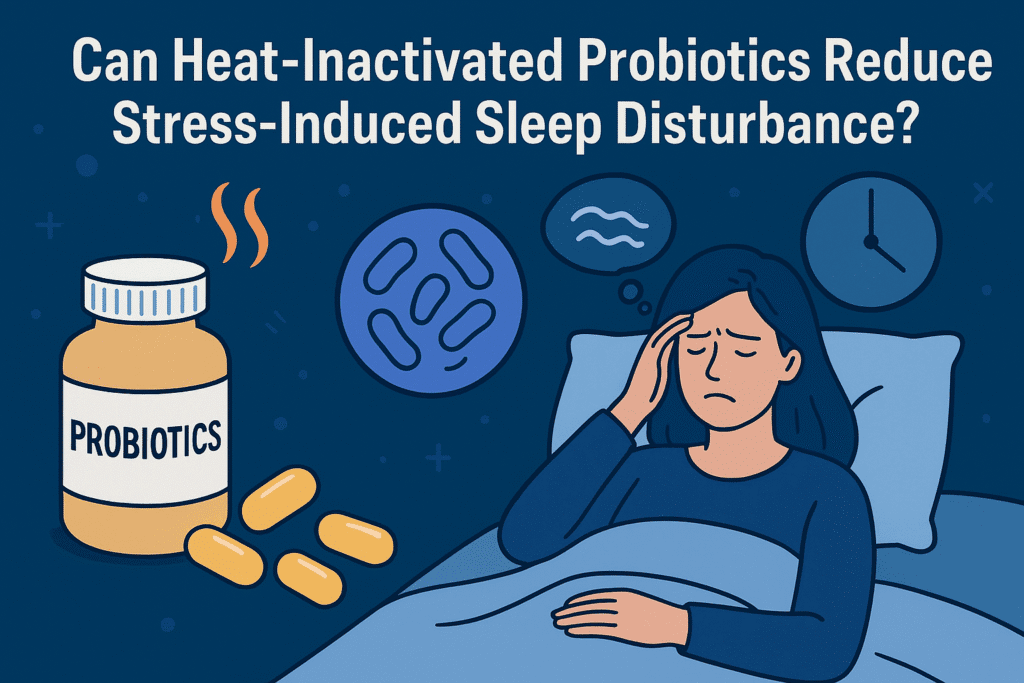
Stress is one of the most common reasons people sleep badly. In recent years, researchers have started to test whether gut bacteria, including bacteria that have been killed by heat, can soften that effect. The early results are interesting, but the studies are small, and most were paid for by the companies that sell the products. Here is what heat-inactivated probiotics are and what the research really shows.
In this article
The short answer
- Heat-inactivated probiotics are bacteria that have been killed by heat. They are also called paraprobiotics or, more broadly, postbiotics.
- The best-studied one for sleep is Lactobacillus gasseri CP2305, tested in Japanese students under exam stress.
- In those studies, students reported better sleep, and one study measured faster sleep onset.
- The studies are small, few in number and mostly funded by the maker.
- They appear safe, but they are not a treatment for insomnia.
What heat-inactivated probiotics are
Probiotics are live bacteria that may benefit health. Heat-inactivated probiotics are the same kinds of bacteria, killed by heat during manufacturing. The cell walls and other parts remain, and these can still interact with the gut and the immune system.
In 2021, an international expert group (ISAPP) defined postbiotics as preparations of non-living microbes or their parts that benefit health. Heat-killed bacteria fall under this definition. Because they are not alive, they are easier to store and do not need to survive stomach acid.
How gut bacteria might affect sleep
The gut and the brain constantly send signals to each other through nerves (mainly the vagus nerve), hormones and the immune system. This is often called the gut-brain axis. Stress changes the mix of gut bacteria, and gut bacteria can influence the body’s stress response. The idea behind these products is that calming this loop may make stress-related sleep problems a little better. This is a reasonable theory, but how much it matters in people is still being worked out. Our guide to gut bacteria and deep sleep covers the wider research.
What the studies show
L. gasseri CP2305
2017: 32 Japanese medical students took heat-inactivated CP2305 daily for 5 weeks during a stressful dissection course. Their self-reported sleep quality improved, mainly in the men, who also fell asleep faster and slept longer.

2019: 60 medical students preparing for their national exam took CP2305 tablets or a placebo for 24 weeks. The CP2305 group reported less anxiety and better sleep. A simple brain-wave recording also showed that they fell asleep faster and spent less time awake during the night. One of the authors worked for the company that makes CP2305.
B. longum 1714 (a live probiotic)
This strain is often mentioned alongside CP2305, but it is live, not heat-killed. In a 2024 trial, 89 adults with poor sleep took it or a placebo for 8 weeks. Sleep quality improved faster with the probiotic at 4 weeks, but by 8 weeks both groups had improved by a similar amount. A wrist sleep tracker showed no difference. Several authors worked for the maker.
Probiotics in general
A 2024 review of 15 trials found that probiotics, mostly live ones, improved scores on a common sleep questionnaire compared with placebo. The authors noted a risk of bias in some studies and said more research is needed.
Myth vs fact
Myth: Heat-killed probiotics are proven to fix stress-related insomnia. Fact: A few small studies, mostly in Japanese students, show modest improvements in self-reported sleep. That is promising, but far from proof.
Who might consider them
- Healthy adults going through a stressful period, such as exams, who want to try something low-risk alongside good sleep habits.
- People who already take probiotics and want to choose a strain with some sleep research behind it.
They are not a replacement for treating insomnia, anxiety or depression.
If you want to try them
Tips
- Check the strain name, such as “CP2305”. Effects found for one strain do not apply to others.
- Give it 4 to 8 weeks. That is how long the studies ran before differences appeared.
- Keep a simple sleep diary before and during, so you can judge the effect honestly.
- Do not drop the basics. A regular wake-up time, a dark bedroom and less caffeine will do more for most people. See our guide to calming breathing before bed.
Safety
Heat-inactivated bacteria are generally considered very safe, and the trials reported few side effects. Because they are not alive, the small risk of infection that live probiotics carry for very ill or immune-suppressed people is lower. Still, ask your doctor first if you have a serious illness, a weak immune system, or are pregnant.
When to see a doctor
If stress keeps you awake most nights for more than a few weeks, talk to a doctor. Cognitive behavioural therapy for insomnia (CBT-I) is the recommended first treatment, and anxiety or depression may need their own treatment.
Frequently Asked Questions
Are heat-inactivated probiotics as good as live probiotics for sleep?
Nobody has compared them directly for sleep. Each strain has to be judged on its own studies.
How long do they take to work?
In the studies, differences showed up after about 4 to 8 weeks of daily use.
Can I just eat yogurt instead?
Yogurt and fermented foods are good for overall diet, but they usually do not contain the specific strains that were studied for sleep.
Do I need to keep them in the fridge?
Usually not, because the bacteria are not alive. Follow the storage instructions on the label.
Can I take them with other supplements or medicines?
No interactions have been reported in the trials, but ask a pharmacist if you take regular medicine.
Conclusion
Heat-inactivated probiotics are a new and interesting area of sleep research. One strain, CP2305, has a few small studies showing better sleep in stressed students. That is enough to call it promising, not proven. If you try one, choose a named strain, give it a few weeks, and keep working on the sleep habits that have much stronger evidence.
Sources
- Nishida K, et al. Para-psychobiotic Lactobacillus gasseri CP2305 ameliorates stress-related symptoms and sleep quality. J Appl Microbiol, 2017.
- Nishida K, et al. Health benefits of Lactobacillus gasseri CP2305 tablets in young adults exposed to chronic stress. Nutrients, 2019.
- Patterson E, et al. Bifidobacterium longum 1714 improves sleep quality and aspects of well-being in healthy adults. Sci Rep, 2024.
- Ito H, et al. Effects of probiotics on sleep parameters: a systematic review and meta-analysis. Clin Nutr ESPEN, 2024.
- Salminen S, et al. The ISAPP consensus statement on the definition and scope of postbiotics. Nat Rev Gastroenterol Hepatol, 2021.
- Edinger JD, et al. Behavioral and psychological treatments for chronic insomnia disorder in adults: an AASM clinical practice guideline. J Clin Sleep Med, 2021.