
Ever bragged about surviving on just five hours of sleep? You know what I’m talking about. That weird flex where someone casually drops “Yeah, I only sleep like 4-5 hours a night” like it’s some kind of productivity badge of honor. Maybe you’ve even been that person. I sure have.
But here’s the uncomfortable truth: you’re not functioning optimally. Not even close. And I’m about to show you exactly why this whole “sleep less, achieve more” mentality is one of the most dangerous lies we keep telling ourselves.
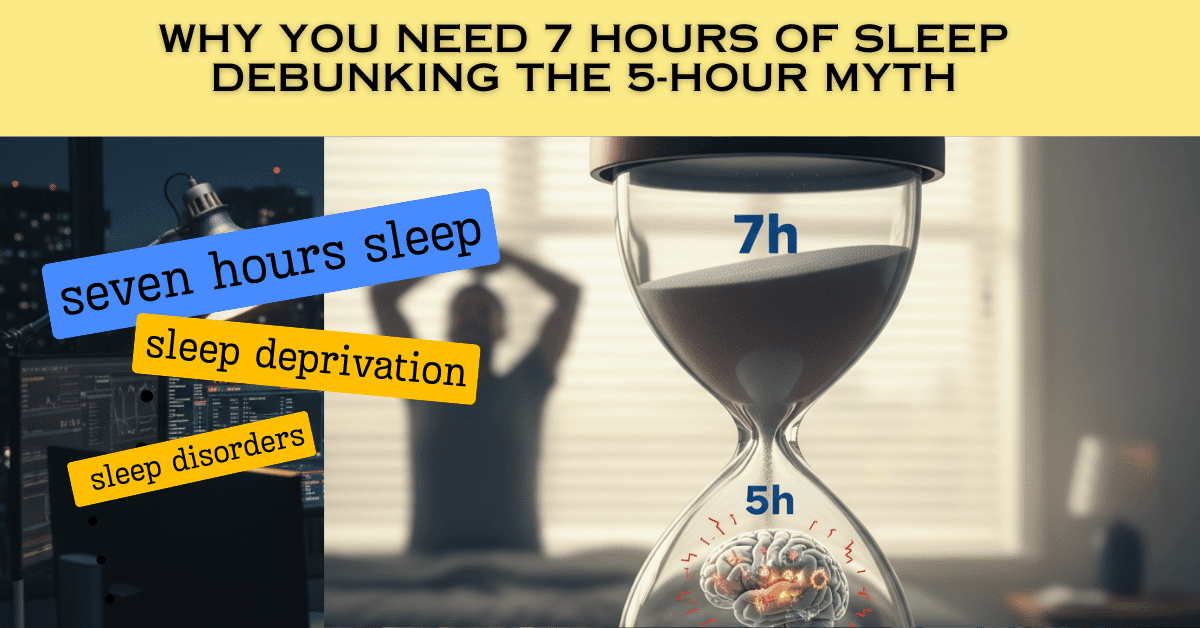
Table of Contents
The Problem: We’re All Sleep-Deprived and Pretending We’re Fine
Let me paint you a picture. It’s 11 PM, and you’re still scrolling through your phone, telling yourself you’ll “just finish this one thing.” Before you know it, it’s midnight. Your alarm is set for 5 AM because you’ve convinced yourself that successful people wake up early. That’s only five hours, but you’ll be fine, right?
Wrong.
Here’s what’s really happening: About 35% of adults in the United States report getting less than seven hours of sleep per night, according to the Centers for Disease Control and Prevention (CDC). That’s more than one in three people walking around in a state of chronic sleep deprivation, thinking they’re crushing it at life.
The problem goes deeper than just feeling tired. We’ve somehow romanticized exhaustion. We glorify the hustle culture that says “sleep when you’re dead” and celebrate CEOs who claim they only need four hours. Social media is full of 5 AM morning routines and productivity hacks that completely ignore one fundamental fact: your body needs sleep to function.
The Hidden Costs Nobody Talks About
When you consistently sleep less than seven hours, you’re not just tired. You’re actively damaging your body and brain in ways you probably don’t even realize. Your reaction time slows down to the point where it’s comparable to being legally drunk. Your immune system starts failing. Your risk of serious diseases skyrockets. And perhaps worst of all, you lose the ability to accurately judge how impaired you actually are.
Think about that last part for a second. You can’t even tell how badly you’re performing because sleep deprivation messes with your self-awareness. It’s like being drunk and thinking you’re totally fine to drive. Scary, right?
The Agitation: What Those Missing Hours Are Actually Costing You
Okay, so you’re probably thinking, “Sure, I’m a bit tired, but I get things done. I manage.” Let me tell you why that’s a problem. Because you’re not just “a bit tired” and you’re not managing nearly as well as you think you are.
Your Brain Is Literally Shrinking
No, I’m not being dramatic. Research from the University of Oxford found that people who regularly sleep less than six hours per night show accelerated brain atrophy. Your brain is actually getting smaller. The parts responsible for decision-making, emotional regulation, and memory are deteriorating faster than they should.
Let that sink in. Every night you choose Netflix over sleep, you’re choosing to make your brain worse at doing literally everything.
The Cognitive Decline Is Real and Immediate
Here’s what happens to your brain on five hours of sleep:
- Your attention span drops by up to 50%
- Your ability to form new memories decreases significantly
- Your problem-solving skills become about as useful as a chocolate teapot
- Your emotional regulation goes out the window (hello, random irritability and mood swings)
One study from the University of Pennsylvania found that people who slept six hours per night for two weeks showed cognitive impairment equivalent to staying awake for 48 hours straight. And most of these people reported feeling “only slightly sleepy.” They had no idea how badly they were performing.
Your Body Starts Breaking Down
The physical consequences are just as bad, if not worse:
| Health Impact | Risk Increase with <6 Hours Sleep |
|---|---|
| Heart Disease | 48% higher risk |
| Stroke | 15% higher risk |
| Obesity | 55% higher risk in adults |
| Type 2 Diabetes | 28% higher risk |
| Early Death | 12% higher risk |
These aren’t small numbers. We’re talking about nearly doubling your risk of heart disease just because you’re not sleeping enough. That’s huge.
The Productivity Paradox
Here’s the ironic part that really gets me. People sleep less to get more done, but sleep deprivation actually makes you less productive. Studies show that after 17-19 hours of wakefulness, your cognitive performance is equivalent to having a blood alcohol level of 0.05%.
You know what else? Sleep-deprived workers cost the US economy about $411 billion annually in lost productivity. That’s with a B. Billion.
So all those extra hours you’re working while exhausted? You’re probably producing worse quality work in more time than if you’d just gotten proper sleep and worked efficiently.
The Immune System Collapse
Your immune system rebuilds itself during sleep. When you don’t get enough, you’re leaving your body defenseless. Research shows that people who sleep less than seven hours are three times more likely to develop a cold when exposed to the virus compared to those who sleep eight hours or more.
During the COVID-19 pandemic, studies found that adequate sleep was crucial for vaccine effectiveness. People who slept less than six hours had a significantly reduced antibody response to vaccinations. Your body literally can’t fight off infections properly without sleep.
The Solution: Why Seven Hours Is Your Non-Negotiable Baseline
Alright, enough doom and gloom. Let’s talk about why seven hours is the magic number and what happens when you actually give your body what it needs.
The Science Behind Seven
The National Sleep Foundation, after a comprehensive review of scientific literature, recommends 7-9 hours of sleep for adults aged 18-64. But why not five? Why not six?
Because sleep isn’t just “rest time.” It’s when your body does critical maintenance work that can’t happen when you’re awake.
What Actually Happens During Those Seven Hours
Stage 1-2 (Light Sleep): Your body temperature drops, your heart rate slows, and your brain starts organizing information from the day. This is prep work.
Stage 3 (Deep Sleep): This is where the magic happens. Your body:
- Repairs and builds muscle tissue
- Strengthens the immune system
- Consolidates memories
- Releases growth hormones
- Clears out metabolic waste from your brain (yes, your brain literally takes out the trash)
REM Sleep: Your brain processes emotions, consolidates learning, and basically defragments like an old computer. This is when you dream vividly.
Here’s the thing: you need to cycle through all these stages multiple times per night to get the full benefits. A full sleep cycle takes about 90 minutes, and you need 4-6 complete cycles. Do the math: that’s 6-9 hours, with seven being the sweet spot for most people.
What Changes When You Hit That Seven-Hour Mark
I’m going to be real with you. When I finally committed to getting seven hours consistently (and trust me, it took a while), the changes were almost suspicious at first. I kept thinking, “Is this real, or am I just having a good week?”
But nope, it’s real. Here’s what the research shows happens:
Cognitive Performance: Your reaction time improves by up to 25%. Your ability to focus and sustain attention increases dramatically. Decision-making becomes sharper, and you can actually remember where you put your keys.
Physical Health: Within just one week of adequate sleep, insulin sensitivity improves, inflammation markers decrease, and blood pressure normalizes. Your body starts healing itself.
Mental Health: This one’s big. People who sleep 7-8 hours per night are 27% less likely to experience depression compared to those sleeping less than six hours. Your emotional resilience improves, anxiety decreases, and you stop snapping at people over minor inconveniences.
Weight Management: Adequate sleep regulates the hormones leptin and ghrelin, which control hunger and fullness. When you’re sleep-deprived, ghrelin (the hunger hormone) spikes and leptin (the fullness hormone) drops. This is why you crave junk food when you’re tired. Get seven hours, and those cravings naturally decrease.
The Real-World Impact: Numbers That Matter
Let’s talk about what this looks like in practical terms:
| Benefit | 5 Hours Sleep | 7+ Hours Sleep |
|---|---|---|
| Immune Function | 29% antibody response | 100% antibody response |
| Attention Span | 40-50% of baseline | 95-100% of baseline |
| Memory Consolidation | Reduced by 40% | Optimal |
| Hunger Hormone (Ghrelin) | 15% increase | Normal levels |
| Appetite Suppression (Leptin) | 15% decrease | Normal levels |
| Risk of Work Errors | 70% increase | Baseline |
These aren’t marginal differences. We’re talking about functioning at half capacity versus full capacity.
But What About the “Short Sleeper” Gene?
Okay, I know what you’re thinking. “But I heard some people have a gene that lets them sleep less!”
Yes, the DEC2 gene mutation exists. You know how many people have it? Less than 1% of the population. That’s about 3 in every 1,000 people.
So statistically, you almost certainly don’t have it. And even if you think you do, you probably don’t. The people who actually have this gene don’t feel tired on less sleep and show no cognitive or health impairments. If you ever feel tired, foggy, or need caffeine to function, you don’t have this gene.
How to Actually Get Your Seven Hours
I’m not going to give you some magical sleep routine that requires seventeen steps and buying expensive supplements. Let’s keep this practical.
Start with your wake-up time and work backward. If you need to wake up at 6 AM, you need to be asleep (not in bed, actually asleep) by 11 PM. That means lights out at 10:30 PM, giving yourself 30 minutes to fall asleep.
Make your bedroom actually conducive to sleep:
- Keep it cool (60-67°F is optimal)
- Make it dark (blackout curtains or a sleep mask)
- Keep it quiet (earplugs or white noise)
- Reserve your bed for sleep and intimacy only (no working from bed)
Create a wind-down routine that starts 1-2 hours before bed:
- Dim the lights in your house
- Put your phone on do-not-disturb (or better yet, charge it in another room)
- Do something relaxing that doesn’t involve screens
- Maybe take a warm shower (the temperature drop afterward signals sleep time)
Watch your caffeine and alcohol:
- No caffeine after 2 PM (it stays in your system for 6-8 hours)
- Alcohol might make you drowsy, but it ruins your sleep quality
- Don’t eat heavy meals within 3 hours of bedtime
Be consistent. This is probably the most important one. Go to bed and wake up at the same time every day, including weekends. I know, weekends are sacred, but your circadian rhythm doesn’t care about your social calendar.
What About Sleep Debt?
Quick myth-bust: you can’t really “catch up” on sleep debt by sleeping in on weekends. I mean, it helps a little, but it’s like trying to water a dying plant once a week instead of regularly. The damage from chronic sleep deprivation is cumulative.
That said, when you start getting seven hours consistently, you’ll probably need 8-9 hours for the first week or two as your body recovers. That’s normal. Let it happen.
Key Takeaways
Let me break down the essentials because I know that was a lot:
- Seven hours is the minimum, not the goal. Most adults need 7-9 hours for optimal functioning.
- You can’t train yourself to need less sleep. Your body adapts to feeling like garbage, but that doesn’t mean you’re actually functioning well.
- Sleep deprivation impairs you as much as alcohol. Staying awake for 17-19 hours affects you like being legally drunk.
- The health risks are serious and long-term. We’re talking about significantly higher risks of heart disease, diabetes, obesity, and cognitive decline.
- Productivity actually increases with adequate sleep. That extra hour of work you’re doing while exhausted is probably producing worse results than 30 minutes of focused work after proper sleep.
- Your brain literally cleans itself during sleep. Miss out on sleep, and toxic proteins build up, potentially contributing to Alzheimer’s and other neurodegenerative diseases.
“Sleep is the single most effective thing we can do to reset our brain and body health each day.” – Dr. Matthew Walker, sleep scientist and author of “Why We Sleep”
FAQ: Your Burning Sleep Questions Answered
Can I really not function well on 5-6 hours of sleep?
No, you really can’t. While you might feel like you’re managing, objective measurements show significant cognitive and physical impairments. The problem is that chronic sleep deprivation impairs your ability to judge your own impairment. You literally don’t know how badly you’re performing.
What if I feel fine on less sleep?
You probably don’t feel as fine as you think. Studies show that people who regularly sleep less than six hours report feeling “only slightly sleepy” while performing at levels equivalent to being awake for 48 hours straight. Your baseline for “fine” has shifted downward.
How long does it take to recover from chronic sleep deprivation?
It varies by individual and how long you’ve been sleep-deprived, but most people start feeling significantly better within 1-2 weeks of consistent 7-9 hour sleep. Full cognitive recovery can take several weeks to a few months. The key is consistency.
What about naps? Can they make up for lost nighttime sleep?
Naps can help temporarily, but they can’t replace proper nighttime sleep. Your body needs those consecutive hours to go through multiple complete sleep cycles. That said, a 20-30 minute power nap can help with alertness if you’re in a pinch. Just don’t let it become your primary sleep strategy.
I have insomnia. What should I do?
If you’re consistently unable to fall asleep or stay asleep despite giving yourself adequate time in bed, talk to a doctor. Cognitive behavioral therapy for insomnia (CBT-I) is highly effective and doesn’t involve medication. Don’t just accept chronic insomnia as your fate.
Does sleep quality matter as much as sleep quantity?
Both matter. You can spend eight hours in bed but only get five hours of actual quality sleep due to interruptions, sleep apnea, or other issues. If you’re sleeping 7-8 hours but still feel exhausted, you might have a sleep disorder that needs medical attention.
What’s the deal with blue light from screens?
Blue light suppresses melatonin production, making it harder to fall asleep. It’s not the only factor, but it matters. Use blue light filters after sunset, or better yet, put screens away 1-2 hours before bed. I know this one’s tough, but it really does make a difference.
Can I train myself to be a “short sleeper”?
Unless you have the rare DEC2 gene mutation (which you almost certainly don’t), no. You can train yourself to feel less terrible on insufficient sleep, but that doesn’t mean your body and brain aren’t suffering the consequences. It’s like training yourself to ignore a fire alarm – the fire is still burning.
Conclusion: Stop Treating Sleep Like It’s Optional
Look, I get it. We live in a world that celebrates busyness and treats sleep like a luxury or a sign of weakness. There are always more emails to answer, more episodes to watch, more work to do. The pressure to sacrifice sleep is real.
But here’s what I want you to understand: sleep isn’t negotiable. It’s not something you can hack or optimize away. It’s as essential as food and water, and treating it like anything less is setting yourself up for serious health problems down the road.
Those successful people bragging about their four-hour sleep schedules? Either they’re lying, they’re suffering consequences they’re not telling you about, or they’re the rare genetic exception that you almost certainly aren’t.
The truth is less sexy but more powerful: getting adequate sleep is one of the single most important things you can do for your health, productivity, and quality of life.
Seven hours isn’t asking too much. It’s asking for the bare minimum your body needs to function properly. And honestly, most of us need closer to eight.
So tonight, instead of scrolling through social media for another hour or answering just one more email, try something radical: go to bed. Set yourself up for seven solid hours. See how you feel in a week. I’m betting you’ll be surprised by how much better you function when you’re actually giving your body what it needs.
Your future self – with a healthier heart, sharper mind, and better mood – will thank you for it.
Now, if you’ll excuse me, I need to take my own advice and get some sleep. It’s been real.
Sweet dreams.