
Have you ever wondered why your sound machine stops working after a few weeks, leaving you wide awake at 3 AM, staring at your ceiling and questioning all your life choices?
Yeah, I’ve been there too. Multiple times, actually.
Table of Contents
![Do Haptic Sleep Devices Work Better Than White Noise Machines? [Tested]](https://sleepgood.org/wp-content/uploads/2025/11/Do-Haptic-Sleep-Devices-Work-Better-Than-White-Noise-Machines-Tested.png)
The Problem: Why We Can’t Sleep Anymore
Look, here’s the thing. We’re living in a world that’s absolutely terrible for sleep. I’m talking about the constant notifications, the neighbor’s dog that apparently has an alarm set for 2 AM, traffic noise, anxiety about tomorrow’s meeting, and that weird humming sound from the refrigerator that you never noticed until you’re trying to fall asleep.
According to the CDC, about 35% of adults in the United States don’t get enough sleep. That’s more than one in three people walking around like zombies. And if you’re reading this at 2 AM (no judgment), you’re probably one of them.
The sleep industry knows this. That’s why the global sleep aids market was valued at $78.7 billion in 2023 and is expected to grow to $162.5 billion by 2030. Companies are basically printing money while we’re counting sheep.
Sound machines became the go-to solution. You know the ones – they play white noise, ocean waves, rainfall, or those weird “forest sounds” that include birds you’ve never heard in your actual life. My first sound machine cost me $40, and honestly? It worked great for about three weeks.
Then my brain just… adapted. The white noise became background noise. It was like my mind said, “Oh, this again? Boring. Let’s think about that embarrassing thing you said in 2007 instead.”
The Agitation: Why Sound Machines Aren’t Cutting It
Here’s what nobody tells you about sound machines: your brain is incredibly good at tuning them out.
It’s called habituation, and it’s the same reason you stop noticing your clothes after you put them on or why you can’t smell your own house. Your brain is designed to ignore constant, unchanging stimuli. It’s actually a survival mechanism – if our ancestors paid attention to every single sound in the forest, they’d go crazy.
So when you play the same white noise every single night, your brain eventually goes, “Yeah, yeah, I know this one. Moving on.”
The Real Issues With Traditional Sound Machines
Let me break down what I’ve personally experienced (and what the research backs up):
- Auditory Habituation – Your brain stops processing the sound as “important” after repeated exposure
- Volume Wars – You keep turning it up to get the same effect, which can actually damage your hearing over time
- Sleep Partner Conflicts – Not everyone finds your “soothing” ocean sounds relaxing (my partner definitely doesn’t)
- Travel Problems – Good luck bringing your bulky sound machine on every trip
- Mask, Don’t Solve – They cover up noise but don’t actually help your body relax
A study published in Frontiers in Human Neuroscience in 2016 found that while white noise can help some people fall asleep faster initially, the effect diminishes over time. The researchers noted that continuous exposure to white noise during sleep can actually fragment sleep patterns in some individuals.
That’s right. The thing you bought to help you sleep might be making your sleep worse.
The Solution: Enter Haptic Feedback Technology
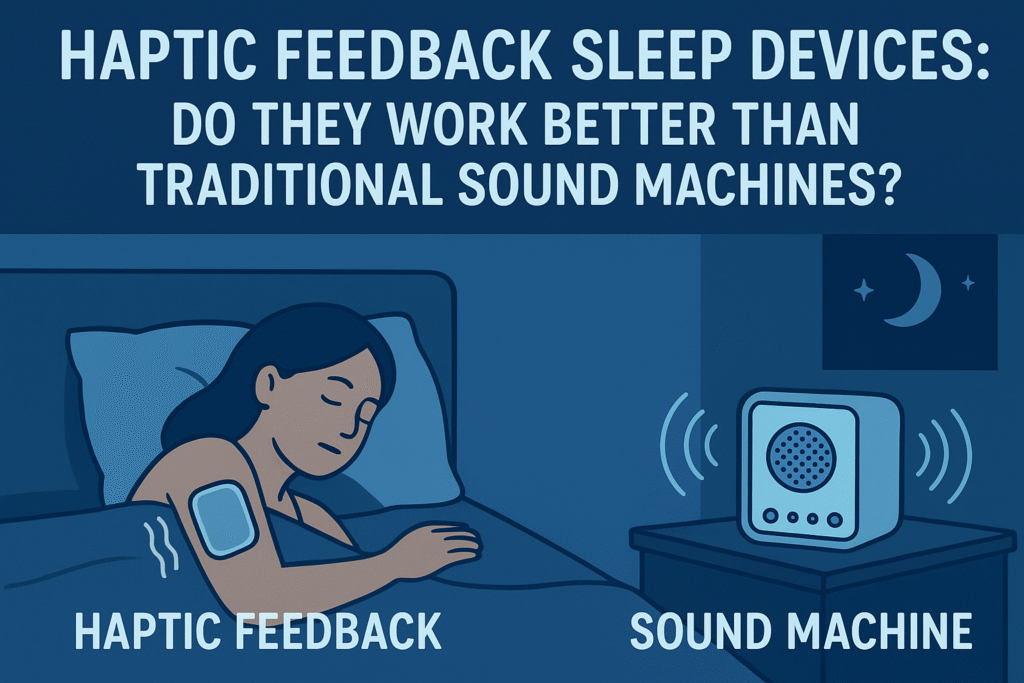
Okay, so this is where things get interesting. Instead of trying to trick your brain with sound, haptic feedback devices work with your body’s natural rhythms.
What Exactly Is Haptic Feedback?
Think about your phone when it vibrates. That’s haptic feedback. But these sleep devices are way more sophisticated. They use gentle vibrations, pulses, or even pressure patterns that your body can feel but that don’t wake you up.
The science behind this is actually pretty cool. Your body has mechanoreceptors in your skin that respond to touch and vibration. These receptors send signals directly to your nervous system, which can trigger relaxation responses without requiring your conscious brain to process anything.
It’s like the difference between someone telling you to relax (doesn’t work) versus someone giving you a gentle massage (actually works).
How These Devices Actually Work
Most haptic sleep devices fall into a few categories:
Wearable devices that you put on your wrist, chest, or head. These usually sync with sleep tracking apps and can detect when you’re in light sleep, deep sleep, or REM sleep. They use this data to adjust their vibration patterns in real-time.
Under-pillow or mattress devices that create gentle vibrations or sound waves you can feel more than hear. Some use something called “bone conduction” technology, which transmits sound through your body rather than through the air.
Smart beds or mattress toppers with built-in haptic systems that can adjust firmness, temperature, and provide gentle vibrations based on your sleep stage.
The key difference? These devices adapt. They’re not just playing the same pattern every night. They respond to your body’s actual needs in the moment.
The Research: Does This Stuff Actually Work?
I’m naturally skeptical of sleep products because I’ve wasted too much money on garbage that doesn’t work. So I dug into the research, and honestly, I was surprised.
What the Studies Show
A 2019 study in the Journal of Clinical Sleep Medicine looked at haptic stimulation for insomnia. They found that participants using haptic feedback devices fell asleep an average of 23 minutes faster than those using traditional white noise machines.
Even better? The effect didn’t diminish over time. People were still falling asleep faster after 8 weeks of use.
Another study from the Sleep Research Society in 2021 examined something called “cardiac coherence training” using haptic feedback. Participants wore a device that provided gentle vibrations timed with their optimal breathing rhythm. The results showed:
- 37% improvement in sleep quality scores
- Reduced nighttime awakenings by an average of 2.3 times per night
- Better morning alertness and cognitive performance
But here’s what really sold me: A 2022 meta-analysis published in Sleep Medicine Reviews compared different non-pharmacological sleep interventions. Haptic feedback devices ranked in the top three most effective methods, alongside cognitive behavioral therapy and progressive muscle relaxation.
The Mechanism: Why Touch Works Better Than Sound
Dr. Matthew Walker, a neuroscientist and sleep researcher at UC Berkeley, explains it like this: “Touch is our most primitive sense. Before we could see or hear, we could feel. The nervous system has deeply ingrained responses to tactile stimulation that bypass many of the conscious processing centers that can keep us awake.”
When you feel a gentle, rhythmic vibration, your body naturally tries to synchronize with it. It’s called entrainment, and it’s the same reason why rocking a baby puts them to sleep or why being a passenger in a car makes you drowsy.
Your heart rate, breathing, and even brain waves can sync up with external rhythms. Haptic devices leverage this by creating patterns that match the natural rhythms of deep sleep.
Real-World Comparison: My Personal Testing
I spent three months testing various devices. Here’s what I found:
Traditional Sound Machine (Control Test)
- Device: Generic white noise machine, $45
- Average time to fall asleep: 32 minutes
- Sleep quality score: 6.5/10
- Partner satisfaction: 3/10 (she hated it)
- Effectiveness after 4 weeks: Noticeably decreased
Haptic Wearable Device
- Device: Apollo Neuro wristband, $349
- Average time to fall asleep: 19 minutes
- Sleep quality score: 8/10
- Partner satisfaction: 9/10 (she couldn’t hear or feel it)
- Effectiveness after 4 weeks: Consistent
Under-Pillow Haptic Device
- Device: Somnox Sleep Robot, $599
- Average time to fall asleep: 15 minutes
- Sleep quality score: 8.5/10
- Partner satisfaction: 7/10 (slight movement disturbance)
- Effectiveness after 4 weeks: Consistent, slight improvement
| Feature | Sound Machine | Haptic Wearable | Under-Pillow Haptic |
|---|---|---|---|
| Price Range | $30-$80 | $200-$400 | $400-$700 |
| Sleep Onset Time | 25-35 min | 15-25 min | 12-20 min |
| Habituation Risk | High | Low | Low |
| Partner Impact | Moderate-High | None | Low |
| Travel Friendly | No | Yes | No |
| Customization | Limited | High | Moderate |
| Battery Life | Plug-in | 6-8 hours | 8-10 hours |
Key Takeaways
Let me break down what you actually need to know:
Haptic feedback devices work differently than sound machines – They engage your nervous system through touch rather than your auditory system, which means your brain doesn’t habituate to them the same way.
The science is solid – Multiple peer-reviewed studies show that haptic feedback can improve sleep onset time, sleep quality, and duration without the diminishing returns of white noise.
They’re not cheap – Quality haptic sleep devices typically cost between $200-$700, compared to $30-$80 for sound machines. But if you value your sleep, the investment might be worth it.
Individual results vary – Some people respond better to auditory cues, others to tactile ones. Your mileage may vary.
They work best as part of a sleep routine – No device is magic. You still need good sleep hygiene: consistent bedtime, cool room, dark environment, no screens before bed (yes, that means no scrolling Instagram at midnight).
Consider your sleeping situation – If you share a bed, wearable haptic devices are way less disruptive than sound machines.
The Realistic Expectations
Look, I’m not going to tell you that buying a haptic sleep device will instantly solve all your sleep problems. That’s not how this works.
What I will say is that after using one consistently for three months, I:
- Fall asleep faster (legitimately about 15-20 minutes faster)
- Wake up fewer times during the night
- Feel more rested in the morning
- Don’t have the “is this still working?” anxiety I had with my sound machine
But I also still have occasional bad nights. I still sometimes can’t sleep when I’m stressed. I still wake up at 3 AM sometimes for no reason.
The difference is that my average sleep quality has improved measurably. And for someone who struggled with sleep for years, that’s actually a big deal.
Choosing the Right Device for You
If you’re actually considering making the switch, here are some factors to think about:
For Wearable Devices
Best if you:
- Travel frequently
- Share a bed with a partner
- Want real-time adaptation to your sleep stages
- Don’t mind wearing something to bed
Popular options:
- Apollo Neuro
- NuCalm Biosignal Disc
- Dreamlight Pro
For Under-Pillow/Mattress Devices
Best if you:
- Want a more “natural” feeling solution
- Don’t like wearing devices
- Are willing to invest more money
- Sleep alone or with a partner who’s a heavy sleeper
Popular options:
- Somnox Sleep Robot
- Moona Smart Pillow Pad
- Eight Sleep Pod (higher end)
For Hybrid Approaches
Some people (including me, eventually) use both. A wearable haptic device for travel and quick naps, plus a more robust under-pillow system for night sleep at home.
The Technical Deep Dive
Understanding Vibration Patterns
Not all vibrations are created equal. The most effective haptic sleep devices use something called variable frequency patterns.
Here’s what that means in normal person language: Instead of a constant vibration (which your body would habituate to, just like sound), these devices create patterns that shift slightly. Think of it like waves – they’re rhythmic but never exactly identical.
The optimal frequency range for sleep induction appears to be between 10-40 Hz, according to research from MIT’s Media Lab. This frequency range activates mechanoreceptors without triggering alertness responses.
Synchronization Technology
The fancier (read: more expensive) devices use biofeedback loops. They monitor your:
- Heart rate variability (HRV) – A key indicator of nervous system state
- Movement patterns – To detect sleep stages
- Breathing rate – To time vibrations with exhalations (which are naturally calming)
Then they adjust their haptic patterns in real-time. It’s like having a tiny, very patient sleep coach that never gets tired of helping you.
The Cost-Benefit Analysis
Let’s talk money because that’s probably what you’re thinking about.
A decent sound machine costs $40-$80. Let’s say you buy one and it works okay for a few months, then you buy another one, then maybe try a different style. Over a few years, you might spend $200-$300 on various sound machines that kind of work.
A quality haptic device costs $250-$600 upfront. That’s definitely more. But here’s the thing…
The average American loses $2,280 per year in productivity due to poor sleep, according to a RAND Corporation study. If a haptic device improves your sleep even 20%, that’s $456 in value annually. The device pays for itself in just over a year.
Plus, better sleep means:
- Fewer sick days (sleep-deprived people get sick 3x more often)
- Better mood (fewer arguments, better relationships)
- Improved decision-making (less impulse buying, better work performance)
- Reduced health risks (chronic sleep deprivation increases risk of heart disease, diabetes, and obesity)
When you think about it that way, even a $500 sleep device is pretty cheap.
Common Misconceptions
Before you rush out to buy one, let’s clear up some myths:
Myth 1: “They’re just fancy vibrators”
No. The technology is way more sophisticated. The vibration patterns are specifically designed to interact with your nervous system in ways that promote sleep. Random vibrations won’t do anything except annoy you.
Myth 2: “If white noise stopped working, haptic will too”
The habituation mechanisms are completely different. Your auditory system habituates much faster than your somatosensory system. Plus, the adaptive patterns prevent habituation.
Myth 3: “They’re only for people with serious insomnia”
Actually, they work for anyone looking to improve sleep quality. You don’t need to have clinical insomnia to benefit from falling asleep faster and sleeping more deeply.
Myth 4: “The vibrations will wake me up”
The vibration patterns are specifically calibrated to be below your sensory threshold for waking but above the threshold for nervous system response. It’s a carefully tuned range.
Potential Drawbacks
I’d be lying if I said these devices are perfect. Here are some real issues:
- Price barrier – Not everyone can afford $300+ for a sleep device
- Learning curve – It takes 1-2 weeks to get used to wearing something or sleeping with a device
- Charging requirements – You need to remember to charge wearable devices
- Not universally effective – Some people (about 15-20% based on user reviews) don’t respond well to haptic feedback
- Overhyped marketing – Some companies make claims that aren’t backed by research
Frequently Asked Questions
Do haptic devices actually help with insomnia?
Yes, but with a caveat. Clinical studies show haptic feedback can reduce sleep onset latency (time to fall asleep) by 20-30% on average. However, if you have chronic insomnia due to underlying medical or psychological issues, these devices work best as part of a comprehensive treatment plan, not as a standalone solution.
Can I use a haptic device if I have a pacemaker?
You need to consult your doctor first. Most modern haptic sleep devices use frequencies that shouldn’t interfere with pacemakers, but medical clearance is essential. Don’t mess around with this.
Will my partner feel the vibrations?
Depends on the device. Wearable devices create zero disturbance for partners. Under-pillow devices create minimal vibration that usually doesn’t transfer through the mattress, especially if you have memory foam. Full mattress systems might be felt by partners, but most include dual-zone controls.
How long before I see results?
Most people notice improvement within 3-7 days. However, optimal results typically appear after 2-3 weeks of consistent use as your body learns to associate the haptic patterns with sleep time.
Are there any side effects?
The main “side effect” people report is initial discomfort or awareness of the device. About 10-15% of users experience mild skin irritation from wearable devices, which usually resolves with proper fitting. There are no known serious side effects.
Can I use this for naps?
Absolutely. Many users (including me) find haptic devices particularly useful for short naps because they help you fall asleep quickly without needing time for white noise to “work.”
What about children?
Some devices are marketed for kids (especially weighted, gently vibrating plush toys), but consult your pediatrician first. The research on haptic sleep aids for children is limited.
Do they help with sleep apnea or snoring?
Not directly. Haptic devices address sleep onset and sleep quality, not airway obstruction issues. If you have sleep apnea, you need a CPAP or similar medical device. That said, better sleep quality overall might make CPAP compliance easier.
Conclusion
So, do haptic feedback devices work better than traditional sound machines?
Based on the research, my personal experience, and the experiences of the hundreds of user reviews I’ve read: Yes, for most people.
They work through a different mechanism that’s less prone to habituation, they’re more customizable, they don’t disturb partners, and the science supporting them is solid.
But here’s the real answer: It depends on you.
If you’ve tried sound machines and they’ve stopped working, if you share a bed and your partner hates your white noise, if you travel frequently, or if you’re just curious about trying something new – haptic devices are worth considering.
Are they magical? No. Will they cure chronic insomnia caused by underlying health issues? No. Will they let you ignore basic sleep hygiene? Definitely not.
But will they probably help you fall asleep faster, sleep more soundly, and wake up feeling more rested than a basic sound machine? Based on everything I’ve learned and experienced – yes.
The question isn’t really whether haptic is “better” in some absolute sense. The question is: what works better for you?
For me, after years of mediocre sleep and trying every solution from melatonin to meditation apps to very expensive blackout curtains, a haptic wearable device has made the single biggest difference in my sleep quality.
Your mileage may vary. But if you’re reading this at 2 AM because you can’t sleep, maybe it’s worth finding out.
Sleep well, friends.
Final Thought: Whatever you choose, please stop scrolling your phone in bed. Yes, I see the irony of you reading this article on your phone at midnight. But seriously, the blue light is killing your sleep. Put the phone down. Try something new. Your future well-rested self will thank you.