
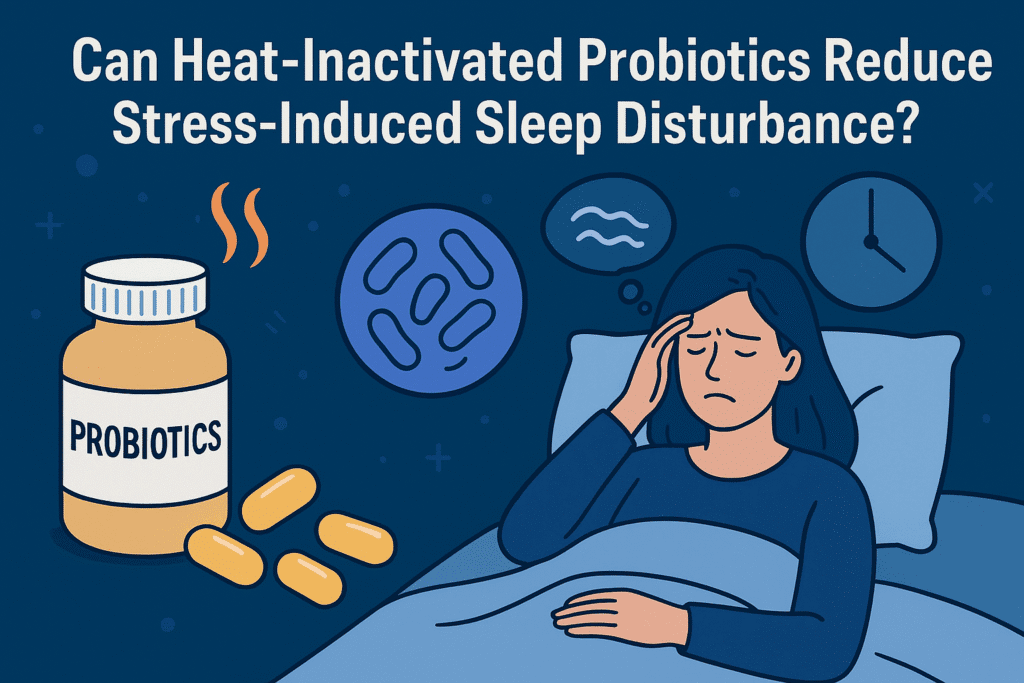
What if I told you that dead bacteria might actually work better than live ones for fixing your stress-ruined sleep?
Yeah, I know. That sounds completely backwards, right? We’ve all been told that probiotics need to be alive to do their job. But here’s where things get interesting. Scientists are now discovering that heat-killed probiotics – technically called paraprobiotics – might be just as effective (and sometimes even better) for dealing with the kind of sleep problems that stress throws at us.
And trust me, if you’ve ever found yourself staring at the ceiling at 3 AM because your brain won’t shut up about tomorrow’s presentation, you’re going to want to hear about this.
Table of Contents
The Problem: When Stress Hijacks Your Sleep (And Your Life)
Let’s be real for a second. How did you sleep last night?

If you’re like most people I know, probably not great. Maybe you tossed and turned for an hour before finally falling asleep. Or you woke up at 4 AM and couldn’t get back to sleep. Or you slept through the night but somehow woke up feeling like you’d been hit by a truck.
Here’s the thing: stress-induced sleep disturbance isn’t just about feeling tired. It’s way more complicated than that.
When you’re stressed, your body goes into this whole cascade of reactions. Your hypothalamic-pituitary-adrenal axis (let’s just call it the HPA axis because that’s a mouthful) kicks into overdrive. Cortisol levels spike. Your sympathetic nervous system stays activated when it should be winding down. And your brain? Well, your brain decides that 2 AM is the perfect time to replay every embarrassing thing you’ve ever said.
The numbers on this are actually kind of shocking. Studies show that a significant portion of adults deal with sleep disturbances related to stress, and it’s not just affecting how we feel – it’s messing with our immune function, our metabolism, our mental health, and even our relationships.
The Real Cost of Bad Sleep
Before we go further, let me paint you a picture of what chronic stress-induced sleep problems actually do to you:
- Your cognitive function drops. Making decisions becomes harder. Remembering things? Forget about it (pun intended).
- Your emotional regulation goes out the window. Little things that wouldn’t normally bother you suddenly feel like huge deals.
- Your physical health takes a hit. We’re talking increased inflammation, higher risk of cardiovascular issues, weight gain, and weakened immune response.
- Your gut health deteriorates. And here’s where things get really interesting – because your gut and your brain are in constant communication.
Agitating the Problem: It’s Worse Than You Think
Now, I hate to make you feel worse, but we need to talk about how this whole stress-sleep-gut thing becomes a vicious cycle.
See, when you don’t sleep well, your stress levels go up. When your stress levels go up, you sleep worse. And while all this is happening, your gut microbiota – those trillions of bacteria living in your intestines – starts getting out of balance.
This dysbiosis (fancy word for “bacterial imbalance”) then feeds back into the cycle. Your gut bacteria produce neurotransmitters and metabolites that affect your brain. When they’re out of whack, they’re producing the wrong stuff at the wrong times. This affects your mood, your stress response, and yes, your sleep quality.
The Medical Student Example
Let me tell you about a study that really drives this home. Researchers looked at medical students going through autopsy courses – talk about stressful situations. These students were experiencing significant sleep disturbances because of the stress.
Think about it: you’re a young person trying to become a doctor, and you’re spending your days around human cadavers, learning complex anatomy, dealing with the emotional weight of mortality, and probably not sleeping much because of studying. Your sleep quality tanks. Your stress hormones are through the roof. You’re exhausted but wired.
This isn’t just about students though. Whether you’re dealing with work stress, family pressures, financial worries, or just the general chaos of modern life, the mechanism is the same. Stress disrupts sleep, and poor sleep makes everything worse.
The Solution: Enter Heat-Inactivated Probiotics
Okay, so here’s where things get exciting.
You’ve probably heard about probiotics before. They’re those “good bacteria” that everyone’s been talking about for years. Yogurt commercials love them. Health food stores dedicate entire aisles to them. Your wellness-obsessed friend won’t shut up about them.
But here’s what’s new: researchers have discovered that you don’t actually need live bacteria to get benefits for your sleep and stress levels. Heat-inactivated probiotics – bacteria that have been specifically killed through heat treatment – can still work.
I know what you’re thinking: “Wait, how does dead bacteria do anything?”
Great question. Let me break it down.
What Are Paraprobiotics, Exactly?
Paraprobiotics is the technical term for these heat-inactivated or killed probiotic bacteria. They’re defined as nonviable microbial cells or crude cell extracts that, when given in adequate amounts, provide benefits to the consumer.
Think of it this way: the bacteria might be dead, but their components are still intact. The cell walls, the proteins, the beneficial compounds they produced – all that stuff is still there and still active. It’s like having a library where the librarian is gone, but all the books are still on the shelves and you can still read them.
Why Heat-Inactivated Might Actually Be Better
Here’s something that blew my mind when I first learned about it: in some cases, heat-inactivated probiotics might actually have advantages over live ones:
- Storage is easier – No need to refrigerate or worry about the bacteria dying during shipping
- Shelf life is longer – They don’t expire as quickly as live cultures
- Safety concerns are eliminated – No risk of infection in people with compromised immune systems
- Dosing is more consistent – You know exactly what you’re getting because nothing’s dying off
- They still work – This is the big one. The research shows they actually improve sleep and reduce stress
The Evidence: What Does Science Actually Say?
Alright, let’s talk data. Because I’m not just making this stuff up.
The Meta-Analysis Results
A recent meta-analysis examined multiple randomized controlled trials involving probiotics and paraprobiotics for sleep disorders. These weren’t small studies either – we’re talking about research involving hundreds of participants across different populations.
The findings? Pretty compelling:
Table 1: Key Research Findings on Paraprobiotics and Sleep
| Study Focus | Probiotic Strain | Duration | Key Results |
|---|---|---|---|
| Medical students under stress | Lactobacillus gasseri CP2305 (heat-inactivated) | 12 weeks | Significant improvement in sleep disorders and stress symptoms |
| Healthy adults with poor sleep | Bifidobacterium longum 1714 | 8 weeks | Improved sleep quality and reduced daytime dysfunction |
| Hybrid workers | B. longum 1714 | 10 weeks | Increased sleep duration, reduced stress and fatigue |
| Adults with impaired sleep | B. longum 1714 | 8 weeks | Better sleep quality, improved social functioning |
The CP2305 Success Story
Let’s zoom in on one particular strain that’s been studied extensively: Lactobacillus gasseri CP2305.
When medical students took a heat-inactivated beverage containing CP2305 daily for 12 weeks, they experienced significant improvements in their sleep disorders. But it wasn’t just about sleep – they also reported better stress management and improved gut function.
What makes this strain special? After taking CP2305 orally, studies found it could colonize the intestinal tract and continue to play a stress-relieving role through certain cellular components even after being inactivated.
That’s wild, right? The bacteria don’t need to be alive to keep working.
The Bifidobacterium longum 1714 Studies
Another strain that’s been getting a lot of attention is Bifidobacterium longum 1714. In a study of male university students, eight weeks of taking B. longum 1714 significantly increased sleep duration during exam stress.
Another trial showed improvement in sleep quality after just four weeks of supplementation, along with a reduction in daytime dysfunction due to sleepiness.
And here’s something I find particularly interesting: the reductions in tiredness and fatigue that participants experienced were linked to B. longum 1714-induced changes in neural activity that correlated with increased energy and vitality.
In other words, this isn’t just about sleeping better – it’s about functioning better while you’re awake too.
Real-World Evidence
In a real-world study of 20 hybrid workers who took B. longum 1714 for 10 weeks, researchers found improvements in both biometric and self-reported measures of sleep.
These weren’t people in a controlled lab environment. They were regular folks dealing with the stress of switching between home and office work, managing their regular lives, and trying to get decent sleep. And it still worked.
How Does This Actually Work?
Okay, so we know heat-inactivated probiotics can help with stress-induced sleep problems. But how?
The Microbiota-Gut-Brain Axis
There’s this incredible communication highway in your body called the microbiota-gut-brain axis. It’s basically a bidirectional superhighway where your gut and your brain are constantly sending messages back and forth.
This communication happens through multiple routes:
- The HPA Axis – This is your body’s main stress response system. When it’s working well, cortisol levels drop as you prepare for sleep. When it’s dysregulated (hello, chronic stress), you stay wired when you should be winding down.
- Microbial Metabolites – Your gut bacteria produce short-chain fatty acids (SCFAs) that can prolong sleep. Studies have shown that butyrate injections in mice extended sleep duration, and SCFA mixtures in humans helped reduce the cortisol response.
- The Immune System – Probiotic supplementation can reduce inflammation and oxidative stress by boosting antioxidant capacity in the brain. Less inflammation means better sleep.
- The Vagus Nerve – This is like the main cable connecting your gut to your brain. It mediates connections between gut microbiota, your brain, and your sleep patterns.
The Specific Mechanisms of Heat-Inactivated Probiotics
So how do dead bacteria work their magic? Here are the key mechanisms:
Components That Stay Active After Heat Treatment:
- Lipoteichoic acid from cell walls – This compound from Gram-positive bacteria has been found to dose-dependently increase NREM sleep in mice.
- Cell wall fragments – These maintain their structure and biological activity even after heat treatment
- Metabolic byproducts – The beneficial compounds these bacteria produced while they were alive
- Structural proteins – These can still interact with your immune system and gut lining
What They Do In Your Body:
- Modulate stress hormones – Animals fed heat-killed lactobacilli showed lower baseline corticosterone levels (the stress hormone) and demonstrated increased sociability.
- Alter gut microbiota composition – The heat-killed probiotics led to subtle but significant changes in the microbiota, with less abundant bacterial taxa being most affected. This creates a healthier bacterial balance.
- Reduce inflammation – By decreasing inflammatory cytokines like TNF-α and IL-6, they help calm your system down.
- Support neurotransmitter production – Some strains help regulate the production of GABA, serotonin, and other sleep-promoting chemicals.
The Stress-Sleep Connection
Here’s what’s happening when you take heat-inactivated probiotics during stressful periods:
First, they help stabilize your gut microbiota. When you’re stressed, your gut bacteria get thrown off balance. The paraprobiotics help restore that balance.
Second, they reduce inflammatory signaling. Stress causes inflammation, which disrupts sleep. By calming inflammation, sleep improves.
Third, they help normalize your HPA axis activity. Remember that stress response system we talked about? Heat-inactivated probiotics help keep it from going haywire.
Fourth, they support the production of sleep-promoting compounds in your gut. Your microbiota produces various metabolites that influence sleep, and paraprobiotics help maintain healthy production.
Who Can Benefit Most?
Based on the research, heat-inactivated probiotics seem particularly helpful for:
Students Under Academic Stress
Multiple studies have focused on students because they’re a perfect population for studying stress-induced sleep problems. Finals week, anyone? Medical school rotations? Dissertation deadlines?
Major benefits on sleep were observed among university students exposed to stressful conditions like academic examinations or challenging courses.
Workers Dealing With Job Stress
Whether you’re switching between home and office work, dealing with demanding deadlines, or just managing the everyday stress of modern work life, paraprobiotics might help.
The hybrid worker study showed real improvements in people dealing with normal work-life balance challenges.
People With Stress-Related Sleep Issues
If your sleep problems are directly tied to stress (as opposed to sleep apnea or other medical conditions), heat-inactivated probiotics could be particularly beneficial.
Healthy Adults Looking to Optimize Sleep
You don’t need to have diagnosed sleep disorders to benefit. Research has looked at whether microbial manipulation within the gut could be a reasonable target for sleep quality in healthy populations without clinically diagnosed sleep abnormalities.
Practical Considerations
Dosing and Duration
Based on the research:
- Most studies used daily supplementation
- Benefits often appeared within 4 weeks
- Full effects typically seen at 8-12 weeks
- Colony-forming units (CFU) varied by strain, typically ranging from 1 billion to 10 billion CFU daily
What to Look For
If you’re considering trying heat-inactivated probiotics for sleep, here’s what matters:
- Specific strain identification – Not all probiotics are the same. Look for products that specify the exact strain (like CP2305 or 1714)
- Research backing – Choose strains that have actual studies supporting their use for sleep and stress
- Quality manufacturing – Heat inactivation needs to be done properly to maintain beneficial components
- Transparent labeling – The product should clearly state it contains heat-inactivated or “para” probiotics
Realistic Expectations
Let me be straight with you: paraprobiotics aren’t magic pills. They’re not going to completely eliminate stress or turn you into a perfect sleeper overnight.
What they can do is:
- Help stabilize your sleep patterns during stressful periods
- Reduce the severity of stress-induced sleep disturbances
- Improve how you feel during the day (less fatigue, better mood)
- Support overall stress management
You still need to do the other stuff: manage your stress where possible, maintain good sleep hygiene, exercise, eat well. Think of paraprobiotics as one tool in your toolkit, not the whole toolbox.
Safety and Side Effects
One of the big advantages of heat-inactivated probiotics is their safety profile.
Benefits over live probiotics:
- No risk of infection (especially important for immunocompromised individuals)
- No concerns about antibiotic resistance transfer
- More stable, less likely to cause digestive upset during initial use
What the research shows:
- Prolonged consumption had no adverse effects on general health or body measurements in animal studies.
- Human trials have reported minimal side effects
- Generally well-tolerated even with long-term use
That said, always talk to your healthcare provider before starting any new supplement, especially if you have existing health conditions or take medications.
The Bigger Picture
Why This Matters Beyond Sleep
The research on heat-inactivated probiotics and sleep is part of a bigger shift in how we understand health.
We’re moving away from the idea that the brain is this isolated organ and recognizing that it’s intimately connected to the rest of your body – especially your gut. The microbiota-gut-brain axis isn’t just some abstract concept; it’s a real, physical system that affects everything from your mood to your sleep to your immune function.
Understanding that dead bacteria can still confer benefits challenges our assumptions about how probiotics work. It’s not just about colonizing your gut with live bacteria – it’s about the signaling molecules, the cell components, and the way these elements interact with your existing microbiota and immune system.
Current Research Limitations
Let me be transparent about what we don’t know yet:
- Most studies are relatively short-term (8-12 weeks). We need more data on long-term use.
- Sample sizes in some studies are modest. Larger trials would strengthen the evidence.
- Different subjective sleep measures show varying results, and objective measures sometimes don’t match subjective improvements.
- We need more research on which specific strains work best for different types of sleep problems.
- The exact mechanisms are still being worked out.
Future Directions
The field is evolving rapidly. Researchers are now looking at:
- Personalized approaches based on individual microbiota profiles
- Combination therapies pairing specific probiotic strains
- Synbiotics (probiotics plus prebiotics) for enhanced effects
- Postbiotics (the metabolites and compounds produced by probiotics)
Key Takeaways
Let me break down the most important points:
✓ Heat-inactivated probiotics (paraprobiotics) can genuinely help with stress-induced sleep problems, backed by multiple clinical trials and meta-analyses.
✓ You don’t need live bacteria to get benefits – the cellular components and metabolites remain active and beneficial even after heat treatment.
✓ Specific strains matter – Lactobacillus gasseri CP2305 and Bifidobacterium longum 1714 have the strongest evidence for sleep and stress benefits.
✓ The gut-brain axis is real – your gut bacteria directly influence your sleep, stress response, and overall mental health through multiple pathways.
✓ Effects take time – expect to wait 4-8 weeks to see significant improvements, though some benefits may appear sooner.
✓ Stress amplification works – these probiotics seem particularly effective when you’re under increased stress, making them useful for students, workers, and anyone dealing with life pressures.
✓ Safety profile is excellent – heat-inactivated probiotics have fewer risks than live probiotics and are generally very well tolerated.
✓ Not a standalone solution – best results come when combined with other healthy sleep and stress management practices.
Frequently Asked Questions
Q: Are heat-inactivated probiotics as effective as live probiotics for sleep?
A: For sleep and stress specifically, research suggests they’re comparably effective and may even have some advantages. A meta-analysis found that when sleep was assessed using the Pittsburgh Sleep Quality Index, both probiotics and heat-killed bacteria showed efficacy in improving perceived sleep health. The key is choosing strains that have been studied for these specific benefits.
Q: How long do I need to take them before seeing results?
A: Most people start noticing improvements within 4 weeks, with full benefits typically appearing around 8-12 weeks. However, everyone’s different. Some people report feeling better within 2 weeks, while others take longer. Consistency is key – daily supplementation works better than sporadic use.
Q: Can I take these with other supplements or medications?
A: Heat-inactivated probiotics are generally safe to combine with other supplements and most medications. However, you should always consult your healthcare provider, especially if you’re taking immunosuppressants, have a serious health condition, or are pregnant or breastfeeding.
Q: Do they work for all types of sleep problems?
A: They seem most effective for stress-related sleep disturbances – trouble falling asleep due to racing thoughts, waking up due to stress, or poor sleep quality during stressful periods. They’re less likely to help with sleep problems caused by sleep apnea, restless leg syndrome, or other medical conditions that need specific treatment.
Q: How do I know if my sleep problems are stress-related?
A: Common signs include: difficulty falling asleep when you have a lot on your mind, sleep problems that worsen during stressful periods, waking up with your mind already racing about daily concerns, and sleeping poorly before important events. If you’re unsure, talk to a healthcare provider.
Q: Are there any side effects?
A: Side effects are rare and typically mild. Some people report minor digestive changes when first starting, but these usually resolve quickly. The heat-inactivated nature means there’s no risk of infection, which is a concern with some live probiotics in vulnerable populations.
Q: What’s the difference between probiotics, paraprobiotics, and postbiotics?
A: Probiotics are live beneficial bacteria. Paraprobiotics (also called heat-inactivated or killed probiotics) are dead bacterial cells that still have beneficial effects. Postbiotics are the metabolites and compounds produced by probiotics. All three can have health benefits, but they work through different mechanisms.
Q: Can I just eat yogurt or fermented foods instead?
A: Fermented foods are great for general gut health, but they typically don’t contain the specific heat-inactivated strains studied for sleep benefits. Plus, the dosing isn’t standardized. If you’re specifically targeting stress-induced sleep problems, a supplement with researched strains is more reliable.
Q: Will this replace my sleep medication?
A: Absolutely not – don’t stop taking prescribed medications without consulting your doctor. Heat-inactivated probiotics can potentially complement other treatments, but they’re not a replacement for medical care. If you’re on sleep medications, talk to your healthcare provider about whether adding paraprobiotics makes sense for you.
Q: Do I need to refrigerate heat-inactivated probiotics?
A: One of the advantages of heat-inactivated probiotics is that they typically don’t require refrigeration, unlike many live probiotic supplements. However, always follow the storage instructions on your specific product.
Conclusion
So, can heat-inactivated probiotics reduce stress-induced sleep disturbance?
The evidence says yes – but with important caveats.
This isn’t about finding a magic bullet that erases stress and gives you perfect sleep forever. What we’re talking about is a science-backed tool that can help your body better manage the sleep disruptions that stress causes.
The research is compelling: from medical students dealing with the stress of autopsy courses to hybrid workers juggling home and office life, people supplementing with specific strains of heat-inactivated probiotics are sleeping better, feeling less stressed, and functioning better during the day.
What makes this particularly exciting is that we’re learning the bacteria don’t need to be alive to work. The cellular components, the metabolites, the way these elements interact with our gut microbiota and influence the gut-brain axis – it all still functions even after heat treatment. This opens up possibilities for safer, more stable products that maintain effectiveness.
But here’s what I want you to remember: your gut health matters for your brain health. The trillions of bacteria in your intestines aren’t just sitting there digesting food – they’re actively communicating with your brain, influencing your stress response, and affecting your sleep quality.
When you’re dealing with stress-induced sleep problems, addressing your gut microbiota through tools like paraprobiotics can be one piece of a larger strategy. Combined with good sleep hygiene, stress management techniques, regular exercise, and proper nutrition, heat-inactivated probiotics can help tip the scales toward better sleep.
The science is still evolving. We’ll learn more about which strains work best for different people, what the optimal dosing strategies are, and how to personalize these interventions. But right now, today, the evidence suggests that for many people struggling with stress-related sleep issues, heat-inactivated probiotics are worth considering.
Your sleep matters. Your stress levels matter. And your gut – even the bacteria that aren’t technically alive anymore – might just be a key player in helping you manage both.
Sweet dreams, and happy gut health.
Note: This article is for informational purposes only and does not constitute medical advice. Always consult with a qualified healthcare provider before starting any new supplement regimen, especially if you have existing health conditions or take medications.