If you thought your expensive memory foam mattress was the only hero in your quest for perfect sleep, I’m sorry to break the news: you’ve been overlooking the real villain. And that villain is probably shining directly above you right now, actively undermining your health.
The Great Sleep Heist: How Your Light Bulbs Are Stealing Your Rest (Blue vs. Amber Showdown)
Let’s cut the corporate fluff. You don’t need another jargon-filled lecture about “wellness synergy” or “holistic optimization.” You need sleep. Period. And if you’re waking up feeling groggy, anxious, or just plain miserable, it’s highly probable that your bedroom lighting is actively sabotaging your body’s natural chemistry. It’s time we talk about the stark difference between blue light and amber light, and why choosing the wrong one for your evening routine is the biological equivalent of drinking espresso before a meditation session.
Why Does Your Bedroom Lighting Feel Like a Corporate Breakroom After Sundown?
We spend thousands curating the perfect bedroom—blackout curtains, sound machines, cooling sheets—yet we treat the single most important sensory input, light, like a disposable plastic spoon. We grab whatever cheap LED pack is on sale at the big box store and blithely assume “soft white” means “good for sleep.” This staggering negligence is crushing your circadian rhythm, and frankly, as an industry veteran, it makes me agitated.
Your body operates on a rigid 24-hour master clock. This clock, known as the circadian rhythm, is primarily and powerfully calibrated by light exposure. Specifically, the melanopsin receptors in your eyes are exquisitely sensitive to a narrow band of the visible spectrum. Guess which color dominates that band? That’s right: blue.
Blue Light: The Energy Drink of the Spectrum
Blue light (typically light sources with a Correlated Color Temperature, or CCT, above 4000K, often marketed ominously as “Daylight” or “Cool White”) serves a crucial evolutionary purpose: signaling to your primitive brain that it is high noon. It’s a powerful, non-negotiable wake-up call, designed to keep you hunting, gathering, and generally being productive until the sun dips below the horizon.
Melatonin Suppression: Your Brain’s Worst Nighttime Enemy
When those melanopsin receptors detect high-intensity blue wavelengths, your brain immediately slams the brakes on melatonin production. Melatonin isn’t merely a sleep hormone; it’s the conductor of your entire sleep orchestra. It tells your body to lower its core temperature, reduce the flow of cortisol (your stress hormone), and generally prepare the system for deep, necessary repair and rest.
“Treating your bedroom like a runway at 9 PM is a fundamental biological error. You are asking your primitive brain to initiate deep rest while simultaneously screaming ‘SUN IS UP!’ at your photoreceptors. The resulting insomnia is not a flaw in your psychology; it’s a failure of your lighting design.”
The core problem is that modern life is absolutely drenched in blue light. We know about screens, but we often ignore the flood coming from poorly chosen overhead bulbs. If your bedroom light is bright, white, and cool-toned, you are actively suppressing the very hormone you desperately need to wind down, leading inevitably to:
- Delayed Sleep Onset: You feel exhausted, but your brain remains stubbornly wired, unable to initiate sleep for ages.
- Fragmented Sleep Cycles: Even if you manage to crash, the quality is poor because your vital deep NREM and REM stages are constantly disrupted.
- Increased Nighttime Cortisol: Your body remains slightly stressed and ready for action, rather than sliding into recovery mode.
Let me be clear: we’re not talking about minor inconveniences here. Chronic, systemic disruption of the circadian rhythm is linked to serious, long-term health issues, from metabolic dysfunction and weight gain to mood disorders and heightened anxiety. Stop messing around with blue light in the evening. The cost is too high.
Amber Light: The Cozy, Non-Negotiable Sleep Signal
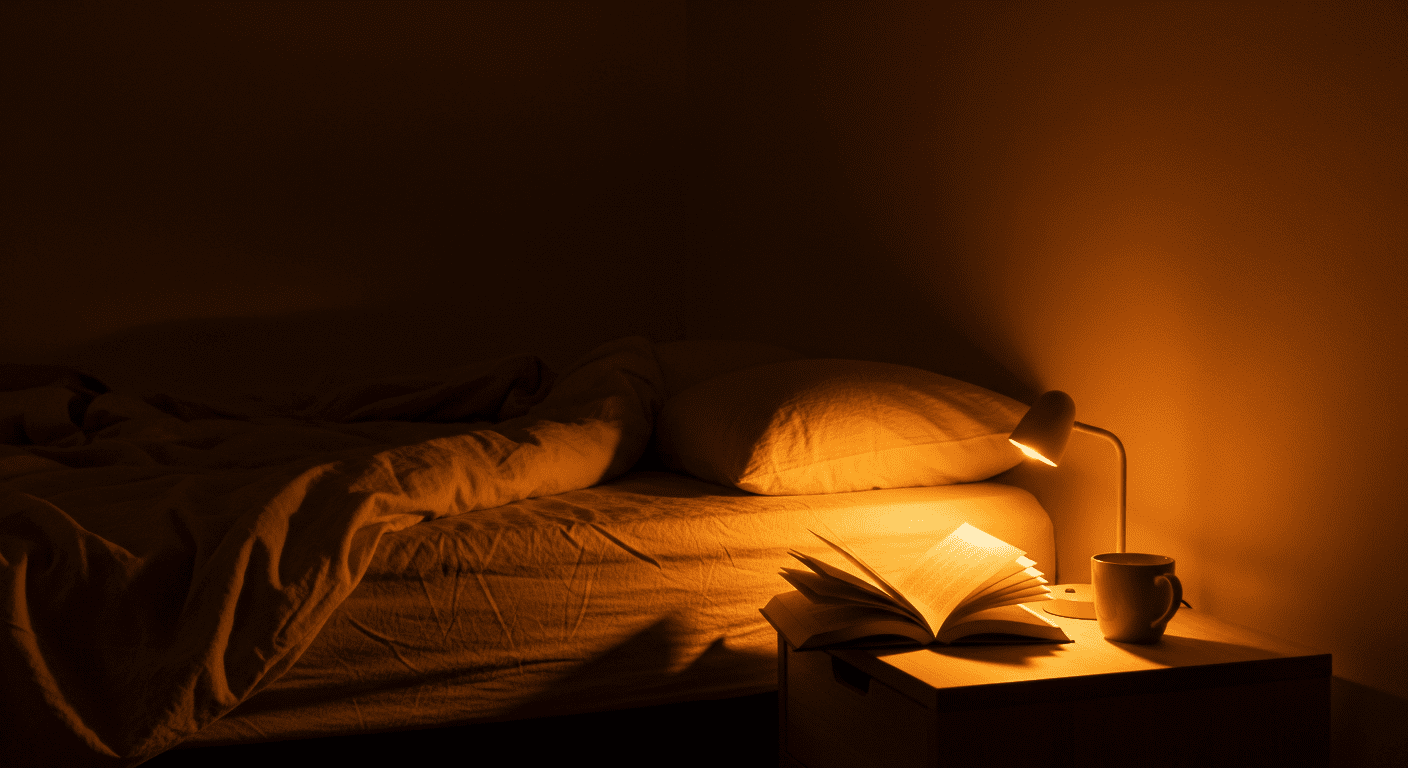
If blue light is the signal for daybreak, amber light—and its warmer cousins, deep orange and red—is the universal, primal signal for safety, warmth, and rest. It’s what you see when you look at a campfire, a candle, or the final moments of the setting sun. Our brains, honed over millennia in environments dictated by fire and dusk, inherently trust this color temperature.
What is CCT and Why is 2700K Your Bedtime BFF?
When selecting a bedroom bulb, the single most important number is the Correlated Color Temperature (CCT), measured in Kelvins (K). The lower the number, the warmer, yellower, and ultimately safer the light appears to your neurology.
- 4000K+ (Cool White/Daylight): High blue content. Absolute poison for evening use. If you have these in your bedroom, they need to go.
- 3000K (Warm White): Acceptable for high-activity living areas earlier in the evening, but still contains too much blue energy for the sleep environment.
- 2700K (Standard Soft White): This is the baseline, non-negotiable minimum. It mimics the light of an old incandescent bulb and significantly reduces the biologically disruptive blue spectrum. This is your minimum standard for the bedroom.
- 2200K – 1800K (Ultra Warm/Filament/Candle Light): This is the gold standard. These lights are often visibly amber or orange. They contain virtually no melatonin-suppressing blue spike and are the closest we can get to mimicking firelight. If you are truly serious about sleep hygiene, aim here.
The transition from blue-rich day light to deep amber evening light is not a luxury or an aesthetic choice; it’s a biological requirement. It allows melatonin production to surge unimpeded, preparing your entire body for restorative sleep without conflict.
The Devil is in the Details: Dimming, Flicker, and CRI
Hold on—just buying an amber-colored bulb isn’t enough to call the job done. Many cheap LED manufacturers focus only on the CCT number, completely ignoring crucial operational quality indicators that can equally disrupt your nervous system. Remember, we’re optimizing the environment for a biological process here, not just swapping colors.
Flicker Rate: The Unseen Sleep Disruptor
Poorly engineered LEDs often have a measurable, rapid flicker as a result of cheap drivers attempting to convert AC power to DC. While you may not consciously perceive this flicker—it happens faster than the eye can register—your brain and retina absolutely do. This constant, subliminal pulsing keeps your nervous system mildly agitated. It contributes significantly to eye strain, headaches, and general neurological stress—the exact opposite of the calm state you want while winding down.
The Fix: Look specifically for LEDs labeled “flicker-free” or use high-quality, name-brand bulbs that feature robust, high-frequency drivers. This is where spending an extra five bucks per bulb pays massive dividends in long-term health and decreased anxiety.
CRI: Don’t Compromise on Color Quality
Color Rendering Index (CRI) measures how accurately a light source reveals the true colors of objects compared to natural daylight (which is 100 CRI). Many older or cheaper warm LEDs (even at 2700K) have terrible CRI (e.g., 70 CRI). This means even though the light is warm, the colors in your room look muddy, muted, and often cast a sickly green or gray tinge on surfaces and skin tones.
A low CRI light, even if amber, can make the environment feel unnatural, flat, and subtly depressing. For a quality bedroom environment that supports well-being, look for bulbs with a CRI of 90 or higher. You want true color vibrancy, even when the color temperature is low and cozy.
Dimming Protocol: Smooth Transitions are Mandatory
The ideal bedtime lighting scenario is not just amber; it is dim amber. The best light for reading in bed should hover around 50 lux, and the light you use just before closing your eyes should be near 10 lux—barely visible. This smooth reduction in intensity is as important as the color shift.
Many cheap dimmable LEDs “step” aggressively, dropping from 100% to 50% quickly, or they suffer from annoying “pop-on” at low levels. Look for bulbs designed for deep, smooth dimming, ideally down to 1% or 0.5%. This controlled, gradual descent of light intensity is the second key ingredient (after CCT) in signaling seamless rest to your brain. Don’t cheap out on the dimmer switch or the bulb driver.
The Bedroom Lighting Strategy: Layering Amber
We need to stop relying on a single overhead fixture that blasts light everywhere. A sophisticated bedroom uses layers of light, all carefully calibrated to the evening schedule, mimicking the natural reduction of solar intensity.
Layer 1: General Ambient (The Sunset Mimic)
- Purpose: Used immediately after leaving the main living areas; 2-3 hours before sleep.
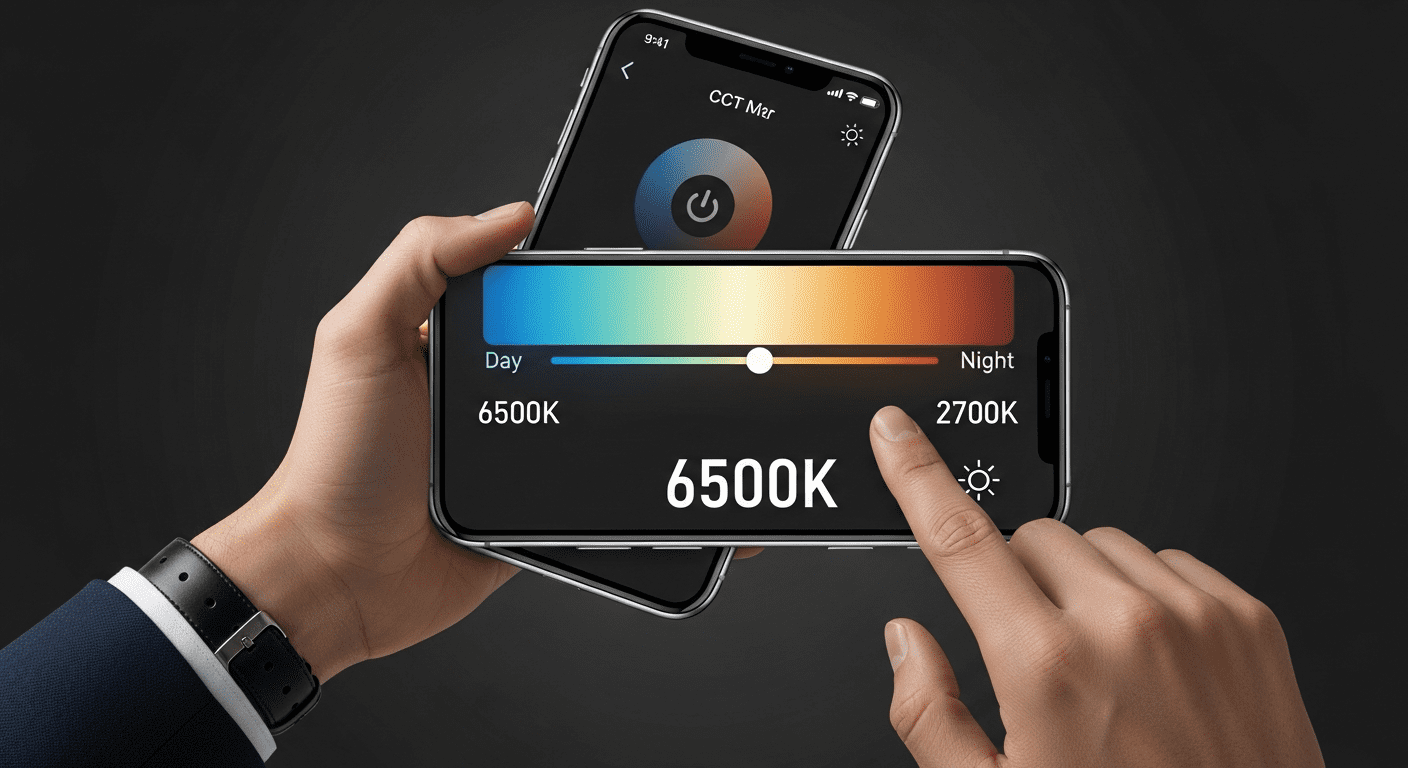
- Recommendation: Overhead fixtures or main lamps should use 2700K CCT bulbs with high CRI (90+). Crucially, dim them to 50% power as a firm, visual cue that the active part of the day is winding down. If you can afford Tunable White Smart Bulbs, set them to automatically shift from 4000K during the day to a rich 2200K by 8:00 PM.
Layer 2: Task Lighting (The Reading Nook)
- Purpose: Necessary light for reading, organizing, or putting away clothes without disturbing your partner or spiking your melatonin.
- Recommendation: Use dedicated task lamps (like bedside reading sconces). These must be 2200K CCT or lower. They should be positioned narrowly to illuminate only the required area (e.g., your book pages) without spilling excessive light into the rest of the room. The goal here is low intensity, high contrast reading light.
Layer 3: Sleep Prep (The Final Cue)
- Purpose: The last light used 30 minutes before closing your eyes, or for navigating to the bathroom at night.
- Recommendation: Use extremely low-lumen nightlights or small accent lamps (think 10-20 lumens) that utilize deep red or 1800K amber bulbs. Red light has the least impact on melatonin production. If you wake up startled at 3 AM, hitting one of these low-level amber lights is far, far better than flipping on the main lamp and shocking your system back to alertness.
Comparative Analysis: Blue vs. Amber Light Bulbs
Here is a straightforward look at why your bulb choices matter, breaking down the technical differences that impact your physiology. Stop guessing.
| Feature | Blue/Cool White LED (4000K+) | Amber/Warm White LED (2200K – 2700K) | Ideal Use Case |
|---|---|---|---|
| CCT Range (Kelvin) | 4000K – 6500K | 2200K – 2700K | Sleep Preparation |
| Melatonin Impact | High Suppression (Peak Sensitivity) | Minimal Suppression (Safe Zone) | Biological Impact |
| Wavelength Appearance | Crisp, often slightly blue, sometimes harsh or sterile | Soft, yellow, orange, or reddish hue (mimics firelight) | Aesthetic Experience |
| CRI Quality (Often) | Easier to achieve high CRI at higher CCTs, but often unnecessary for atmosphere | Requires high-quality engineering to achieve CRI 90+ without a muddy green tint | Color Fidelity |
| Energy/Alertness Signal | Strong alertness signal (mimics midday sun) | Strong rest signal (mimics firelight/sunset) | Circadian Effect |
| Evening Recommendation | Never use in bedrooms after sunset. Confine to kitchens and offices, only during the day. | Mandatory for 3 hours before sleep. The lower the K, the better. | Health Recommendation |
The Smart Home Investment: Tunable White Technology
If you genuinely want to optimize your environment without constant bulb swapping and dimmer fidgeting, invest in tunable white smart lighting. We’re not talking about those novelty RGB party lights that glow purple and green; we’re talking about high-end systems (like Philips Hue or Lutron) that allow you to seamlessly shift the CCT and intensity throughout the day, automatically.
A proper circadian lighting schedule uses automation to do the heavy lifting for you, providing the precise biological cues your body requires:
- Morning (7 AM – 12 PM): Bright, high-CCT light (5000K – 6000K) to ensure full wakefulness and a necessary cortisol spike.
- Afternoon (12 PM – 5 PM): Reduced brightness, slightly warmer CCT (4000K) to sustain focus without peaking stress.
- Evening Transition (5 PM – 8 PM): Light intensity drops sharply, and CCT automatically shifts from 3000K toward 2700K, signaling preparation for rest.
- Sleep Prep (8 PM onwards): CCT locks down to 2200K (or lower) and brightness dims to less than 20%, ensuring melatonin production surges.
“I hear people complain about the cost of quality, flicker-free, high-CRI, tunable smart bulbs. My response is simple: Calculate the annual cost of the coffee you drink to mitigate fatigue, the supplements you buy for anxiety, and the productivity you lose from chronic poor sleep. The light bulb is, fundamentally, a medical device for your neurology. Stop treating it like a disposable commodity. It’s a necessary investment in your biological performance.”
Key Takeaways: Your Action Plan
The Amber Mandate
- Purge the Blue: Immediately remove all bulbs above 3000K CCT from your bedroom, especially overhead fixtures. They are counterproductive.
- Set the Baseline: The absolute minimum CCT for evening light is 2700K. Aim for 2200K or lower for reading and relaxation right before bed.
- Prioritize Quality: Always check for a Color Rendering Index (CRI) of 90+ and ensure the bulbs are explicitly rated as “flicker-free.” Cheap LEDs are a false economy leading to headaches and stress.
- Dim It Down: Use dimmers rigorously. The light should be dim enough that you feel cozy and restful, not just visible. The dimmer the light, the safer the color temperature, psychologically and physiologically.
- Start Early: Begin dimming and warming your lights at least two hours before your desired bedtime to give melatonin time to ramp up properly and prepare your system for rest.
FAQ: Addressing Your Lighting Doubts
1. Does the color of the lampshade matter if the bulb is amber?
Yes, significantly, but it’s secondary. A thick, dark fabric lampshade acts as an additional physical filter, reducing overall luminance (brightness) and often shifting the color slightly further towards the warmer end of the spectrum. However, a thin white shade over a cool 4000K bulb will still transmit problematic blue light. Always tackle the bulb CCT first; use a shade to soften and dim the intensity for aesthetic and comfort purposes.
2. I use my bedroom as an office sometimes. Can I use two different sets of lights?
Absolutely. This is the optimal solution for multipurpose rooms. Install high-CCT (5000K) bulbs in an office-specific task lamp or fixture that you only activate during daylight working hours. Crucially, use your dedicated, deeply dimmable 2200K lights for the evening transition. Ensure the “office” lights are completely off, unplugged, or physically covered when not in use so the cool light doesn’t contaminate your sleep environment during rest periods.
3. Are blue light blocking glasses enough to mitigate the problem?
Blue light blocking glasses (especially those with highly saturated orange/amber lenses that block 99% of wavelengths below 550nm) are effective tools for managing screens, but they are a compensating measure, not a replacement for fundamental lighting hygiene. Why wear goggles indoors to manage a problem you created with the wrong bulb choice? Change the bulb first; use the glasses for unavoidable exposure, like checking your phone late at night, or when you’re stuck under awful airport lighting.
4. What about red-only nightlights? Are they better than amber?
For the lowest possible biological disruption, deep red light (around 600nm to 700nm) is superior to standard amber (which is closer to 570nm). If you need low-level ambient light to navigate a hallway or bathroom trip overnight, red is the undisputed champion—it has virtually zero effect on melatonin. Use amber (2200K) for functional tasks like reading, and reserve red for pure navigation and mood setting when truly minimal light is required.
5. Should I worry about my hallway or bathroom lighting too?
You bet you should. A midnight trip to the bathroom that involves flipping on a bright, cool 5000K bulb is a severe circadian shock. You just signaled high noon to your brain and immediately reset your body clock to alertness. Install motion-sensor nightlights or very low-lumen, deep amber bulbs (1800K) in the bathroom and hallways near the bedroom. Keep the shock zone warm and dim—protect your periphery.
The Verdict: Stop Negotiating with Your Biology
The choice between blue light and amber light for your bedroom isn’t merely aesthetic; it’s profoundly physiological. Blue light shouts “work, stress, alertness.” Amber light whispers “rest, repair, safety.”
You’ve optimized your diet, your exercise, and likely spent a fortune on minimizing your stressful morning routine. It’s time to realize that your lighting is the single easiest, most cost-effective switch you can make right now to drastically improve your rest quality.
Toss out the clinical “Daylight” bulbs, invest in quality, flicker-free amber bulbs, implement a robust dimming strategy, and watch your body thank you for finally respecting its operating manual. Go get some rest—the deep, restorative kind.