

Ever woken up with your partner’s foot in your face, wondering if your bed is just too small, or are you sleeping in a room that’s basically a glorified closet?
Look, I’ve been there. Three years ago, I upgraded from a full to a queen, thinking I’d finally solved my cramped sleeping situation. Spoiler alert: I hadn’t. The bed fit in my bedroom, sure, but I couldn’t open my closet door without doing some weird sideways shuffle. Nobody tells you this stuff when you’re mattress shopping, right?
Here’s the thing that really gets me: Americans spend roughly one-third of their lives sleeping, yet most of us know more about our phone specs than we do about bed dimensions. We’ll research a $50 toaster for hours but drop thousands on a mattress setup without checking if it’ll actually fit our lifestyle.
Table of Contents
The Problem: Why Getting Your Bed Size Wrong Is Costing You More Than Sleep
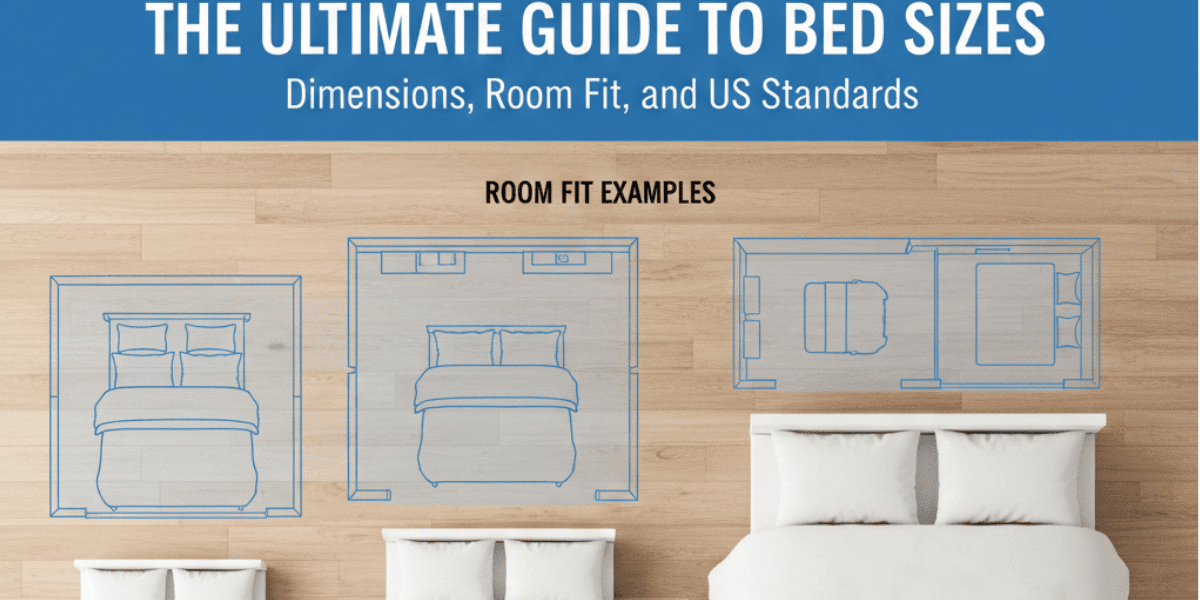
Let me paint you a picture. You walk into a mattress store, lie down on that California King for exactly 47 seconds (yes, studies show that’s the average time people spend testing a mattress), and think “This is it. This is the one.” You’re imagining yourself sprawled out like a starfish, finally getting that quality sleep you’ve been dreaming about.
Fast forward two weeks.
The delivery guys are sweating, your bedroom door frame has a new dent, and suddenly that king bed makes your room look like a furniture showroom gone wrong. You can’t fit your nightstands. The bedroom door barely opens. And forget about having any kind of walking space.
But here’s what really keeps people up at night (ironically): it’s not just about the bed fitting in your room. It’s about:
- Whether you can actually move around the room
- If your current sheets will fit (spoiler: they probably won’t)
- Whether two people can comfortably sleep without the dreaded “middle-of-the-night elbow to the ribs”
- If you’re wasting money heating or cooling unnecessary bed space
- Whether you can even get the thing up your stairs
According to the Better Sleep Council, 45% of Americans say they’d sleep better with more space in bed. Yet here’s the kicker: many people are either sleeping in beds that are too small OR have bought beds that are too large for their actual bedroom setup.
I talked to my buddy Mike last month. Guy bought a king bed for his 10×10 bedroom because he’s 6’3″ and figured he needed the space. Now he literally has to crawl over the foot of the bed to get to his dresser. He jokes about it, but his girlfriend? Not laughing.
The Solution: Understanding Bed Sizes Like You Actually Live With Them
Alright, let’s break this down in a way that actually makes sense for real life, not showroom life.
The Standard US Bed Size Breakdown
Here’s the truth about bed sizes in the United States. I’m going to give you the dimensions, but more importantly, I’m going to tell you what they actually mean for your day-to-day life.
Twin and Twin XL
Dimensions:
- Twin: 38 inches wide x 75 inches long
- Twin XL: 38 inches wide x 80 inches long
Let me be straight with you: if you’re over 5’9″ and sleeping on a regular twin, your feet are hanging off the edge, and you know it. The Twin XL adds 5 inches of length, which is why every college dorm room in America uses them.
I spent four years sleeping on a Twin XL in college, and here’s what nobody tells you: it’s basically a solo operation. If you have overnight guests (wink wink), someone’s sleeping on the floor or you’re getting very cozy. These beds are 38 inches wide. That’s narrower than most people’s shoulders when they sleep.
Best for:
- Kids and teenagers
- College students (Twin XL specifically)
- Guest rooms where you’re not expecting couples
- Small studio apartments where every inch counts
Room size recommendation: Minimum 7×10 feet, but honestly, you can squeeze these into almost anything.
Full (Double)
Dimensions: 54 inches wide x 75 inches long
Okay, here’s where things get interesting. The full bed is also called a “double,” which is honestly false advertising. Can two adults technically fit on a full bed? Yes. Will they be happy about it? That’s a different question entirely.
Do the math with me: 54 inches divided by 2 equals 27 inches per person. That’s narrower than a crib mattress, which is typically 28 inches wide. You’re literally giving each adult less space than a baby gets.
I slept on a full with my ex for two years, and let me tell you, it builds character. Or resentment. Depends on who you ask.
But here’s where the full bed actually shines: solo sleepers in smaller spaces. If you’re single and living in a city apartment, a full bed gives you way more sleeping room than a twin without eating up your entire bedroom like a queen would.
Best for:
- Single adults who like to spread out
- Teenagers transitioning from twin beds
- Couples who really, REALLY like each other (or are both under 5’6″)
- Bedrooms that are 10×10 feet or smaller
Room size recommendation: Minimum 9×10 feet for basic functionality, but 10×12 feet is way more comfortable.
Queen
Dimensions: 60 inches wide x 80 inches long
Now we’re talking. The queen is the Goldilocks of American beds—it’s the most popular mattress size in the United States, and for good reason.
At 60 inches wide, you’re giving each partner 30 inches of personal space. Is it luxurious? No. Is it workable? Absolutely. Plus, that extra 5 inches of length compared to a full means most people can actually stretch out without their feet dangling off the edge.
Here’s something interesting: furniture retailers will tell you a queen fits “perfectly” in a 10×10 bedroom. Technically true. Practically? You’ll be squeezing past your bed to get anywhere. I learned this the hard way.
The real sweet spot for a queen bed is a 10×12 foot bedroom, minimum. This gives you about 2-3 feet on either side of the bed for nightstands and walking space. You want to be able to make your bed without doing gymnastics, right?
Best for:
- Couples who sleep reasonably well together
- Single people who want maximum sleep space without going overboard
- Guest rooms that might host couples
- Bedrooms between 10×12 and 12×12 feet
Room size recommendation: 10×12 feet minimum for comfort, 12×12 feet is ideal.
King and California King: The Big Boys
Standard King (Eastern King)
Dimensions: 76 inches wide x 80 inches long
Let’s talk about the king bed, which Americans sometimes call the “Eastern King” to differentiate it from the California King (we’ll get to that in a second).
At 76 inches wide, a king bed is literally two Twin XL mattresses pushed together. In fact, that’s exactly how a lot of adjustable king beds work. Each person gets 38 inches of space—the same width as a twin bed. Finally, some actual personal space!
But here’s the reality check: a king bed requires serious real estate. We’re talking a minimum bedroom size of 12×12 feet, and honestly, that still feels tight. The ideal room for a king is 13×13 feet or larger.
My parents upgraded to a king last year. Their bedroom is 12×14, and Dad still complains about bumping into the bed frame when he’s getting dressed. Mom loves it though, says she finally doesn’t wake up every time Dad rolls over.
Best for:
- Couples who value personal sleep space
- Anyone over 6 feet tall who sleeps with a partner
- Parents who have kids that like to crawl into bed in the morning
- People with pets who sleep on the bed (game changer)
- Bedrooms 12×12 feet or larger
Room size recommendation: Minimum 12×12 feet, but 13×13 or 12×14 feet is much more practical.
California King
Dimensions: 72 inches wide x 84 inches long
The California King is longer and narrower than a standard king—4 inches longer, 4 inches narrower. It was originally designed for Hollywood celebrities (because of course it was), but it’s actually perfect for a specific type of person: tall folks.
If you’re 6’2″ or taller, those extra 4 inches of length can be the difference between sleeping comfortably and waking up with your feet hanging off the edge. But here’s the trade-off: you’re losing 4 inches of width, so each person only gets 36 inches instead of 38.
Also, California King bedding is more expensive and harder to find than standard king bedding. Just something to keep in mind when you’re budgeting.
Best for:
- Very tall individuals (6’2″ and up)
- Couples where at least one person is very tall
- Longer, narrower bedrooms (works better in 11×14 than 13×13)
- People who prioritize length over width
Room size recommendation: Minimum 12×12 feet, but a longer room (like 11×14 or 12×15) works better than a square room.
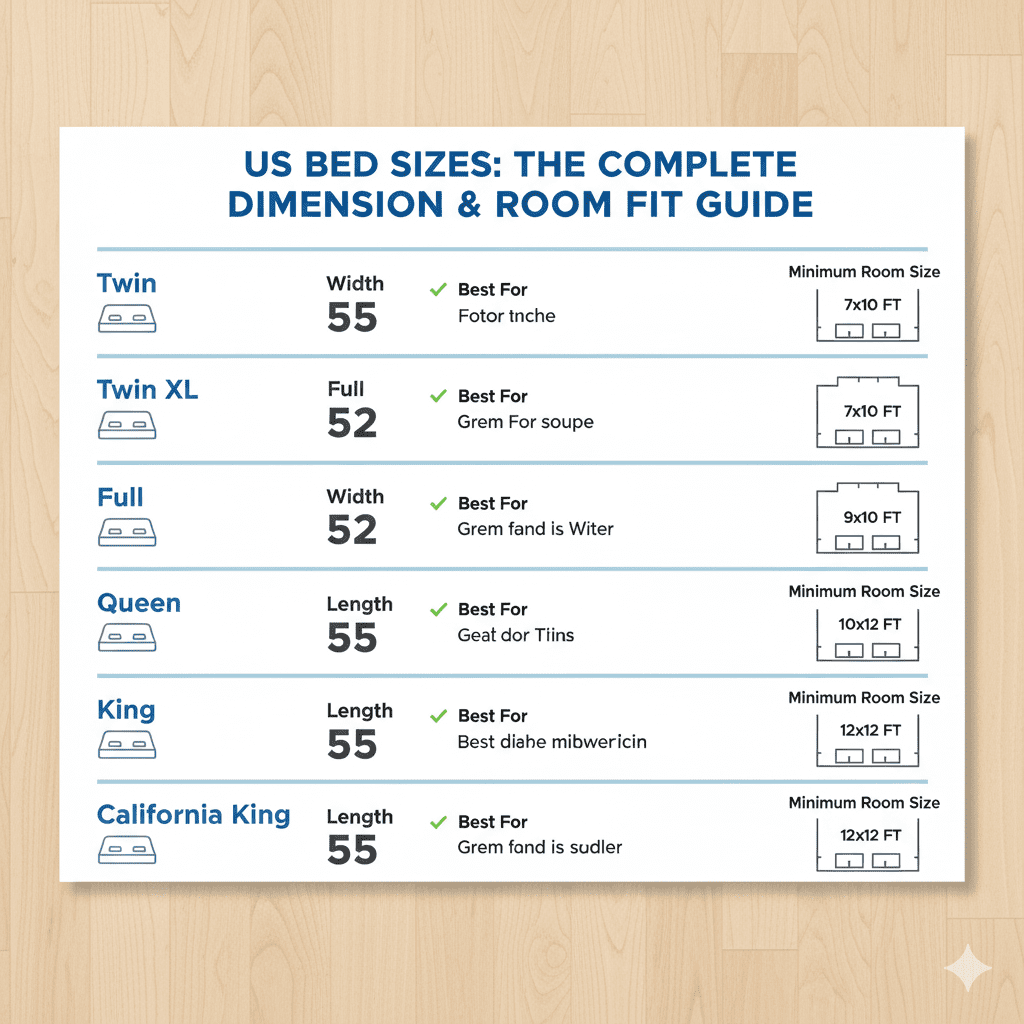
Quick Reference: Complete US Bed Size Table
| Bed Size | Width (inches) | Length (inches) | Best For | Minimum Room Size |
|---|---|---|---|---|
| Twin | 38 | 75 | Kids, single sleepers | 7×10 feet |
| Twin XL | 38 | 80 | Tall kids, college students | 7×10 feet |
| Full | 54 | 75 | Single adults, tight couples | 9×10 feet |
| Queen | 60 | 80 | Most couples, single adults | 10×12 feet |
| King | 76 | 80 | Couples wanting space | 12×12 feet |
| California King | 72 | 84 | Tall couples | 12×12 feet |
The Real Talk: Figuring Out What Actually Fits
Okay, so you know the dimensions. Great. But how do you actually figure out if a bed will work in YOUR space? Let me walk you through this like I’m helping you plan your own bedroom.
The 30-Inch Rule (And Why It Matters)
Interior designers recommend at least 30 inches of walking space around your bed. Notice I said “at least.” That’s the bare minimum to squeeze past without stubbing your toe every morning at 6 AM when you’re half-asleep and need coffee.
Here’s how I actually measure this:
- Measure your room (obviously, but you’d be surprised how many people skip this)
- Subtract the bed dimensions from your room dimensions
- Divide what’s left by 2 if you want space on both sides, or just subtract it from one side if your bed goes against a wall
Let’s do a real example. Say you have a 12×12 bedroom and you’re thinking about a queen:
- Room: 144 inches x 144 inches
- Queen bed: 60 inches x 80 inches
- Leftover width: 144 – 60 = 84 inches
- Space on each side: 84 ÷ 2 = 42 inches
That’s actually pretty comfortable! You’ve got space for nightstands and walking room.
Now let’s try a king in that same room:
- Room: 144 inches x 144 inches
- King bed: 76 inches x 80 inches
- Leftover width: 144 – 76 = 68 inches
- Space on each side: 68 ÷ 2 = 34 inches
Still doable, but you’re cutting it closer. Add nightstands (typically 20-24 inches wide), and you’re down to about 10-14 inches of walking space per side. Tight, but manageable if you really want that king.
The Furniture Factor Nobody Talks About
Here’s what tripped me up when I upgraded beds: I completely forgot about my other furniture.
Your bedroom isn’t just a bed floating in space. You’ve got:
- Nightstands: Usually 20-30 inches wide each
- Dressers: Typically 30-60 inches wide
- Desk or chair: If you work from home, add another 40-60 inches
- Closet doors: Need clearance to actually open (usually 30 inches)
- Regular doors: Also need to open (another 30+ inches)
When I got my queen bed, I measured the bed. What I didn’t measure was whether I could still open my closet door and have my nightstand in place. Turns out, I couldn’t. Had to ditch one nightstand and put a small shelf on the wall instead.
Pro tip: Use painter’s tape to mark out the bed dimensions on your floor before you buy. Live with it for a day. Walk around it. Pretend to open your closet. Pretend to get dressed. If you’re constantly tripping over the tape or feeling claustrophobic, that bed’s too big.
Ceiling Height and Visual Proportions
This might sound weird, but hear me out: ceiling height matters for how your bed feels in the room.
If you’ve got 8-foot ceilings (standard in most homes), a massive king bed with a tall headboard can make your room feel like a cave. I stayed at my cousin’s place once—she had a king bed with a 60-inch headboard in a room with 8-foot ceilings. I felt like I was sleeping in a furniture store.
With 9 or 10-foot ceilings, you can go bigger and bolder without the room feeling cramped. Visual proportions matter just as much as actual measurements.
The Hidden Costs of Choosing the Wrong Size
Let’s talk money, because nobody else seems to.
Bedding Costs Add Up Fast
A queen sheet set from a decent brand runs about $50-100. King? $70-150. California King? Good luck finding anything under $100, and you’ll have way fewer options.
But here’s the real kicker: those trendy bed-in-a-bag sets at Target? Almost always queen. Maybe king if you’re lucky. California King? Forget about it.
Over the lifetime of your bed (typically 7-10 years), you’ll probably buy 4-6 sheet sets. That’s an extra $200-400+ for king and California King sizes.
Room Temperature and Energy Bills
A bigger bed means more surface area to heat or cool. If you’re someone who needs that bedroom at a perfect 68 degrees to sleep, a king bed has about 27% more surface area than a queen. Your heating and cooling costs will reflect that.
Is it going to break the bank? No. But over 10 years, you might spend an extra $50-100 on energy just from your bed size. Just saying.
Mobility and Future Moves
I moved three times in five years (don’t ask). My queen bed came with me each time. My friend’s California King? He sold it before his second move. Getting a king or California King up a narrow stairwell is basically a physics problem.
If you’re renting or think you might move in the next few years, seriously consider whether you want to deal with moving a 76-inch-wide mattress. Moving companies charge extra for kings. Some won’t even attempt California Kings up certain staircases.
Key Takeaways: What You Actually Need to Remember
Look, I know this has been a lot of information. Let me boil this down to what actually matters:
On Bed Sizes:
- Twin and Twin XL are for solo sleepers only—38 inches is cramped for anyone over 5’9″
- Full beds are surprisingly bad for couples (27 inches per person is less than a crib)
- Queen beds are the sweet spot for most couples and master bedrooms
- King beds require serious space commitment (minimum 12×12 room, really 13×13)
- California King is for tall people, not big rooms
On Room Fit:
- Always leave at least 30 inches of walking space around your bed (more is better)
- Measure your room, your doors, your hallways, and your stairs before buying
- Use painter’s tape to map out the bed size on your floor—live with it first
- Remember to account for nightstands, dressers, and other furniture
- Check if your closet and bedroom doors can still open with the bed in place
On Hidden Factors:
- King and California King bedding costs 30-50% more and has fewer options
- Moving larger beds is expensive and sometimes impossible
- Ceiling height affects how big your bed should feel
- You might actually sleep worse in a bed that’s too big for your room (feeling cramped affects sleep quality)
On Making the Choice:
- Measure twice, buy once (seriously, measure everything)
- Consider your lifestyle—are you moving soon? Do you have pets? Kids who crawl in bed?
- Think about your actual sleeping habits, not idealized ones
- Remember that couples need about 30 inches per person minimum for good sleep
- When in doubt, go with a queen—it’s popular for a reason
The Bottom Line: What I’d Tell My Past Self
If I could go back and talk to myself three years ago, standing in that mattress store, here’s what I’d say:
“Dude, measure your actual bedroom, not just the floor space. That queen will technically fit, but you’re going to hate squeezing past it every morning. Also, your room is 10×11, not 10×12 like you think. I know, I know, you’re bad at measuring. And for the love of all that’s holy, bring a tape measure to the store and lie on that mattress for more than 30 seconds. You wouldn’t buy a car after a 30-second test drive, right?”
The truth is, the perfect bed size isn’t about the biggest bed you can afford or the one that looks coolest. It’s about the bed that fits your space, your lifestyle, and your actual sleeping needs.
I eventually went back to a full bed when I moved to a smaller apartment in the city. At first, I felt like I was downgrading. But you know what? I sleep great, my bedroom doesn’t feel like a furniture warehouse, and I can actually afford the nice sheets now because full-size bedding is way cheaper.
Your bed should work for you, not the other way around.
FAQ: The Questions Everyone Asks
What bed size should couples get?
For most couples, a queen bed (60×80 inches) is the minimum comfortable size. It gives each person about 30 inches of space. If you have the room and budget, a king (76×80) is ideal, especially if either of you is a restless sleeper or over 6 feet tall.
Can a king bed fit in a 12×12 room?
Technically yes, but it’ll be tight. A king bed is 76×80 inches, leaving you with only 34 inches of space on each side in a 12×12 room (144 inches total). Once you add nightstands, you’re down to barely enough walking room. I’d recommend 13×13 minimum for actual comfort.
Is a California King bigger than a regular king?
No, it’s actually slightly smaller in total area. A California King is 72×84 inches (longer and narrower), while a regular king is 76×80 inches (wider and shorter). Cal King has 6,048 square inches vs. King’s 6,080 square inches. California King is better for tall people, regular king is better for width.
What size bed should a 6-foot-tall person get?
Anyone over 6 feet should look for beds that are at least 80 inches long. That means Twin XL, Queen, King, or California King. If you’re 6’2″ or taller, seriously consider a California King (84 inches long) so you’re not constantly sleeping diagonally.
How much space should be around a bed?
Designers recommend at least 30 inches of walking space on each side of the bed and at the foot. In reality, you can get away with 24 inches if you’re tight on space, but anything less feels cramped. If you want nightstands, factor in their width (usually 20-24 inches) when calculating.
Are king sheets way more expensive than queen?
Yes, typically 30-50% more expensive. A decent queen sheet set runs $50-100, while king is $70-150. California King is even more, often $100+, and you’ll have way fewer options. Over the 7-10 year life of your bed, you’ll spend an extra $200-400+ on bedding for a king size.
Can you fit a king bed up normal stairs?
Sometimes. King mattresses are 76 inches wide, and most stairways are 36-42 inches wide. The mattress is flexible, so it can usually bend around corners, but the box spring often can’t. Many people opt for split box springs for king beds specifically for this reason. Measure your stairwell before buying—seriously.
What’s the most popular bed size in America?
Queen beds are the most popular in the US, making up about 47% of all mattress sales. King beds are second at around 23%, followed by full (20%), twin/twin XL (8%), and California King (2%). The queen dominates because it’s a good compromise between comfort and room size for most homes.
Remember: your bed is where you spend one-third of your life. Take the time to get it right. Measure your space, think about your lifestyle, and don’t let a salesperson convince you that bigger is always better. Sometimes, the perfect bed is just the one that actually fits your life.