
Ever wonder why you feel like a zombie after working nights, even when you’ve slept for 8 hours?
Here’s something that’ll blow your mind: your body has no idea you’re trying to be nocturnal. While you’re chugging coffee at 3 AM and forcing yourself to stay alert, every cell in your body is screaming “why aren’t we asleep right now?” Your brain is literally fighting against millions of years of evolution that says “dark = sleep time.”
I learned this the hard way during my first month of night shifts. I’d come home at 7 AM, pull the regular curtains closed, and wonder why I’d wake up two hours later feeling worse than before. Spoiler alert: I was doing everything wrong.
Table of Contents
The Problem: Your Body Is Stuck in Daylight Mode
Let me paint you a picture. You finish your night shift at 6 AM. The sun is rising, birds are chirping, and your neighbor is mowing his lawn because apparently 7 AM on a Saturday is a perfectly reasonable time for that. You drive home with sunlight streaming through your windshield, walk into your house where light is peeking through every gap in your curtains, and try to convince your body it’s bedtime.
Good luck with that.
Here’s what’s actually happening inside your body. You have this tiny region in your brain called the suprachiasmatic nucleus (SCN). Think of it as your body’s internal clock, except it’s way more powerful than any alarm clock you own. This little cluster of about 20,000 neurons controls pretty much everything about when you feel awake or sleepy.
The SCN takes its orders primarily from light. When light hits your eyes, it sends a signal that says “it’s daytime, stay awake!” When it’s dark, it tells your pineal gland to release melatonin, the hormone that makes you sleepy. Simple, right?
Except when you work nights, you’re trying to override this system. You’re exposing yourself to bright light when your body expects darkness, and trying to sleep when every fiber of your being is primed for activity.
The Real Cost of Fighting Your Biology
According to the National Sleep Foundation, approximately 15 million Americans work full-time night shifts. That’s a lot of people fighting their circadian rhythms every single day.
And here’s the kicker: this isn’t just about feeling tired. Studies show that night shift workers have a:
- 29% higher risk of obesity
- 23% increased risk of heart attacks
- Significantly higher rates of diabetes and metabolic syndrome
- Greater susceptibility to depression and mood disorders
A 2019 study published in the American Journal of Preventive Medicine followed over 74,000 nurses for 24 years. The results? Those who worked rotating night shifts for five years or more had a 11% increase in mortality risk compared to those who never worked nights.
I’m not trying to scare you here. I’m just saying this is serious stuff, and we need to take it seriously.
The Agitation: Why Traditional Sleep Advice Doesn’t Work
You’ve probably heard the standard advice for night shift workers:
- “Just maintain a consistent schedule”
- “Make sure your bedroom is dark”
- “Avoid caffeine before bed”
Cool, cool. But here’s what they don’t tell you: regular curtains don’t cut it. Not even close.
I remember buying what I thought were “room darkening” curtains from a big box store. They were thick, they were dark blue, and they cost me 60 bucks. I hung them up feeling pretty proud of myself. Then I tried to sleep at 8 AM on a sunny day.
The light was everywhere. Around the edges. Through the fabric itself. Under the door. From the hallway. It was like trying to sleep in a tanning booth with slightly dimmed lights.
The Light Exposure Problem
Even small amounts of light can mess with your melatonin production. We’re not just talking about bright sunlight here. Studies have shown that exposure to light as dim as 8 lux (about the brightness of a nightlight) can suppress melatonin by up to 50%.
For reference, a typical sunny day is around 10,000 to 25,000 lux. Your bedroom with regular curtains during daytime? Probably 200-500 lux. Way, way too much.
But here’s where it gets interesting. The problem isn’t just about sleeping. It’s also about your commute home and those first few hours after your shift.
When you drive home in bright morning sunlight, you’re basically telling your body “wake up, it’s morning!” right when you need to be winding down for sleep. It’s like chugging an espresso right before bedtime, except the espresso is free and comes from a giant ball of nuclear fusion 93 million miles away.
The Solution: Strategic Light Management (It’s Not as Complicated as It Sounds)
Alright, here’s where we get into the practical stuff. The stuff that actually works.
The strategy is simple: control light exposure like your sleep depends on it (because it does).
This means two things:
- Block light when you need to sleep
- Block light when you’re transitioning to sleep
Let me break down exactly how to do this.

The Sunglasses Trick: Your Secret Weapon
This is probably the simplest and most effective thing you can do, and it costs about $10.
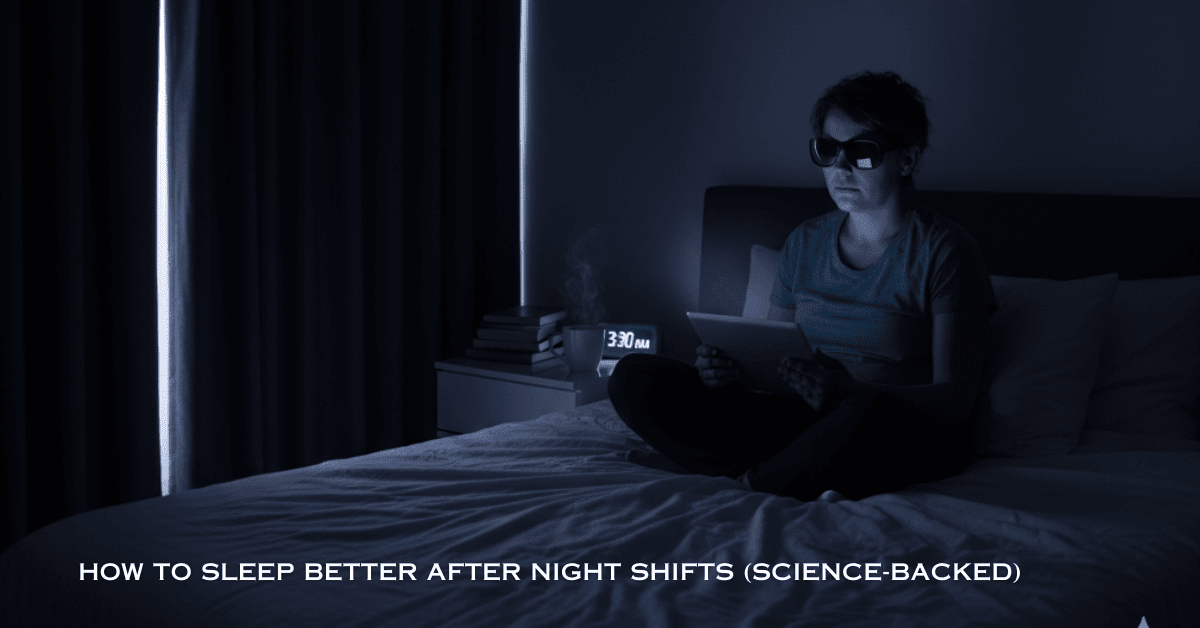
Get yourself a pair of amber-tinted or red-tinted sunglasses. Not your regular sunglasses. Not those cool aviators you wear to look mysterious. Special blue-light blocking glasses.
Here’s why this works: the SCN in your brain is especially sensitive to blue light (wavelengths around 460-480 nm). This is the type of light that’s most abundant in morning sunlight. It’s also why your phone keeps you awake at night.
Amber or red-tinted glasses filter out this blue light. When you wear them during your commute home and for the first hour or so after you get home, you’re essentially telling your brain “nope, still nighttime, nothing to see here.”
My Sunglasses Protocol
Here’s exactly what I do:
60 minutes before shift ends: I put on my amber glasses inside the workplace if possible, or immediately when I walk outside.
During commute: Glasses stay on the entire drive home. Yes, I look a bit weird wearing sunglasses at 7 AM, but I also actually sleep when I get home, so who’s winning?
First hour at home: I keep them on while I do my wind-down routine. Shower, light snack, whatever. Glasses stay on.
Remove when ready for bed: Only take them off when I’m actually in bed, ready to sleep.
This simple routine made a massive difference for me. I went from taking 2 hours to fall asleep to falling asleep within 30 minutes.
The Blackout Curtain Investment
Now let’s talk about your bedroom. This is where you need to get serious.
Regular curtains are not enough. Room-darkening curtains are not enough. You need actual blackout curtains, and you need to install them properly.
Here’s what makes a real blackout curtain different:
- Multiple layers of tightly woven fabric
- Rubber or foam backing that completely blocks light
- Thick enough that you can’t see your hand when you hold it behind the curtain
But having good curtains is only half the battle. Installation matters just as much.
How to Install Blackout Curtains Properly
Most people mess this up. They buy great curtains, then hang them exactly like regular curtains, and wonder why light still gets in.
Here’s what you need to do:
Mount the curtain rod higher and wider: Install your curtain rod at least 4-6 inches above the window frame and extend it 6-8 inches beyond each side. This prevents light from sneaking in around the edges.
Use a wrap-around rod: These special rods have a return on each end that curves back to the wall, closing the gap where light usually streams in at the sides.
Add side channels: You can get vertical tracks or even just some velcro strips to seal the sides of your curtains to the wall.
Double up if needed: Sometimes one layer isn’t enough. I use blackout curtains with blackout roller shades behind them. Overkill? Maybe. But my room is pitch black at noon, and that’s worth it.
Block light from other sources: Don’t forget about light coming from under your door, electrical outlets, or any electronics. Use a door sweep, outlet covers, and either remove electronics or cover their LED lights with black electrical tape.
The Complete Light Management Schedule
Let me give you a real schedule that actually works. This is what I follow, and I’ve recommended it to dozens of night shift workers.
| Time | Activity | Light Management |
|---|---|---|
| 11:00 PM | Start of shift | Normal indoor lighting |
| 5:00 AM | Last hour of shift | Put on amber glasses if possible |
| 6:00 AM | Shift ends | Amber glasses on before going outside |
| 6:30 AM | Commute home | Keep glasses on entire drive |
| 7:00 AM | Arrive home | Glasses stay on, keep lights dim |
| 7:30 AM | Wind-down routine | Still wearing glasses, minimal lighting |
| 8:00 AM | Get into bed | Remove glasses, room is pitch black |
| 8:30 AM | Usually asleep | Complete darkness maintained |
| 4:00 PM | Wake up time | Gradually expose to light |
Additional Tricks That Actually Help
Temperature control: Your body temperature naturally drops when you sleep. Keep your bedroom cool (60-67°F is ideal). I use a fan even in winter.
White noise: This masks the daytime sounds. I use a cheap box fan. Works better than any fancy white noise machine I’ve tried.
Melatonin timing: If you use melatonin (check with your doctor first), take it about 30 minutes before you want to fall asleep. For me, that’s around 7:30 AM. The dose matters too – most people take way too much. 0.5-3 mg is usually enough.
Consistency is key: Try to keep the same sleep schedule even on your days off. I know, I know, this is the hardest part. But your circadian rhythm hates variability.
What About Days Off?
This is the million-dollar question. What do you do on your days off?
Honestly, this depends on your social life and family situation. If you can maintain your night schedule even on days off, that’s ideal for your circadian rhythm. But let’s be real: most people can’t or don’t want to do that.
If you need to flip back to a day schedule on your days off, here’s my advice:
Don’t flip too quickly: Gradually shift your sleep time by 1-2 hours each day rather than forcing a complete flip.
Use light strategically: Expose yourself to bright light when you want to be awake, avoid it when you want to sleep.
Be consistent with your flip pattern: If you flip schedules every weekend, do it the same way each time so your body learns the pattern.
Understanding Your Circadian Rhythm (The Science Part, But I’ll Keep It Simple)
Your circadian rhythm is basically a 24-hour internal clock, but it’s not just about sleep. It affects:
- Body temperature
- Hormone release
- Metabolism
- Blood pressure
- Cognitive performance
- Immune function
Think of it like a symphony orchestra. Your SCN is the conductor, and light is the sheet music it’s reading from. When you work nights, you’re basically asking the conductor to play a completely different piece while everyone in the audience (your environment) is expecting the original show.
The Two-Process Model
Sleep scientists talk about two main processes that determine when you feel sleepy:
Process C (Circadian): This is your biological clock telling you when you should be awake or asleep based on the time of day. It’s regulated primarily by light exposure.
Process S (Sleep Homeostatic): This is basically sleep pressure building up the longer you’re awake. Think of it like hunger – the longer since you last ate (slept), the hungrier (sleepier) you get.
For night shift workers, these two processes are constantly fighting each other. Process S is screaming “you’ve been awake for 16 hours, sleep now!” while Process C is yelling “but it’s 3 PM, you should be awake!”
This is why strategic light management works. You’re basically hacking Process C to align with your actual sleep schedule.
Why Blue Light Is the Villain (and the Hero)
Blue light gets a bad rap, but it’s actually not evil. It’s just powerful.
Your eyes have special photoreceptor cells called intrinsically photosensitive retinal ganglion cells (ipRGCs). These cells are packed with a photopigment called melanopsin that is extremely sensitive to blue light.
When these cells detect blue light, they send signals directly to your SCN saying “it’s daytime!” This triggers a cascade of events:
- Melatonin production stops
- Cortisol levels rise
- Body temperature increases
- Your brain becomes more alert
This is great when it’s actually daytime and you want to be awake. It’s terrible when you’re trying to sleep at 8 AM after a night shift.
The genius of wearing blue-blocking glasses is that you’re specifically targeting this pathway. You’re not blocking all light (you can still see where you’re going), just the wavelengths that mess with your sleep.
Real-World Success Stories
Let me share some stories from people who’ve actually made this work.
Sarah, ER Nurse: “I worked night shifts for three years and felt like garbage the entire time. Constant fatigue, gained 30 pounds, my mood was awful. Started using blackout curtains and blue-blocking glasses six months ago. The difference is honestly shocking. I sleep 6-7 hours now instead of 4-5, and I actually feel rested when I wake up.”
Mike, Factory Worker: “The sunglasses thing seemed stupid to me at first. Spent $12 on Amazon just to try it. Now I won’t leave work without them. It’s like someone flipped a switch in my brain. I used to lie in bed staring at the ceiling for hours. Now I’m out in 20 minutes.”
Jessica, Police Officer: “Made the investment in proper blackout curtains and installation. Cost about $300 total for my bedroom. Worth every penny. My bedroom is now darker at noon than most people’s bedrooms are at midnight. Finally getting the sleep I need.”
Common Mistakes to Avoid
Mistake 1: Inconsistent Light Management
Don’t be that person who wears the glasses sometimes but not always because you forgot them or felt self-conscious. Consistency is everything.
Mistake 2: Cheap Blackout Solutions
I tried everything before getting real blackout curtains. Aluminum foil on windows (looked ridiculous and didn’t work well). Blankets thumbtacked up (fell down constantly). Regular curtains layered together (still too much light). Just invest in the proper solution the first time.
Mistake 3: Ignoring Other Light Sources
Your curtains are perfect, but you have six electronic devices with LED lights creating a constellation in your bedroom. Block all light sources.
Mistake 4: Only Focusing on Sleep
Light management isn’t just about when you’re sleeping. It’s about your whole routine – commute, wind-down time, everything.
Mistake 5: Giving Up Too Soon
Your circadian rhythm doesn’t reset overnight (pun intended). Give these strategies at least 2-3 weeks before deciding if they work.
The Ultimate Night Shift Sleep Setup
Here’s what your ideal setup looks like:
Bedroom:
- Proper blackout curtains, correctly installed
- Blackout roller shades (optional but recommended)
- Door sweep to block light from underneath
- All electronic lights covered or removed
- Temperature controlled (60-67°F)
- White noise source
Transition Kit:
- High-quality blue-blocking glasses (amber or red-tinted)
- Keep a spare pair in your car
- Small dim light for wind-down activities if needed
Sleep Hygiene:
- Consistent sleep schedule (as much as possible)
- No caffeine 4-6 hours before planned sleep time
- Light wind-down routine
- Cool, dark, quiet environment
Cost Breakdown: Is This Expensive?
Let’s be honest about the money:
| Item | Cost | Notes |
|---|---|---|
| Blue-blocking glasses | $10-30 | Start with cheaper ones, upgrade if needed |
| Blackout curtains | $50-150 per window | Depends on size and quality |
| Proper curtain rod | $20-50 | Extended rod with wrap-around |
| Installation supplies | $10-30 | Velcro, side channels, etc. |
| Door sweep | $10-15 | Don’t skip this |
| Total | $100-275 | One-time investment |
Is this expensive? Compared to what? Missing work because you’re exhausted? Medical bills from shift-work disorder? Your health and quality of life?
I spent about $200 total and consider it one of the best investments I’ve ever made.
The Bigger Picture: Why This Matters
Look, I get it. Working nights isn’t ideal. If you could work days, you probably would. But for many of us, night shifts are a reality – whether it’s because the pay is better, we’re new to the field, or it’s just what the job requires.
The good news is that with the right strategies, you can work nights without destroying your health and quality of life. You don’t have to accept feeling like a zombie as the price of your job.
These aren’t just tips and tricks – they’re scientifically-backed strategies for managing your circadian rhythm. You’re not fighting against your biology; you’re working with it in a smarter way.
Key Takeaways
- Your circadian rhythm is controlled primarily by light exposure, specifically blue light wavelengths that signal “daytime” to your brain
- Blue-blocking glasses worn during your commute home and wind-down routine can significantly improve your ability to fall asleep
- Proper blackout curtains, correctly installed, are non-negotiable for quality daytime sleep
- Consistency matters more than perfection – stick to your light management routine as much as possible
- The investment is minimal ($100-275) compared to the health benefits and improved quality of life
- Give the system 2-3 weeks to work; your circadian rhythm needs time to adapt
- Light management isn’t just about sleep time – it’s about your entire post-shift routine
Frequently Asked Questions
Q: How long does it take for this to start working?
Most people notice some improvement within 3-5 days, but significant changes usually take 2-3 weeks. Your circadian rhythm is stubborn and needs time to adapt to the new light cues.
Q: Can I use any sunglasses, or do they need to be special blue-blocking ones?
Regular sunglasses aren’t as effective. You need glasses specifically designed to filter blue light wavelengths (460-480 nm). Look for amber, orange, or red-tinted lenses marketed as blue-blocking glasses.
Q: What if I can’t make my bedroom completely dark?
Do the best you can. Even significantly reducing light is better than nothing. A sleep mask can help with any remaining light, though I find properly installed blackout curtains work better.
Q: Should I wear blue-blocking glasses during my actual night shift?
No! You want blue light exposure during your shift to help you stay alert. Only use the glasses when you’re winding down and preparing for sleep.
Q: What about my days off? Should I keep the same sleep schedule?
This is personal. Keeping the same schedule is ideal for your circadian rhythm, but many people need to flip back for social/family reasons. If you flip, do it gradually and consistently.
Q: Will this work if I rotate between day and night shifts?
Rotating shifts are the hardest on your circadian rhythm. These strategies will help, but rotating schedules are inherently difficult for your body to adapt to.
Q: Are there health supplements that can help?
Melatonin (0.5-3 mg) taken 30 minutes before sleep can help, but check with your doctor first. It’s a supplement, not a substitute for proper light management.
Q: My partner sleeps during the night. How do I manage the bedroom?
This is tricky. You might need to use a sleep mask instead of blackout curtains, or consider temporary room-darkening solutions that can be removed when you’re not sleeping.
Conclusion
Here’s the truth: working night shifts will always be somewhat unnatural for your body. We evolved to be awake during the day and asleep at night, and no amount of modern technology changes our basic biology.
But that doesn’t mean you’re doomed to feel terrible forever.
By understanding how your circadian rhythm works and strategically managing your light exposure, you can dramatically improve your sleep quality and overall health. It’s not about fighting against your biology – it’s about providing the right environmental cues so your body can adapt as well as possible.
The combination of blue-blocking glasses and proper blackout curtains isn’t a magic cure, but it’s pretty damn close. These simple tools give you control over the most powerful regulator of your circadian rhythm: light.
I won’t lie and say night shifts become easy. They don’t. But they become manageable. You can work nights without sacrificing your health, relationships, and quality of life.
Start with the basics:
- Get some blue-blocking glasses ($10-30)
- Invest in real blackout curtains ($50-150)
- Install them properly
- Be consistent with your routine
Give it 2-3 weeks. Track how you feel. I’m willing to bet you’ll notice a real difference.
Your sleep matters. Your health matters. And you deserve to feel good, even if you work when the rest of the world is sleeping.
“Sleep is the golden chain that ties health and our bodies together.” – Thomas Dekker
Take control of your light exposure, and you take control of your sleep. It really is that simple.
Now if you’ll excuse me, it’s 8 AM, and I need to put on my ridiculous orange glasses and go to bed. See you tonight.