
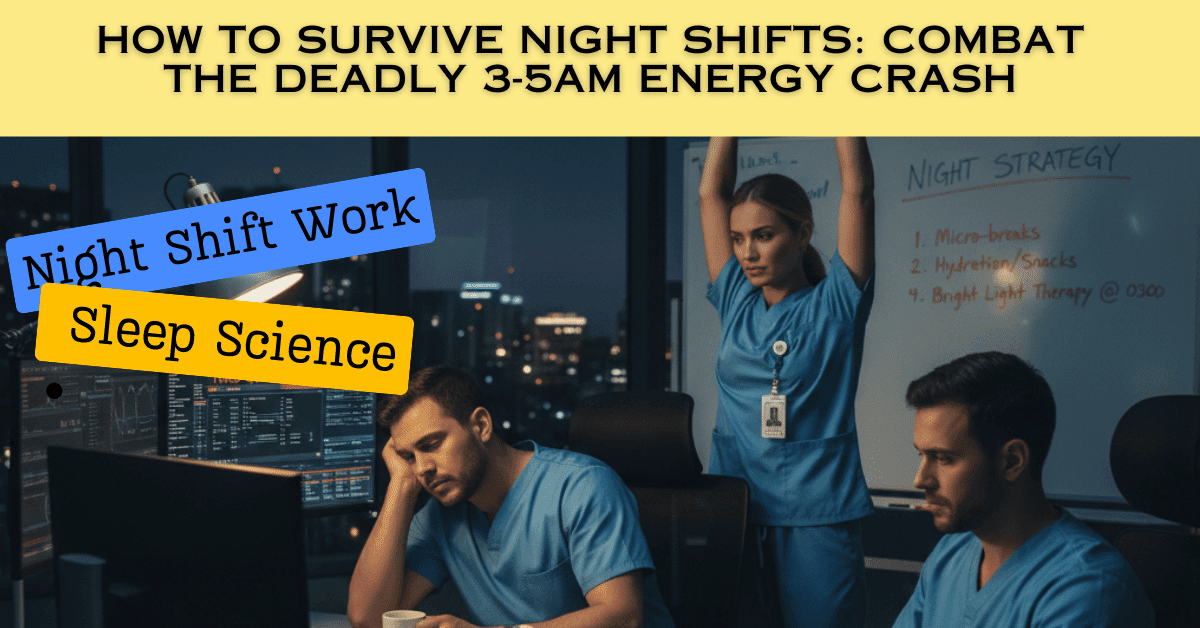
Why do the most experienced night shift workers crash hardest between 3 AM and 5 AM?
You’ve been cruising through your shift with coffee in hand, productivity humming along, and then it hits. That wall. That moment when your eyelids feel like they’re made of concrete and your brain seems to be operating through molasses. You check the clock: 3:47 AM. Right on schedule.
This isn’t weakness. This isn’t poor preparation. This is biology declaring war on your work schedule.
Table of Contents
The Problem: Your Body Wasn’t Built for This
Let me paint you a picture that’s probably familiar. You’re six hours into your night shift. The first few hours went fine—maybe you even felt sharp and focused. Then somewhere around 3 AM, everything changes. Your concentration shatters. Simple tasks suddenly require twice the mental effort. You catch yourself reading the same paragraph three times without absorbing a single word.
This phenomenon has a name in circadian biology: the third quarter phenomenon. It’s the period during night shifts when your body’s internal clock is screaming at you to sleep, and it happens to coincide with the lowest point in your natural circadian rhythm.
Research from the Journal of Sleep Research shows that cognitive performance drops by 15-20% during this window, reaction times slow by up to 30%, and the risk of errors spikes dramatically. In medical settings, medication errors increase by 43% between 3 AM and 5 AM compared to evening hours. In transportation, the National Transportation Safety Board found that 33% of single-vehicle truck crashes occur during this exact time frame.
The numbers don’t lie. Your body’s core temperature drops to its lowest point around 4 AM. Your melatonin production peaks. Your alertness plummets. And no amount of willpower can override these fundamental biological processes.
But here’s what makes this truly problematic: most night shift workers don’t have a strategy for this predictable crash. They rely on caffeine, determination, and hope—a recipe for burnout, health issues, and dangerous mistakes.
The Agitation: What’s Actually Happening Inside Your Body
Let’s get specific about what’s sabotaging your performance.
Your circadian rhythm operates on a roughly 24-hour cycle, controlled by a tiny cluster of cells in your brain called the suprachiasmatic nucleus. This internal clock regulates everything from body temperature to hormone release to cognitive function. It evolved over millions of years to keep us alert during daylight and sleepy at night.
When you work night shifts, you’re asking this ancient system to reverse itself. And it fights back.
The Biological Mutiny
Between 3 AM and 5 AM, your body experiences:
- Core body temperature dropping to 97.6°F (36.4°C), compared to the daytime average of 98.6°F (37°C)
- Melatonin levels peaking at 200% of baseline levels
- Cortisol at its lowest point, reducing alertness and stress response
- Glucose metabolism slowing by 15-20%
- Prefrontal cortex activity declining, impacting decision-making and impulse control
Dr. Charles Czeisler from Harvard Medical School puts it bluntly: “Working the night shift is like asking your body to function at 3 AM with the same efficiency it has at 3 PM. It’s physiologically impossible without countermeasures.”
The Cascade Effect
Here’s where it gets worse. This isn’t just about feeling tired. The third quarter phenomenon triggers a cascade of effects:
Cognitive impairment: Your working memory capacity drops. You struggle with complex problem-solving. Your ability to filter distractions weakens.
Physical performance: Fine motor skills deteriorate. Reaction times lag. Coordination suffers.
Mood regulation: Irritability increases. Emotional control diminishes. Social interactions become more difficult.
Health risks: Long-term night shift work increases the risk of cardiovascular disease by 40%, obesity by 29%, and Type 2 diabetes by 32%, according to a meta-analysis in the American Journal of Preventive Medicine.
And the cruel irony? The more consecutive night shifts you work, the worse this gets. Sleep debt accumulates. Your circadian rhythm becomes more disrupted. Recovery becomes harder.
The Solution: Building Your Night Shift Defense System
Now for the good news: you can fight back. Not by trying to overpower your biology, but by working with it strategically.
I’m going to walk you through a comprehensive system that addresses the third quarter phenomenon from multiple angles. These aren’t theories—these are evidence-based strategies used by military personnel, emergency responders, and organizations that depend on peak performance during night hours.
Strategic Caffeine Deployment
Forget everything you know about coffee consumption. Random caffeine intake throughout your shift is counterproductive.
Here’s the research-backed approach:
Timing Protocol:
- Consume no caffeine in the 2-3 hours before your shift starts
- First caffeine dose: 30 minutes into your shift (not before)
- Second dose: 2.5-3 hours into your shift
- Final dose: No later than 4 hours before shift end
Dosage Guidelines:
| Time Into Shift | Caffeine Amount | Form | Purpose |
|---|---|---|---|
| 30 minutes | 75-100mg | Coffee or tea | Gradual onset |
| 2.5-3 hours | 100-150mg | Coffee or gum | Peak third quarter |
| 5-6 hours | 50-75mg (optional) | Tea | Maintenance only |
The U.S. Army Research Institute of Environmental Medicine conducted studies showing that this staggered approach maintains alertness 28% more effectively than front-loading caffeine at shift start.
Why this works: Caffeine has a half-life of 5-6 hours. By timing your intake, you ensure peak caffeine levels hit during your third quarter vulnerable period, not when you’re already naturally alert or when you need to sleep post-shift.
The Light Manipulation Protocol
Light is the single most powerful tool for shifting your circadian rhythm. Use it wrong, and you’ll make everything worse. Use it right, and you’ll maintain alertness through the toughest hours.
During Your Shift
Bright light exposure (10,000 lux) during the first half of your shift helps suppress melatonin and signals alertness to your brain. Studies show this can improve reaction times by 20% and reduce sleepiness scores by 35%.
Practical implementation:
- Position yourself near bright overhead lights when possible
- Use a light therapy box for 20-30 minutes during breaks
- If working at a computer, increase screen brightness during the 3-5 AM window
- Take outdoor breaks if dawn is approaching (the blue wavelengths are particularly effective)
Critical Period: Post-Shift
This is where most night workers sabotage themselves. Morning sunlight exposure on your commute home will reset your circadian rhythm to a day schedule, making your next night shift even harder.
Protection strategy:
- Wear wrap-around sunglasses with amber or red lenses on your drive home
- Block bedroom windows completely (blackout curtains or aluminum foil)
- Keep lights dim in your home before sleeping
- Consider blue light blocking glasses for the last 2 hours of your shift
A study in the Journal of Biological Rhythms found that night workers who used light protection had 40% less difficulty falling asleep and reported 30% better sleep quality.
Nutritional Tactical Planning
Your metabolism is fighting against you at night. Insulin sensitivity drops by 60% during circadian misalignment. Your digestive system slows down. Food choices that would be fine during the day become performance saboteurs at night.
The Eating Window Strategy
Pre-shift meal (2-3 hours before):
- High protein (30-40g)
- Complex carbohydrates
- Moderate healthy fats
- Example: Grilled chicken with sweet potato and avocado
During shift:
- Small, frequent snacks rather than large meals
- Focus on protein and fiber
- Avoid high-glycemic carbs that spike blood sugar
Post-shift:
- Light protein-based snack only
- Avoid large meals which interfere with sleep
Foods That Fight Third Quarter Fatigue
Include:
- Nuts and seeds (sustained energy, no crash)
- Greek yogurt (protein and probiotics)
- Berries (antioxidants and stable blood sugar)
- Hummus with vegetables
- Hard-boiled eggs
- Tuna or chicken
Avoid:
- Sugary snacks and energy drinks
- Heavy, fatty meals
- Large portions after midnight
- High-carb foods without protein balance
Research from the University of Pennsylvania shows that night shift workers who followed a protein-focused, low-glycemic eating pattern had 25% higher alertness scores during the third quarter compared to those eating conventional shift meals.
Physical Countermeasures
When that 3 AM wall hits, your instinct might be to sit still and power through. That’s exactly wrong.
The Movement Protocol
Every 60-90 minutes during your shift:
- Stand up and move for 3-5 minutes
- Include dynamic movements: arm circles, leg swings, torso twists
- Get your heart rate up slightly—take stairs, do jumping jacks, walk briskly
During third quarter (3-5 AM):
- Increase movement frequency to every 45 minutes
- Make movements more vigorous
- If possible, step outside for cold air exposure (temperature drop provides alertness boost)
- Do 10-20 bodyweight squats or push-ups
A NASA study on pilot alertness found that brief physical activity breaks improved reaction time by 18% and reduced error rates by 23% during the circadian low point.
Temperature Manipulation
Remember, your core body temperature drops during the third quarter. Use this to your advantage:
- Keep your workspace cooler (65-68°F is ideal)
- Splash cold water on face and wrists during the 3-5 AM window
- Drink cold water (not just for hydration—the temperature helps)
- If possible, step outside into cold air for 2-3 minutes
The Strategic Nap Advantage
Here’s a controversial one: napping during your shift. Many organizations prohibit it, but the data is undeniable.
The 20-minute power nap:
- Timing: Ideally 2-3 hours into your shift (before the third quarter)
- Duration: 15-20 minutes maximum (to avoid sleep inertia)
- Environment: Dark, quiet, cool
- Follow-up: Immediate bright light exposure and movement
Studies by NASA on airline pilots showed that a 26-minute nap improved performance by 34% and alertness by 54%.
If your workplace doesn’t allow naps, advocate for it with safety data. Organizations like hospitals, fire stations, and airlines increasingly recognize prophylactic napping as a safety measure, not a weakness.
Mental Strategy and Task Scheduling
Not all tasks are created equal for circadian timing.
Task Allocation Strategy
First third of shift (11 PM – 2 AM):
- Complex problem-solving
- Critical decision-making
- Learning new information
- Detailed documentation
Third quarter (2 AM – 5 AM):
- Routine, procedural tasks
- Physical activities
- Collaborative work (social interaction boosts alertness)
- Tasks with built-in accountability or checking systems
Final third (5 AM – 7 AM):
- Moderate complexity tasks
- Wrap-up and handoff preparation
- Final checks and reviews
This strategic task scheduling can reduce errors by up to 30% according to research in Ergonomics journal.
Social Engagement Tactics
Isolation amplifies fatigue. Conversation stimulates alertness.
During the third quarter:
- Schedule collaborative work if possible
- Check in with colleagues—even brief conversations help
- Use phone calls instead of emails when appropriate
- Join team discussions or huddles
- Teach or explain something to someone (explaining activates alertness)
Research shows that social interaction during the circadian nadir can improve alertness ratings by 40% compared to solo work.
The Shift Rotation Consideration
Your schedule pattern matters as much as what you do during shifts.
Rotation Patterns Compared
| Rotation Type | Circadian Disruption | Recovery Time | Recommendation |
|---|---|---|---|
| Permanent nights | Moderate | 2-3 days between weeks off | Best for long-term night workers |
| Rapid rotation (2-3 nights) | Low | 1-2 days | Good for minimizing disruption |
| Slow rotation (7+ nights) | High | 4-6 days | Most difficult physiologically |
| Mixed/random | Severe | Variable/incomplete | Avoid if possible |
The European Heart Journal published findings that slow rotation schedules increase cardiovascular risk by 52% compared to rapid rotation or permanent night shifts.
If you have input on your schedule:
- Push for either permanent nights or rapid rotation (2-3 nights maximum)
- Avoid slow rotations of 5-7 nights
- Ensure at least 2 full days off between rotation changes
- Rotate forward (day→evening→night) rather than backward
Recovery Days: What Actually Works
The day(s) after your last night shift are critical. Most workers do this wrong.
First day post-shift:
- Sleep 3-4 hours immediately after getting home (with full light protection)
- Wake up, stay active
- Go to bed at a normal evening time (even if not tired)
- Use melatonin 30 minutes before bed (0.5-1mg)
Second day:
- Wake at normal morning time
- Get bright light exposure immediately
- Resume normal schedule completely
This “anchor sleep” method from Dr. Charmane Eastman at Rush University helps resynchronize your circadian rhythm 40% faster than sleeping all day after your last shift.
The Long-Term Health Protection Strategy
Night shift work isn’t just about getting through each shift—it’s about protecting your health over years or decades.
Non-Negotiable Health Practices
Sleep Hygiene Enhancement:
Your sleep environment matters more as a night worker
- Blackout curtains plus eye mask (redundancy matters)
- White noise machine or earplugs
- Room temperature at 65-68°F
- Inform household members of your sleep schedule
- Turn off phone notifications
- Consider separate sleeping space if possible
Exercise Timing:
- Exercise before your shift when possible (3-4 hours before)
- Alternative: Exercise before sleeping (helps consolidate sleep)
- Avoid exercise immediately before trying to sleep
- Aim for 150 minutes weekly minimum
Social Connection Maintenance:
Night work isolates you from normal social rhythms. This isolation predicts depression and burnout.
- Schedule regular social activities on days off
- Join online communities of night workers
- Maintain relationship time even when tired
- Don’t let your entire life revolve around work-sleep cycles
Medical Monitoring:
If you work nights long-term, get yearly screening for:
- Blood pressure and cardiovascular markers
- Blood glucose and A1C (diabetes risk)
- Lipid panel (cholesterol)
- Vitamin D levels (commonly deficient in night workers)
- Mental health assessment
Advanced Tactics for the Committed
For those who want to take their night shift performance to the next level:
Cognitive Enhancers (Non-Pharmaceutical)
L-theanine + Caffeine combination:
- 200mg L-theanine with 100mg caffeine
- Smoother alertness without jitters
- Take during third quarter window
Taurine:
- 1000-2000mg during shift
- Supports cognitive function and reduces oxidative stress
- Particularly effective for night workers
Mindfulness and Alertness Training
Brief mindfulness practices during the third quarter:
- The 4-7-8 breathing technique (paradoxically increases alertness when done briefly)
- Body scan (5 minutes)—increases body awareness and reduces fatigue perception
- Active meditation—mindful walking for 3-5 minutes
Studies in Consciousness and Cognition show that brief mindfulness interventions during night shifts reduce perceived fatigue by 30%.
Technology Tools
Apps and devices that help:
- Sleep tracking (Oura Ring, Whoop) to optimize recovery
- Light exposure apps (f.lux, Iris) for blue light management
- Shift worker-specific apps (Sleep Cycle Shift Worker)
- Smart alarm clocks that wake during light sleep phases
The Caffeine Nap Combination
Advanced technique: consume 150mg caffeine, then immediately take a 20-minute nap.
Why this works: Caffeine takes 20 minutes to reach the brain. You wake up just as it’s kicking in, getting the benefits of both rest and stimulation. Japanese studies show this technique improves alertness by 91% compared to caffeine alone.
Key Takeaways
Your third quarter survival depends on these fundamentals:
- The 3-5 AM crash is biological, not personal weakness—it happens to everyone working nights
- Strategic caffeine timing (not amount) makes the difference between alertness and jitters
- Light manipulation is your most powerful circadian tool—use it during your shift, block it after
- Protein-focused, low-glycemic eating prevents energy crashes
- Movement every 60-90 minutes, increased during the third quarter, maintains alertness
- Task scheduling should match your circadian energy pattern
- Recovery strategy matters as much as shift strategy
- Long-term health requires proactive protection, not just getting through each night
The bottom line: Night shift work demands a systematic approach. You can’t willpower your way through circadian biology, but you can work with your body using evidence-based strategies. The third quarter phenomenon will always exist—the question is whether you’re prepared for it or victimized by it.
Conclusion
The night shift will never be easy. Your body will always resist it at some level. But understanding the third quarter phenomenon transforms you from a victim of your biology into a strategic operator who anticipates and counters predictable challenges.
The strategies in this article aren’t about working harder—they’re about working smarter with your circadian reality. Implement them systematically, not randomly. Track what works for your specific situation. Adjust based on your results.
Remember: every night shift worker experiences the 3-5 AM wall. The difference between those who struggle and those who thrive isn’t determination—it’s preparation.
Your next night shift is an opportunity to test these strategies. Start with the basics: strategic caffeine timing, light manipulation, and movement protocols. Add additional tactics as you master the fundamentals.
The third quarter phenomenon isn’t going anywhere. But now, neither are you.
Frequently Asked Questions
Q: Can I eventually adapt to night shifts completely?
A: No. Research shows that even permanent night workers never fully adapt their circadian rhythm. Your body continues to receive daytime light signals during off-hours, preventing complete inversion. However, permanent night schedules minimize disruption better than rotating schedules.
Q: How much caffeine is too much during a night shift?
A: Most research suggests staying under 400mg per shift. More importantly, timing matters more than total amount. Consuming 200mg strategically beats 400mg consumed randomly.
Q: Should I keep a night schedule on my days off?
A: No, unless you work permanent nights for extended periods. For most workers, returning to a day schedule on off days maintains social connections and provides health benefits. Use the anchor sleep method to transition smoothly.
Q: Do blue light glasses really work?
A: Yes, but specifically for post-shift protection. Glasses blocking blue light (450-480nm wavelengths) reduce melatonin suppression by 50-60%, helping you sleep after your shift. They’re less effective during your shift—you want alertness then.
Q: What if I can’t implement all these strategies?
A: Start with three: strategic caffeine timing, post-shift light protection, and movement during the third quarter. These three alone can reduce third quarter fatigue by 40% according to combined research data.
Q: How long does it take to see improvements?
A: Acute strategies (caffeine, movement, light) work immediately. Circadian adjustments take 3-5 days. Long-term health benefits require 4-6 weeks of consistent implementation.
Q: Are 12-hour night shifts worse than 8-hour shifts?
A: Yes. Every hour past the 8-hour mark during night shifts increases error rates exponentially. 12-hour night shifts show 65% more cognitive impairment by shift end compared to 8-hour shifts. If you work 12s, the strategies in this article become even more critical.
Q: Can supplements replace sleep for night workers?
A: Absolutely not. No supplement, nootropic, or strategy can replace adequate sleep. These strategies help you work more safely and effectively during unavoidable circadian disruption—they don’t eliminate the need for quality sleep afterward.